
Chronic care management workflow examples for better care

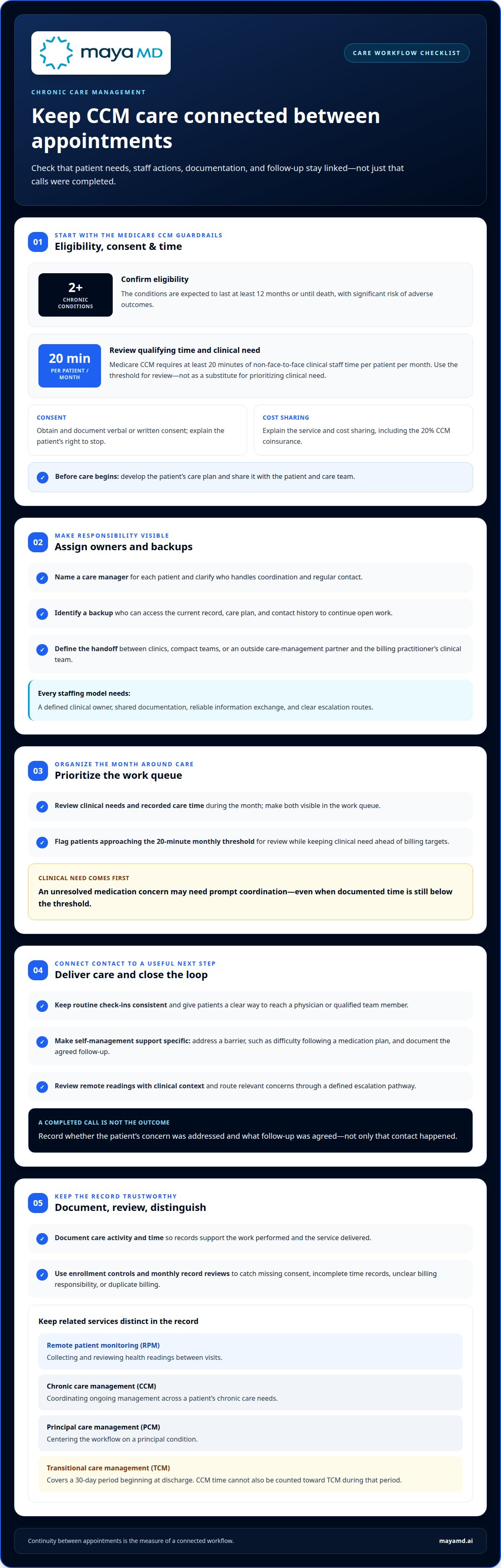
A workflow can look busy and still be broken. The clearest chronic care management workflow examples expose gaps such as missing documented consent, a care plan that isn’t shared or kept current, inconsistent patient contact, and care activity that isn’t documented. For Medicare CCM, the workflow must also account for at least 20 minutes of non-face-to-face clinical staff time per patient per month.
It’s easy to focus on completed calls or enrolled patients, but activity alone does not show whether care is coordinated, compliant, or responsive to changing needs. These chronic care management workflow examples show how to spot breakdowns and build a more reliable process. See how care plans, documentation, compliance checks, and performance measures connect to daily services, from remote check-ins to clinical escalation. The goal is continuity between appointments, not simply a record of tasks completed.
Key Takeaways
• Use remote monitoring data alongside clinical context so changes in a patient’s status can inform follow-up and care coordination.
• Keep electronic care plans patient-centered, accessible to the care team, and updated as needs and priorities change.
• Track both workflow measures, such as communication consistency, and patient outcomes to identify where the program can improve.
• Connect routine check-ins with clear escalation pathways so clinical concerns reach the appropriate care team member.
What does a broken care management workflow look like?
A broken workflow loses continuity between patient needs, staff actions, documentation, and follow-up. Chronic care management workflow examples can help pinpoint where handoffs fail.
Patient Prioritization and Time Thresholds
Prioritization means reviewing clinical needs and recorded care time during the month, then organizing appropriate follow-up. Staff can flag patients approaching the 20-minute monthly threshold for review, while keeping clinical need ahead of billing targets. For example, a patient with an unresolved medication concern may need prompt coordination even if their documented time remains below the threshold. A visible work queue helps teams see both time and care needs.
Care Manager and Backup Assignments
Assign a care manager to each patient and make clear which clinical team member is responsible for coordination and regular contact. Identify a backup who can access the current record, care plan, and contact history. If the primary contact is unavailable, another team member can continue an open referral or return the patient’s call without piecing the case together from scattered notes.
Workflow Differences and Common Problems
Small practices may coordinate care through a compact team, while health systems need consistent handoffs across clinics. If an outside care-management partner is involved, its staff need a clear connection to the billing practitioner’s clinical team. Every model needs defined ownership, shared documentation, and escalation routes. Chronic care management workflow examples can reveal risks such as missing consent, incomplete time records, or duplicate billing. Enrollment controls and monthly record reviews help close these gaps.
Medicare CCM eligibility includes at least two chronic conditions expected to last at least 12 months or until death, with significant risk of adverse outcomes. To enroll a patient, identify eligibility, explain the service and cost sharing, obtain and document consent, then develop and share the care plan. Consent may be verbal or written and must explain the patient’s right to stop. The Centers for Medicare & Medicaid Services requires a 20% coinsurance for CCM.
Workflows differ by practice size and staffing model, but each needs a defined clinical owner and reliable information exchange. A designated team member handles routine coordination and contact, while documented escalation steps route clinical concerns to an appropriate professional. Common compliance risks include incomplete consent, unsupported time records, and unclear billing responsibility. Chronic care management workflow examples are most useful when they show how teams prevent these problems in daily practice.
Patients need a clear way to reach a physician or qualified team member, as well as routine check-ins. Self-management support should address a specific barrier, such as difficulty following a medication plan, and document the agreed follow-up. A completed call alone does not show whether the patient’s concern was resolved.
What is a Chronic Care Management (CCM) program?
A CCM program coordinates support between appointments, linking patient needs with clinical follow-up and documentation. Remote monitoring can add useful information, but the care team needs a defined process for reviewing it and acting on relevant findings.
CCM Workflows in Medical Practices
A medical-practice workflow connects the care plan with routine outreach, clinical review, documentation, and follow-up. Its value is making work visible across the team instead of leaving each member to rely on isolated notes. Software should support these handoffs by organizing patient context, assigned tasks, communications, and outcomes in a usable workflow.
Staffing depends on who performs care-management activities and how the practice oversees them. The work must be carried out by clinical team personnel, not treated as administrative outreach alone. Software requirements depend on the practice’s existing systems and workflow needs. Operating costs vary with staffing, technology, and program design, so no single figure applies to every practice.
CCM and Related Care Models
CCM coordinates ongoing management across a patient’s chronic care needs, while principal care management centers the workflow on a principal condition. Remote patient monitoring focuses on collecting and reviewing health readings between visits. These models can address different needs, so naming each activity correctly helps the care team coordinate work and determine what service is being delivered and billed.
A patient may receive care-management contact alongside monitoring, but records should distinguish the purpose of each task. For example, reviewing a blood pressure reading belongs in the monitoring record, while broader care coordination belongs in the management workflow. Clear separation supports accurate documentation and prevents every remote interaction from being treated as the same service.
Remote Monitoring and Care Transitions
Remote monitoring adds patient-generated readings to the information available between appointments. After a patient returns home from the hospital, those readings can complement follow-up communication and help the care team identify questions for review. The transition workflow should connect discharge information with current care priorities and assigned follow-up, rather than create a separate queue without clinical context.
Monitoring does not replace transition coordination. Transitional care management covers a thirty-day period beginning at discharge, and CCM time cannot also be counted toward transitional care management during that period. Practices should distinguish the service, purpose, and time associated with each interaction. This helps clarify documentation when monitoring and post-discharge follow-up happen close together.
Monitoring Readings, Queues, and Workload
Tracking readings means routing each received result into a review queue with its patient context and follow-up status. Staff can then distinguish readings awaiting review from those already assessed or escalated. For remote physiologic monitoring supply under CPT code 99445, readings are required on at least two days in the period. A queue makes missing activity and unresolved work easier to identify.
Workload monitoring should show task ownership, pending reviews, and completed follow-up, not just the number of readings received. A practical review follows each reading from receipt to clinical assessment and documented disposition. Queue patterns can reveal whether workload is concentrated among particular team members or whether a transition handoff is creating delays. Practices planning connected monitoring workflows can discuss their care-management needs.
Reviewing and sharing electronic care plans
An electronic care plan turns patient priorities and clinical information into coordinated work. Regular review keeps its guidance relevant as needs, treatments, and team responsibilities change.
Comprehensive Person-Centered Care Plans
A comprehensive care plan brings a patient’s clinical needs, goals, and planned support into one accessible record. It should reflect the individual, not just a list of diagnoses. Relevant information may include diagnoses, medications, assessment data, social needs, preventive care gaps, and the date of the last appointment.
For example, a patient managing diabetes and heart disease may need medication follow-up, preventive screening, and help addressing a social barrier. Recording each need alongside its related action helps the physician and care team understand the patient’s priorities. It also gives the patient a clearer view of agreed goals and next steps.
CMS requires the electronic chronic care management plan to be promptly available within and outside the practice. Authorized team members should be able to retrieve the current plan during care coordination, rather than rely on a disconnected document or outdated note. Keep patient-centered plans accessible and update them as circumstances change.
Review the current plan against recent assessments, medication changes, patient-reported concerns, and completed actions. If a patient’s mobility worsens, for example, document the changed need and revise follow-up. Clear dates and assigned team members make updates easier to interpret and preserve a useful record of how priorities have evolved.
Care Protocols and Care Plans
A care protocol defines a consistent response to a clinical situation, while the care plan applies relevant guidance to an individual patient. The distinction matters: a protocol can standardize team actions, but it cannot capture every patient’s goals, barriers, or response to care.
For example, a practice protocol may direct staff to review medication concerns with a clinician. The patient’s plan can specify which issue needs follow-up, who owns the action, and how the patient prefers to engage. This turns general guidance into a documented, patient-specific workflow without treating every case identically.
Review whether each plan action remains relevant, assigned, and connected to a meaningful outcome. A care team member might close a completed referral, revise a follow-up task, or record a change in the patient’s goal. These updates help the next provider understand what has happened and what remains active.
During transitional care management, the electronic plan can connect discharge information with ongoing priorities and assigned follow-up. Record changes in context rather than copying transition notes without reconciling them with the current plan. This supports engagement and continuity while giving each team member a clear basis for coordinated action.
Compliance, documentation, and KPI tracking
A reliable CCM record connects clinical work to the patient, service period, and follow-up. Reviewing documentation alongside performance measures helps a practice find gaps before they affect care coordination or billing.
For Medicare CCM, CPT 99490 is associated with the standard service, while CPT 99487 and 99491 are options for more complex cases or additional time. The documented service and time determine the applicable billing pathway; reimbursement therefore depends on the code and care management provided. CCM is billed once per calendar month based on the time and type of care management delivered.
For the standard time requirement, CMS expects at least 20 minutes of non-face-to-face clinical staff time per patient per month. A record should make the work traceable: include the date, staff member, time spent, activity performed, and relevant outcome. For example, document whether a medication concern led to a clinician review, a patient follow-up, or another action.
Consent documentation should record the patient’s agreement and required disclosures, including that only one health care professional or hospital can provide CCM in a calendar month. A practice should also track whether another practitioner is billing for that patient. CCM and APCM cannot be billed for the same patient in the same month, and CCM time cannot also count toward transitional care management during its period.
Complex CCM has alternative billing codes when a patient requires at least 60 minutes of clinical staff time during a month. The record should support the service’s complexity and show how time relates to documented care. A time total without corresponding activities gives reviewers little context; a clear entry connects each interaction to a patient need, care-plan action, or clinical decision.
KPI tracking should pair workflow measures with patient outcomes. Process measures can include enrollment and communication consistency; outcome measures can include hospital readmissions, blood pressure control, and A1c levels. These measures answer different questions: whether the program delivered its planned work, and whether patient health indicators changed. A dashboard should define each measure and use consistent reporting periods.
Regular performance reviews can compare completed contacts, documented time, unresolved tasks, and outcome trends. If communication becomes less consistent, check whether outreach attempts were recorded and follow-up tasks assigned. If blood pressure control changes, clinicians can review the relevant care plans and patient records. Identify a specific workflow issue, assign an owner, and document the response.
A focused monthly audit can sample records for consent, time entries, current care plans, and billing alignment. Link each finding to a corrective action, such as clarifying a documentation field or adjusting a review queue. This creates a practical feedback loop between compliance oversight, clinical records, and program performance.
Chronic care management services
CCM services organize clinical support between appointments, using patient needs to guide contact, review, and follow-up. Activities may include reviewing medical information, coordinating referrals, supporting self-management, and updating the care plan. Connect each activity to a patient concern or care goal, rather than using completed calls as the sole measure of service.
Most chronic care management services happen between appointments through phone calls, secure messaging, and other remote check-ins. Before a call, a care team member can review diagnoses, medications, assessment data, preventive care gaps, and the patient’s last appointment. Afterward, document the discussion, record next steps, and coordinate referrals when needed.
CCM programs must offer patients 24/7 access to physicians or other qualified healthcare team members, according to the Centers for Medicare & Medicaid Services. This access requirement is distinct from routine monthly outreach. A workflow should make the route for reaching qualified clinical support clear, while preserving the care team’s responsibility to review concerns and document actions.
Escalation criteria help staff distinguish routine coordination from concerns that need clinical attention. A patient reporting a new symptom, difficulty following a medication plan, or a concerning remote reading may need clinician review. Define how the concern reaches the appropriate physician or qualified team member, what information accompanies the handoff, and where the response is recorded.
Checklists can structure monthly calls without making them mechanical. A useful sequence is to review the patient’s priorities, discuss barriers to self-management, identify changes since the last contact, and agree on follow-up. The care team member then documents the interaction and coordinates referrals or other next steps. For example, a missed appointment can prompt follow-up that also identifies transportation concerns.
CCM personnel should be part of the clinical team, not administrative staff working without clinical integration. Physicians, nurse practitioners, physician assistants, clinical nurse specialists, and certified nurse midwives are eligible healthcare providers to bill for CCM services. Under current rules, a practice may also use a care-management partner whose staff provide CCM under the billing practitioner’s general supervision.
Remote physiologic monitoring can provide readings for clinical review, while CCM coordinates the patient’s broader needs. A reading is an input, not a complete care-management service: the workflow must connect it to review, an appropriate response, and documentation. During a hospital transition, discharge information can guide follow-up and referral coordination, while the care plan organizes ongoing priorities.
To strengthen coordination between remote check-ins, clinical review, and follow-up, discuss a care-management workflow.
MayaMD: remote patient monitoring for chronic care management
MayaMD supports chronic care workflows with remote patient monitoring for chronic care management, connecting monitoring activity with ongoing patient support. For practices strengthening communication between visits, AI patient engagement solutions support patient interactions, while the Clinical AI Agent contributes to connected care workflows. Automated post-discharge communication solutions can support follow-up after a hospital transition.
These capabilities can support care teams refining their approach to remote monitoring, patient engagement, or post-discharge communication. They complement clinical processes; the care team remains responsible for decisions, escalation, and care-plan oversight. Aligning the technology with existing documentation and review workflows helps teams see where information goes and who acts on it.
Contact MayaMD to discuss your chronic care management workflow.
Make the next workflow improvement deliberate
Choose one point where coordination slows, then map how information travels from the patient to the responsible team member and back. Look for unclear ownership, disconnected records, or follow-up without a defined next step. Addressing one specific handoff can make improvement more focused than changing several processes at once.
Use chronic care management workflow examples as a diagnostic lens, not a template to copy. Compare each example with your practice’s clinical priorities, existing systems, and patient communication needs. Ask whether every action has a clear owner, whether its outcome is documented, and whether the next person can continue without reconstructing the context. This review can help your team choose a practical starting point for a more connected care-management process.
For support in considering the next step, contact MayaMD about CCM workflows. A deliberate improvement can help your team build a workflow that better supports continuity and patient care.
Frequently Asked Questions
What leads to ineffective care management?
Ineffective care management often starts when information or responsibility is lost between interactions. A patient may report a new concern, but no task reaches the clinician who can respond. Other warning signs include outdated medication information, unresolved referrals, and outreach that does not match the patient’s needs. For example, a missed appointment should trigger a documented follow-up path, not disappear from the schedule.
How Does Chronic Care Workflow Software Work?
Chronic care workflow software organizes patient information and staff tasks so care-management activity can be coordinated and recorded. Teams can use it to view assigned follow-ups, track communication, and connect completed work with the relevant patient record. For example, a reported medication concern can become a clinical review task, with its outcome documented. Software supports coordination, while qualified healthcare professionals make clinical decisions.
How long does it take to start a CCM program?
Implementation depends on the practice’s planning, staffing, technology, and enrollment work. A typical sequence places planning in weeks 1-2, building staffing and protocols in weeks 2-6, and patient outreach and enrollment in weeks 4-8. The first full month of care management and billing typically occurs in months 2-3; pilot results are reviewed for potential expansion in months 4-6.
What services should a CCM program include?
A CCM program should coordinate ongoing support between appointments, including routine patient contact, care-plan follow-up, referral coordination, and escalation of clinical concerns. The Centers for Medicare & Medicaid Services requires patients to have 24/7 access to physicians or other qualified healthcare team members. A program can also incorporate remote monitoring when appropriate, with readings routed for review and linked to documented follow-up rather than treated as stand-alone data.
What are examples of monthly CCM workflows for primary care practices?
A primary care practice might start its monthly cycle by reviewing open tasks and identifying patients due for contact. A care team member can prepare from the record, discuss current concerns during outreach, document the interaction, and route clinical issues for review. The team can then close completed referrals, update follow-up tasks, and review unresolved work. This creates a traceable cycle without making every patient interaction identical.
How should CCM care plans be created, updated, and shared with patients?
Build the plan around the patient’s clinical needs, goals, and relevant barriers, then assign each action to a responsible team member. Update it when assessments, medications, or priorities change, and share the current version with the patient. CMS requires the electronic plan to be promptly available within and outside the practice. For example, a changed medication concern should be reflected in the plan and guide the next follow-up.
How do care managers document CCM time and meet the 20-minute requirement?
Care managers should record each eligible non-face-to-face clinical activity with its date, duration, responsible staff member, and patient-related purpose. The monthly record should show how activities accumulate toward the 20-minute requirement, rather than relying on a month-end estimate. For example, document a care-plan review and follow-up call as separate entries when they are distinct activities. The practice should review entries for completeness before billing.




See The MayaMD Difference
Fill the form below
Download Our Apps
MayaMD for patients and MayaPro for physicians - available on iOS and Android.
FOR PATIENTS
MayaMD App
AI-powered symptom assessment, triage, and secure access to your care team.
FOR PHYSICIANS
MayaPro App
MayaPro brings patient vitals, RPM/PCM care plans, and clinical decision support to your pocket.