
How to Choose a Chronic Care Management Partner

A chronic care management partner should connect ongoing patient support with your practice’s clinical workflows, not create another layer of administration. Knowing what to look for in a chronic care management partner means assessing how it coordinates care, engages patients, and supports consistent follow-up. According to the Centers for Medicare & Medicaid Services, people with two or more chronic conditions expected to last at least 12 months may be eligible for a CCM program.
That support matters because chronic conditions require continuity between appointments. Patients need a clear way to stay connected with their care team, while clinicians need useful information and workflows that fit their responsibilities.
This article explains what chronic care management includes, how it connects patients with primary care teams and specialists, and what to evaluate when choosing a partner. It also covers how patient engagement and remote monitoring can support ongoing care while easing administrative work, and how these approaches fit into a practice’s broader care model.
Key Takeaways
• Understand how chronic care management extends support beyond appointments through ongoing patient engagement and clinical coordination.
• Identify how clear communication among primary care teams, specialists, and patients can help keep care aligned.
• Recognize which administrative tasks and workflow demands a partner may help organize, so clinicians can focus on care delivery.
• Assess a partner’s clinical understanding, technology, and ability to fit into your practice’s existing workflows.
• Explore how remote patient monitoring and digital engagement can support continuity for patients with chronic conditions.
What is Chronic Care Management?
Chronic Care Management (CCM) organizes ongoing support for people living with chronic illnesses between appointments. According to the Centers for Medicare & Medicaid Services, people with two or more chronic conditions expected to last at least 12 months may be eligible for a CCM program. The work combines an individualized care plan, regular communication, and coordination around changing symptoms and treatment needs.
Software can give the care team a shared view of patient information, outreach, and follow-up tasks. Clinical support gives that information context: a change in reported symptoms, for example, can be routed for review rather than treated as an isolated entry. Useful workflows record patient concerns, document actions, and make the next responsibility clear. Practices can also consider how an advanced primary care management framework connects ongoing support with existing care processes.
CCM can also involve caregivers when patients want them included. A caregiver might help record questions before an appointment or describe practical barriers to following a care plan. Conversations about diet and lifestyle are most useful when they focus on achievable changes guided by a clinician. Emotional support matters too: listening to concerns without defining someone by their productivity can help preserve dignity during long-term illness.
Telehealth and other remote communication can extend contact beyond in-person visits, helping teams stay in touch and respond to reported needs through established workflows. Telehealth platforms like askmydoc.ca highlight how virtual doctor appointments can facilitate ongoing patient contact between in-person appointments. A patient may share a new symptom or difficulty following a plan; the care team can review the information and determine an appropriate next step.
To protect privacy and comply with HIPAA, a partner should use HIPAA-compliant systems and defined processes for handling patient information. Ask how it controls access, documents information, and manages privacy incidents.
Patients may have out-of-pocket costs for CCM, depending on their coverage. Provider expenses depend on the staffing, software, and workflow model used to deliver the program; patient responsibility depends on applicable coverage and cost-sharing.
Assess staffing by looking for clearly assigned clinical responsibilities, escalation pathways, and outreach processes. Response expectations for routine messages and urgent concerns should be clear, so patients and practice teams understand how communication is handled.
Track measures such as patient engagement, completed follow-ups, care-plan reviews, and documented responses to reported symptoms. Common risks include unclear task ownership, limited visibility into outreach, and performance claims without transparent reporting. A partner should explain how its workflows connect software activity with clinical review and patient support.
Coordination among specialists, primary care, and patients
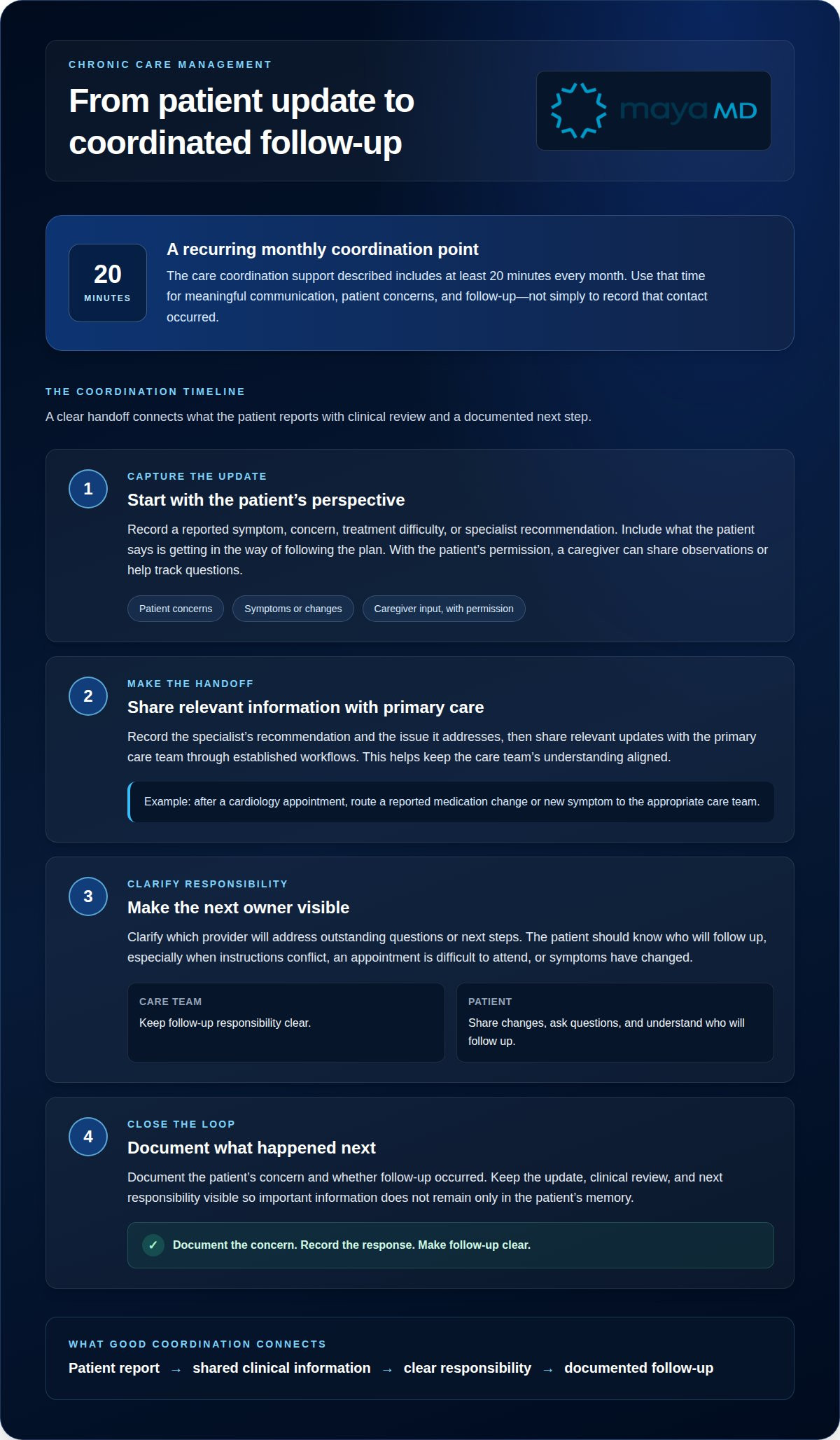
For a patient managing several conditions, care may involve a primary care provider, a specialist, and other treating providers. Coordination helps clinicians maintain an aligned understanding of the patient’s needs. It also clarifies the patient’s role: sharing changes, asking questions, and understanding who will follow up. Without clear communication, a specialist’s recommendation may not reach the primary care team, or the patient may be unsure which instructions to follow.
A chronic care management partner should support communication across the care team without replacing clinical judgment. After a cardiology appointment, for example, a patient may report a medication change or new symptom. A useful coordination process records the update, routes it to the appropriate care team, and makes follow-up responsibility visible. The primary care provider and specialist can then review the relevant information and address gaps in the plan.
Care coordination should include the patient’s perspective. A patient may struggle to follow a treatment plan because instructions conflict, an appointment is difficult to attend, or symptoms have changed. The care team needs a way to capture these concerns and bring them into clinical discussions. With the patient’s permission, a caregiver can share observations or help track questions. The patient remains central to decisions about their care.
Monthly coordination creates a recurring opportunity to review whether the care plan still reflects the patient’s needs. The chronic care management support described includes at least 20 minutes of care coordination every month. That time can support communication with treating providers, review of patient concerns, and follow-up on outstanding care tasks. The value depends on meaningful coordination, not simply recording that contact occurred.
Taking notes during an appointment can help a patient or caregiver remember recommendations and questions. Afterward, the care team can organize the information into practical follow-up:
• Record the specialist’s recommendation and the issue it addresses.
• Share relevant updates with the primary care team through established workflows.
• Clarify which provider will address outstanding questions or next steps.
• Document the patient’s concerns and whether follow-up occurred.
These processes make handoffs more legible and reduce the chance that important information remains only in a patient’s memory. Practices assessing coordination can map how an update moves from patient report to clinical review, then to documented follow-up. To discuss how coordinated digital workflows may fit your practice, explore a conversation about care coordination.
Provider burnout and administrative burden
Chronic disease care involves work that continues after an appointment. A clinician may need to review patient messages, update a care plan, coordinate with another office, and document follow-up. When these tasks compete with scheduled visits, administrative work can fragment attention. A chronic care management partner should make responsibilities and workflow status easier to see, not add disconnected tasks.
Consider a patient who reports difficulty following a treatment plan between visits. The practice needs a process to capture the concern, route it for clinical review, and record the resulting action. If information is scattered across messages or spreadsheets, staff may have to reconstruct the patient’s history before responding. A connected workflow can organize relevant information and show which items still need attention.
Delegation is useful only when clinical accountability stays clear. A partner can support outreach, organize patient-reported information, and prepare documentation for review. The treating clinician remains responsible for clinical decisions. For example, a reported change in symptoms should follow an established review pathway, not trigger an automated conclusion about diagnosis or treatment.
Administrative burden can also affect the relationship between providers and patients. When conversations feel rushed, patients may leave without explaining barriers such as confusing instructions or difficulty arranging follow-up. A structured check-in gives staff a consistent way to surface concerns. The care team can then use appointment time for decisions requiring clinical judgment and discussion with the patient.
When assessing a partner’s workflow, trace a routine care task from start to finish:
Outreach
Identify how patient responses and unanswered messages are recorded.
Review
Confirm how concerns reach the appropriate clinical team member.
Documentation
See how actions and follow-up responsibilities appear in the care record.
Escalation
Understand how staff route urgent concerns through the practice’s defined process.
These steps show whether technology reduces duplicate work or simply shifts it elsewhere. A useful workflow makes the next action visible, preserves context, and helps staff avoid entering the same information repeatedly. It should also distinguish administrative support from clinical review, so automation does not obscure who is accountable for a decision.
Assess the effect on daily operations through concrete examples: fewer duplicate entries, clearer task ownership, and less time spent finding prior outreach. The goal is not to remove human interaction, but to reserve staff attention for patient conversations, care decisions, and the relationships that support ongoing disease management.
Regular check-ins, education, and emotional support can help patients manage medications, make lifestyle choices, and follow care plans.
Chronic Care Management services
Chronic Care Management services support patients beyond the office visit through organized, ongoing care. Chronic conditions are common among adults in the United States. A program can help a practice connect follow-up, patient communication, and care planning for people whose chronic illness requires continuing attention.
An individualized care plan is central to chronic care management. It should reflect the patient’s conditions, goals, medications, and care team. Someone managing diabetes and heart disease, for example, may need coordinated follow-up across primary care and cardiology. The plan should clarify responsibilities, record relevant updates, and help the team recognize when the patient’s needs have changed.
Regular patient contact is another core service. Check-ins can surface new symptoms, difficulty following a treatment plan, or questions that can be addressed through the practice’s established process. The goal is not to replace clinical judgment, but to create a dependable communication path between appointments and keep useful patient information available for review.
Remote monitoring may add information between visits when a care model uses patient-reported readings or connected devices. Blood pressure readings, for instance, can help the care team follow a trend and decide whether clinical review is appropriate. Monitoring needs a defined workflow for reviewing information, documenting actions, and routing concerns to the responsible clinician.
Access expectations also matter. According to the Centers for Medicare & Medicaid Services, the chronic care management support described includes 24/7 access to care for urgent chronic care needs. A practice evaluating services should distinguish this urgent-care access from routine outreach, and understand how each type of communication reaches the appropriate care team.
Education and support help patients put care plans into practice. Someone managing a chronic condition may need clear guidance on a clinician-recommended lifestyle change or help understanding follow-up instructions. For patients exploring root-cause approaches to complex long-term illnesses, platforms like emagene.life illustrate how functional medicine and personalized roadmaps can support lifestyle and recovery goals. Caregivers can contribute when the patient wants them involved, such as by organizing questions before an appointment or sharing observations about daily challenges.
For a practice, the service model should clarify how these components work together. Review how the care plan is maintained, patient concerns are documented, and follow-up actions are tracked. A useful program connects these tasks rather than treating outreach, monitoring, and coordination as separate activities. That structure helps maintain continuity while keeping clinical responsibility clear.
Tasks are routinely assigned and reviewed. Routine check-ins for an ongoing chronic care plan occur every 3-6 months, providing a regular chance to revisit goals and note changes. Chronic conditions account for $4.1 trillion in annual healthcare expenditure in the United States, and 90% of American adults aged 65 and older have at least one chronic condition.
Virtual care teams, such as those provided by MayaMD, should work as a trusted extension of the practice. Digital scales, smart blood pressure cuffs, and wearables can support monitoring for potential setbacks. Partners can also help people with chronic illness handle practical tasks, such as organizing and paying medical bills.
What qualifications and experience should a chronic care management partner have?
A qualified partner understands how chronic care management fits clinical practice, not just how to operate software. Its team should understand care plans, patient outreach, documentation, and the distinction between administrative coordination and clinical decision-making. For example, a new symptom needs a defined route to clinical review, not an automated diagnosis or an unassigned message. Clear role boundaries support continuity and keep clinical judgment with the treating team.
Relevant experience should be evident in the partner’s workflows. Look for processes showing how patient information is received, documented, routed, and followed through. If a patient reports difficulty following a care plan, the workflow should capture the concern, identify who is responsible for the next step, and record the outcome. These details demonstrate operational understanding more clearly than broad claims about improving care.
Technology expertise matters when a partner’s tools become part of daily practice. The system should support the work clinicians and staff actually do, such as reviewing outreach or finding a patient’s reported concern. Assess integration and usability in context: a useful platform fits existing clinical processes and makes relevant information accessible without duplicating documentation or obscuring task ownership.
Evaluate clinical governance alongside technical capability. A well-defined operating model distinguishes routine communication from information that needs clinical attention. It explains who reviews patient-reported information, how responsibilities are assigned, and how actions are documented. For instance, a reported change in a patient’s condition should enter an established review pathway, not remain in an unassigned inbox.
Experience should also cover implementation and ongoing operational support. A partner needs a clear approach to staff orientation, workflow configuration, issue resolution, and performance review. Practices can assess these areas with concrete examples, such as how a new care team member learns the documentation process or how a workflow problem is identified and corrected. The answers show whether a partner can support consistent delivery, rather than simply provide access to a tool.
Use these criteria to structure an evaluation:
Clinical alignment
Roles, review pathways, and escalation processes are clearly defined.
Operational fit
Workflows reflect actual practice tasks and avoid unnecessary duplication.
Technology readiness
Staff can locate relevant patient information and document follow-up.
Accountability
The partner can explain how activity and unresolved tasks are made visible.
A strong evaluation connects qualifications to observable processes, rather than relying on credentials alone. Discuss chronic care management needs with MayaMD to explore how a technology-enabled approach may fit your practice.
MayaMD: remote patient monitoring for chronic care management
MayaMD provides remote patient monitoring and chronic care management support for practices seeking to connect patient information with ongoing care workflows. Its cloud-based, HIPAA-compliant platform combines deterministic logic with generative AI and includes a Clinical AI Agent and patient engagement solutions. These tools support communication and information flow while clinical teams retain responsibility for care decisions.
For a practice assessing remote monitoring, the relevant question is how patient engagement fits existing processes, including review and follow-up. Remote patient monitoring for chronic care management may be a useful part of that model when the practice seeks to extend chronic care support between visits.
Contact MayaMD to discuss your practice’s chronic care management needs.
Build the next step around your care model
Deciding what to look for in a chronic care management partner starts with identifying where continuity matters most in your practice. Consider which patient interactions need stronger connections, where staff workflows become fragmented, and how clinical teams should review incoming information. These priorities can guide a focused discussion about fit, governance, and implementation.
MayaMD offers a Clinical AI Agent, AI patient engagement, and automated post-discharge communication. These capabilities can support your practice’s chronic care management objectives by improving patient communication and fitting into existing workflows.
A useful next step is to align clinical and operational stakeholders around the care model you want to support. Bring those priorities into a conversation about how MayaMD’s patient engagement and remote care solutions may fit your practice’s needs.
Contact MayaMD to discuss care management, and take the next step toward a more connected care experience.
Frequently Asked Questions
What services should a chronic care management partner provide?
A partner should support the specific work your practice needs to sustain between visits. Consider whether its services address patient enrollment, care-plan updates, follow-up communication, and unresolved concerns. If a patient receives instructions from several treating providers, for example, the service should help your team identify gaps and track next steps. Define which tasks the partner handles, which remain with your staff, and how exceptions reach clinical review.
How should providers compare chronic care management vendors and platforms?
Compare partners using the same practice scenario, not just feature lists. To assess what to look for in a chronic care management partner, trace a patient’s reported concern from intake through review, documentation, and follow-up. Note whether staff can see the status and responsible role at each point. Also compare reporting clarity, workflow adaptability, implementation support, and how the platform handles incomplete or conflicting information.
What technology and EHR integrations should a chronic care management partner offer?
Choose technology that fits how your practice manages patient information and daily tasks. Clarify what data moves between systems, how staff access it, and where completed actions are documented. Integration needs vary by workflow. MayaMD’s discharge communication workflow can start without EHR integration: the team sends discharge information via secure email, and patients access it through a secure web link. Consider how any proposed connection supports your specific care processes.
What questions should providers ask before signing a chronic care management contract?
Clarify the service scope, task ownership, implementation process, reporting, and how workflow changes are handled. Ask how the partner documents outreach, routes issues for clinical review, and communicates unresolved tasks. Establish what information the practice receives and how performance is reviewed. The agreement should also define responsibilities during a transition or termination, so patient communication and active workflows have a clear handoff rather than an abrupt interruption.




See The MayaMD Difference
Fill the form below
Download Our Apps
MayaMD for patients and MayaPro for physicians - available on iOS and Android.
FOR PATIENTS
MayaMD App
AI-powered symptom assessment, triage, and secure access to your care team.
FOR PHYSICIANS
MayaPro App
MayaPro brings patient vitals, RPM/PCM care plans, and clinical decision support to your pocket.