
Challenges of Implementing AI in Healthcare

AI can improve healthcare only when the systems behind it are safe, usable, and equitable. The challenges of implementing AI in healthcare include workforce resistance, resource constraints, regulatory and ethical concerns, and bias in data and outcomes. These barriers affect whether a tool can be integrated into care responsibly, not just whether it works technically.
Those concerns are understandable. Clinical teams need to trust how a system fits their workflows, while leaders must weigh the resources it requires and the quality of its outputs. Bias deserves particular attention: data that does not represent the people receiving care can reinforce existing disparities.
This article explains how these barriers arise, why they matter in practice, and what healthcare organizations should consider when implementing AI. It covers workforce readiness, costs, privacy and oversight, and representative data to help you assess the risks and potential effects on patient care.
Key Takeaways
• Build workforce readiness by involving clinical teams early and addressing how AI will affect daily responsibilities.
• Assess the full resource burden, including infrastructure, training, and ongoing maintenance, before implementation.
• Make privacy, safety, validation, and human oversight part of AI governance from the outset.
• Examine whether data represents the populations receiving care, since gaps can shape unequal recommendations and outcomes.
• Use clear monitoring and review practices to identify performance problems and guide responsible adjustments over time.
Employee resistance and workforce adaptation
Resistance often starts with uncertainty about how AI will change clinicians’ day-to-day work. A nurse may worry that automated patient messages will replace personal follow-up. A physician may question whether a recommendation accounts for a patient’s clinical context. Staff may also fear job loss, find unfamiliar interfaces difficult, or lack confidence using AI tools. These concerns can limit adoption, even when a system performs its technical function.
Skills gaps can create another barrier. Healthcare leaders identify limited AI expertise among professionals as an implementation challenge. Clinicians do not need to become software engineers, but they do need practical training to interpret outputs, recognize limitations, and know when human review is appropriate. A simulated patient interaction, for example, can show how an AI-generated response enters the workflow and when staff should step in.
Successful adaptation also calls for communication across professional boundaries. Clinical teams, computer scientists, privacy specialists, and operational leaders may describe the same system differently. A developer may focus on model performance, while a clinician prioritizes safe decisions during a busy shift. Without reconciling those perspectives, even a technically functional tool can disrupt care. Implementation depends on collaboration between developers and people experienced in healthcare delivery and improvement.
Map the workflow
Identify where AI supports a task, such as answering routine patient questions, and where staff retain responsibility.
Invite staff input
Ask nurses, physicians, and administrative teams to identify workflow friction before deployment.
Train for real tasks
Use examples based on actual roles, such as reviewing an automated message before responding to a patient.
Set an escalation path
Define how staff handle outputs that are unclear, incomplete, or inconsistent with clinical judgment.
These measures make adaptation an operational process, not a one-time announcement. They also clarify that AI supports care teams, while clinical judgment remains central to patient care. The right division of work depends on the task: routine administrative support may require a different review process from patient-facing clinical information. Teams should understand those distinctions before introducing a tool into daily use.
Implementation in clinical settings remains at an early stage, and published work has not yet established frameworks that fully address barriers, facilitators, and strategies. Local learning is therefore important. After deployment, healthcare organizations can monitor staff feedback, workflow delays, and patterns of manual correction. If these signals reveal problems, leaders can adjust training, system settings, or task boundaries before resistance takes hold.
Implementation costs and resource constraints
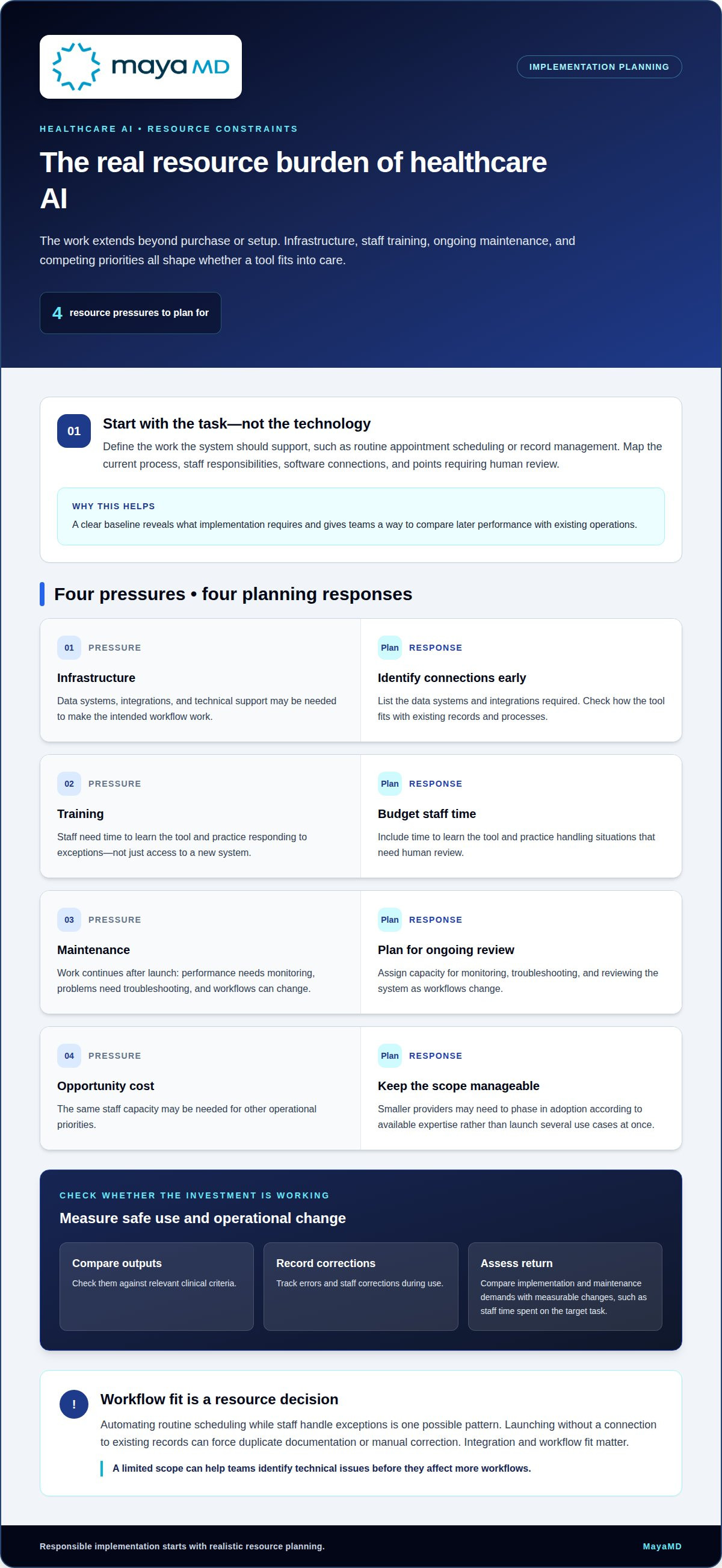
The challenges of implementing AI in healthcare extend beyond the initial purchase or setup. For smaller providers, investment in infrastructure, training, and maintenance can make adoption difficult. Teams also need time to prepare data, connect systems, adapt workflows, and monitor performance after launch. A tool suited to one clinic’s processes may require different integration work elsewhere.
Begin by defining the task the system should support. A clinic, for instance, might assess AI for routine appointment scheduling or record management. Map the current process, including staff responsibilities, software connections, and points that require human review. This baseline helps leaders identify implementation needs and compare later performance with existing operations. It also keeps broad goals from obscuring the specific work the tool must do.
Assess safety and accuracy by comparing outputs with relevant clinical criteria, recording errors, and tracking staff corrections. To evaluate return on investment, compare implementation and maintenance demands with measurable operational changes, such as staff time spent on the target task.
Infrastructure
Identify the data systems, integrations, and technical support required for the intended workflow.
Training
Account for staff time to learn the tool and practice handling exceptions.
Maintenance
Plan for ongoing monitoring, troubleshooting, and review as workflows change.
Opportunity cost
Consider which other operational priorities may compete for the same staff capacity.
For U.S. organizations, a workable pattern might automate routine scheduling steps while staff handle exceptions. A poor pattern could be launching a tool without connecting it to existing records, forcing employees to duplicate documentation or correct outputs manually. These are illustrative scenarios, not named case studies. They show why integration and workflow fit matter.
A central challenge of implementing AI in healthcare is assigning responsibility for each task. An operations lead can coordinate workflow changes, technical staff can manage system connections, and clinical reviewers can assess relevant outputs. Smaller providers may need to phase in adoption according to available expertise rather than launch several use cases at once. Starting with a limited scope helps teams identify technical issues before they affect more workflows.
Track consistent measures during pilot use and routine operation. For an AI healthcare assistant supporting patient questions, teams could assess response accuracy, staff review needs, and unresolved inquiries. These measures connect operational value with safe use, rather than treating adoption alone as success. If evaluation identifies a useful, well-defined role for an AI healthcare assistant, discussing implementation priorities can help clarify a next step.
Regulatory frameworks and ethical implementation
Healthcare AI relies on sensitive patient information, which creates risks of data breaches and misuse. A system handling clinical records may expose details if access controls or data-sharing practices fail. Privacy and security risks include unauthorized access, inappropriate reuse, and exposure of identifiable patient information. Each can undermine trust and disrupt responsible implementation.
Legal access and data integration also affect what an AI system can do. Combining information across organizations, such as hospitals and community care providers, can be difficult. Different rules may govern whether records can be shared, how they are used, and which teams can access them. These constraints can leave a model with incomplete information and make its outputs less relevant.
Regulatory frameworks may also develop more slowly than demand for healthcare AI. U.S. organizations need governance that addresses a system’s purpose, data use, and clinical role without assuming one policy resolves every ethical question. A tool for administrative support raises different oversight questions from one that informs a clinical decision.
Assess safety and validity before incorporating AI into a standardized care process. For example, test a system that summarizes patient information for omissions and errors against relevant clinical records. If mistakes go unnoticed, staff may rely on inaccurate information. Human review helps preserve clinical judgment, but its role in the workflow must be clear.
Organizations can make governance part of daily operations by assigning responsibilities and documenting review:
Specify the use
Record the task, intended users, and decisions the system may support.
Control information
Identify what patient data enters the system and who can access it.
Validate outputs
Review accuracy, safety, and performance using examples relevant to the intended care setting.
Set oversight
Clarify which outputs require clinician review and how staff report errors.
Reassess changes
Revisit the review when data sources, workflows, or system behavior change.
AI-powered anonymization tools can help protect patient data while preserving information needed for analysis. Anonymization does not replace governance: teams still need to consider how data is collected, shared, and used. Responsible implementation calls for collaboration among policymakers, technologists, and healthcare professionals, who each bring a different perspective on privacy, system design, and clinical practice.
Ethical oversight also means avoiding over-reliance on automated outputs. Clinicians need to interpret AI results in context, recognize uncertainty, and apply professional judgment. By documenting these boundaries, organizations can make privacy safeguards and safety review part of everyday practice rather than a separate approval exercise.
Algorithmic bias and health disparities
An AI system can reproduce unequal care if its training data reflects unequal access, diagnosis, or treatment. For example, if a model learns from records in which one patient group received fewer diagnostic tests, it may interpret fewer recorded diagnoses as lower clinical need. It may then rank similar patients differently, even when their symptoms warrant comparable attention. Bias can enter through data selection, labels, outcome definitions, or how the model is used in clinical workflows. The result may reinforce health disparities instead of supporting consistent care.
Bias is not always apparent in an overall performance score. A model may seem accurate across all records yet perform differently for patients grouped by age, race, language, disability, or access to care. Teams can assess performance across relevant patient groups and compare errors that matter for the intended use. For a triage model, for example, reviewers can look for cases in which urgent symptoms receive lower priority for one group. This can reveal patterns hidden by an aggregate result.
Data quality and clinical context also affect fairness. A missing field may reflect incomplete documentation, not a patient’s health status. If an algorithm treats missing information as evidence of low risk, patients with incomplete records may receive less attention. Diverse datasets can help mitigate bias, but diversity alone will not fix flawed labels or inappropriate assumptions. Clinical teams need to examine how each variable relates to the care decision.
Define the intended decision
Specify whether the model supports screening, prioritization, or another task. A measure suitable for one task may not reflect fairness in another.
Review the data
Check which patient groups and clinical situations appear in training and evaluation records. Identify important gaps before interpreting performance.
Compare subgroup errors
Examine false negatives and false positives across relevant groups. For example, missed risk may have different consequences from an unnecessary follow-up.
Test the workflow
Assess how staff use recommendations alongside clinical information. A sound model can still contribute to unequal decisions if its output is applied inconsistently.
Monitoring needs to continue after deployment. Patient populations, documentation practices, and care pathways can change, altering the data an AI system encounters. If a clinic expands language access or changes screening procedures, teams should reassess whether model inputs and outputs remain appropriate. Staff feedback can also reveal recurring cases in which recommendations conflict with observed patient needs. Those cases provide concrete evidence for review.
Addressing algorithmic bias is an ongoing clinical and technical responsibility. Diverse data, subgroup evaluation, and review of real-world cases address different potential failures. Together, these practices help organizations assess whether AI-supported recommendations distribute attention equitably. They also keep the focus on patient outcomes: whose needs are represented, whose cases are missed, and what changes the evidence supports.
Bias in healthcare data and outcomes
AI recommendations reflect the records used to build and evaluate a system. Imagine a dataset with detailed follow-up for patients at one clinic but limited follow-up from another. The model may mistake differences in documentation for differences in health needs. Missing records, inconsistent diagnostic labels, and uneven representation can distort predictions before a clinician sees them. The issue is not simply the amount of data, but whether it represents the people and care decisions involved.
Access and interoperability affect whose information is represented. A patient’s history may be spread across a hospital record, a specialist’s system, and a community provider’s notes. If those systems use different formats or terms, relevant information may be missing or difficult to combine. One record, for example, may describe a condition in free text while another uses a coded field. A model trained on incomplete or mismatched records can miss important context, even when each source contains useful information.
Labels also shape what a model learns. A label such as “high risk” depends on how an organization defines and records risk. If it reflects service use rather than underlying need, groups with less access to care may appear healthier in the data. Recommendations could then reproduce differences in access instead of identifying patients who need support. Review a label’s clinical meaning before treating it as a reliable outcome.
Trace data origin
Record which systems supply each field and how teams define key terms, such as diagnosis or follow-up.
Inspect missingness
Compare which patient records lack information and whether those gaps cluster around a care setting or population.
Test interoperability
Check whether data from hospitals, specialists, and community care retain their meaning when combined.
Review outcomes by group
Compare recommendations and errors across relevant patient populations, not only across the full dataset.
Healthcare organizations can use diverse datasets to help mitigate bias in AI-supported care and outcomes. Diversity must be assessed in context: a broader dataset can still have inconsistent fields, weak labels, or gaps in important care pathways. Pair dataset review with clinical interpretation. A clinician can help determine whether a pattern reflects patient need or simply how care was documented.
After deployment, monitor whether outcomes change across patient groups as records and workflows evolve. If a model’s recommendations differ from observed needs, examine the data path, label definitions, and missing information before changing clinical practice. This makes bias review a continuing quality process rather than a one-time data check. To discuss how AI fits into patient engagement workflows, contact MayaMD about your implementation needs.
MayaMD: Clinical AI Agent
MayaMD’s Clinical AI Agent supports healthcare organizations working to improve patient-facing workflows. Its AI patient engagement and automated post-discharge communication solutions address communication needs during care transitions, when patients may need clear information after leaving a facility.
Consider these offerings when your implementation priorities include structured patient engagement or communication after discharge. They provide a practical context for evaluating how AI could fit existing care processes, staff responsibilities, and patient needs.
To discuss how MayaMD’s solutions can support your organization’s patient communication workflows, contact MayaMD.
Make the Next Step Deliberate
Addressing the challenges of implementing AI in healthcare starts with choosing a defined use case and assessing it against clinical priorities. The next step is not adopting technology for its own sake. Identify where a carefully governed digital workflow could support patients and care teams, then consider how it would fit existing processes.
MayaMD’s Clinical AI Agent, AI patient engagement solutions, and automated post-discharge communication solutions support patient-facing workflows discussed in this article. If these align with your organization’s priorities, contact MayaMD to discuss your goals and how the platform could fit your implementation plans.
Contact MayaMD to discuss healthcare AI and explore a thoughtful next step for your organization. A clear purpose and responsible evaluation can help keep better patient care at the center of innovation.
Frequently Asked Questions
What are the biggest challenges to implementing AI in healthcare?
The main barriers include staff adoption, implementation resources, privacy and safety governance, and equitable performance. Their effects depend on the use case. An administrative scheduling tool, for example, has different workflow risks from a system that informs clinical prioritization. Define the intended task first, then identify who uses the output, who reviews exceptions, and how the organization will detect problems in routine operation.
How do HIPAA and other U.S. regulations apply to healthcare AI?
Applicability depends on the information involved, the organizations handling it, and the system’s intended use. Map each data flow: what patient information enters the tool, where it goes, who can access it, and how its outputs are used. Then assess these details against the organization’s HIPAA responsibilities and other applicable requirements. This gives privacy, security, and compliance teams a concrete basis for review without assuming every AI workflow is governed in the same way.
What clinical validation and FDA approval are required for AI medical devices?
Assess validation and regulatory review in light of the tool’s intended use and clinical role. Evaluate performance using data relevant to the population and setting where the tool will be used, and document clinically meaningful errors and limitations. Before adopting a product as a medical device, determine its FDA regulatory status. Administrative support may raise different questions from a tool intended to inform diagnosis or treatment decisions.
How can bias in healthcare AI affect different patient populations?
Unequal performance can lead to different recommendations for different groups or cause some needs to be overlooked. For example, a tool may perform poorly for patients whose records use different languages, documentation practices, or care pathways from those in its evaluation data. Review performance across patient groups and consider the consequences of errors, not just overall accuracy. A missed escalation and an unnecessary follow-up can affect patients differently, so measures should reflect the decision’s clinical purpose.
How much does it cost to implement AI in a hospital or health system?
Implementation costs depend on the use case, infrastructure, integration needs, data preparation, staff training, and ongoing maintenance. A system connecting to several clinical platforms may require different resources from a narrowly scoped administrative tool. Assess the full lifecycle, including support and evaluation after launch. Compare those demands with the operational value the organization intends to measure, rather than relying on software price alone.
What workforce training and workflow changes are needed to adopt healthcare AI?
Tailor training to each role’s interaction with the tool. A clinician reviewing AI-supported information needs to understand its intended purpose and escalation process; an administrator may need instruction on handling workflow exceptions. Map handoffs before launch: who receives an output, who acts on it, and where decisions are recorded. Scenario-based practice, such as responding to incomplete patient information, helps teams prepare for real operating conditions.
What liability and accountability issues arise when AI contributes to clinical decisions?
Risk increases when responsibility for reviewing, acting on, or challenging an AI output is unclear. Organizations can reduce ambiguity by documenting the tool’s intended role, assigning oversight responsibilities, and retaining records of outputs and human decisions. A protocol, for example, can specify who reviews a recommendation that conflicts with patient information. Legal exposure depends on the circumstances and applicable law, so governance should include clinical, operational, and legal perspectives.
What are examples of successful and failed healthcare AI implementations in the United States?
A successful pattern is to automate routine appointment scheduling while staff handle exceptions. A failed pattern is launching a tool without connecting it to existing records, leaving employees to duplicate documentation or correct outputs manually.




See The MayaMD Difference
Fill the form below
Download Our Apps
MayaMD for patients and MayaPro for physicians - available on iOS and Android.
FOR PATIENTS
MayaMD App
AI-powered symptom assessment, triage, and secure access to your care team.


FOR PHYSICIANS
MayaPro App
MayaPro brings patient vitals, RPM/PCM care plans, and clinical decision support to your pocket.