
Avoiding Common Pitfalls in RPM: Guide for Care Teams

An RPM program can collect readings reliably and still leave patients unsure what to do and care teams unsure who owns the next step. Avoiding common pitfalls in RPM implementation starts with more than choosing devices: it requires a clear workflow for patient support, data review, and clinical escalation before launch.
Low device use, unclear follow-up, and an overflowing review queue can disrupt established care. Remote monitoring should extend a care pathway, not create a separate stream of work with no clear destination. Patient onboarding and defined clinical ownership help connect incoming information to timely, appropriate action.
This guide covers how to prepare an RPM program, assign responsibilities, set escalation pathways, and support consistent participation. It also explains how to evaluate the workflow and refine it over time, with clinicians retaining all care decisions. The aim is a patient-centered program that connects readings to meaningful follow-up without overwhelming the people responsible for care.
Key Takeaways
• Start with the care pathway, then map how readings reach the right team member and prompt an appropriate next step.
• Use a phased rollout to prepare staff, establish review and documentation practices, and choose measures that reflect the program’s clinical purpose.
• Give patients clear instructions and accessible ways to communicate so they know how to participate and respond to follow-up.
• Avoiding common pitfalls in RPM implementation means defining data review and escalation before launch, rather than treating monitoring as a standalone technology project.
• MayaMD’s nationally recognized platform supports care transitions from hospital to home and remote monitoring, with clinicians retaining all care decisions.
Why RPM implementation fails when teams start with devices instead of care workflows
Concerns about workload, patient participation, and readings that arrive without a clear follow-up path are reasonable. A device can capture useful information, but it cannot determine who reviews it, how it fits the patient’s care plan, or what action is appropriate. If the team leaves those decisions until after launch, monitoring can create more work without improving continuity of care.
Remote patient monitoring implementation changes how care is delivered. It is not simply a matter of distributing devices. RPM connects patient measurements and communication to a defined clinical purpose, a review process, and a response pathway. This Remote Patient Monitoring (RPM) overview provides a general introduction, but each care team needs to decide how monitoring fits its own workflow. Avoiding common pitfalls in RPM implementation starts by designing that operating model before readings arrive.
An implementation-ready RPM program connects a defined patient need to clear ownership, reliable communication, and clinician-directed follow-up.
Set a defined clinical purpose before choosing an RPM workflow
First, identify which patients the program is meant to support and what care-transition need it addresses. For example, a program may support people moving from hospital to home who need monitoring as part of ongoing chronic care management. A clear purpose helps the team decide which information matters, how it should be reviewed, and what follow-up is practical within existing responsibilities.
Keep the scope deliberate. RPM is not automatically appropriate for every patient or clinical use. Define how patients enter the program, what support they need to participate, and how monitoring complements established care. A clearly bounded purpose gives staff a consistent basis for decisions and helps prevent enrollment from exceeding the team’s capacity for meaningful follow-up.
Identify ownership gaps before readings begin to arrive
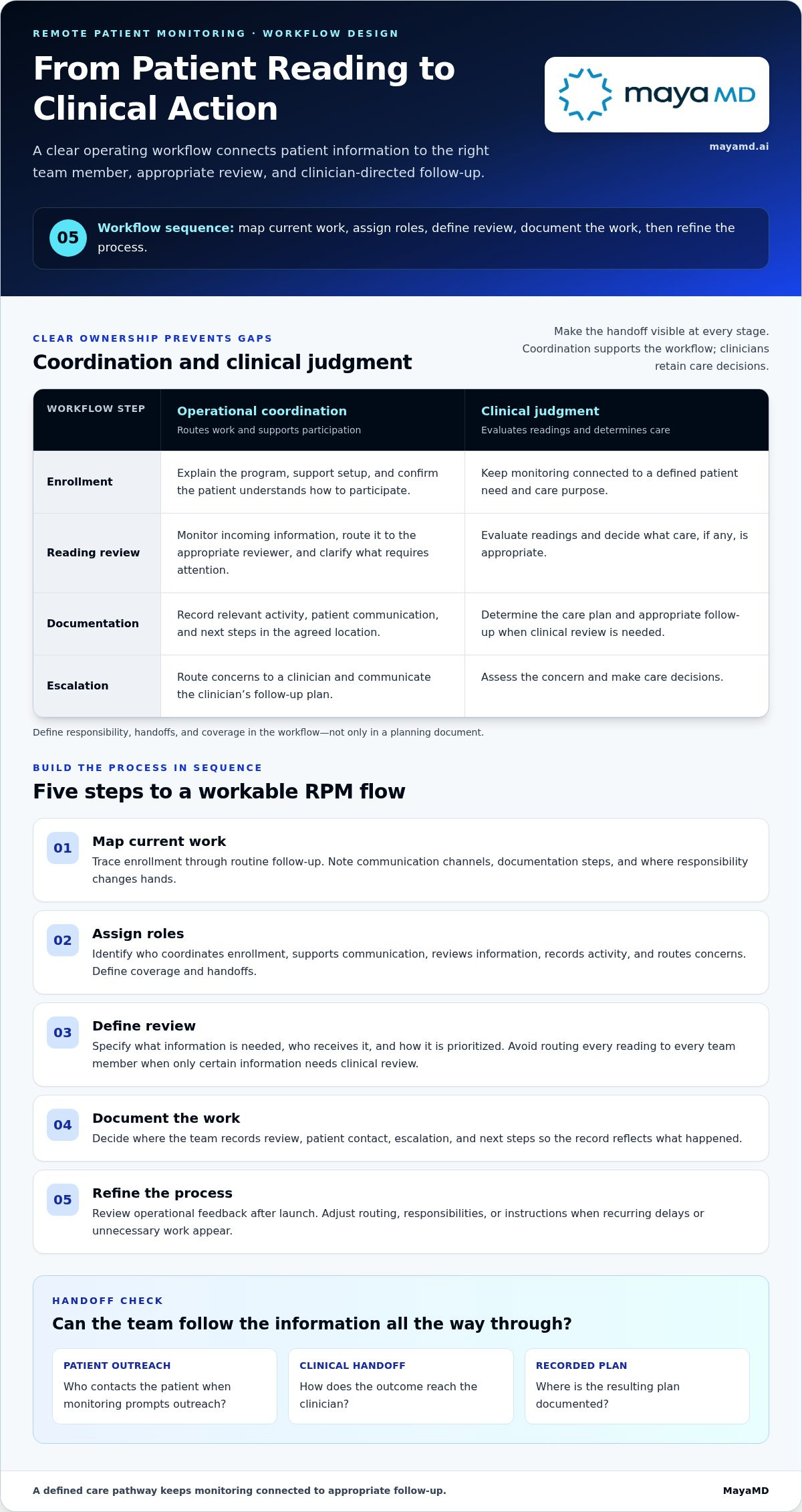
Map every operational step, from enrollment through review and escalation. Distinguish coordination from clinical judgment. Staff may coordinate enrollment and communication, while clinicians evaluate readings and decide what care, if any, is needed. The remote patient monitoring overview describes RPM in the context of chronic care management.
Enrollment
Identify who explains the program, supports setup, and confirms the patient understands how to participate.
Review
Specify who monitors incoming information, how it reaches the appropriate reviewer, and what requires attention.
Documentation
Assign responsibility for recording relevant activity, communications, and next steps.
Escalation
Define how concerns reach a clinician and who communicates the clinician’s follow-up plan.
Make ownership visible in the workflow, not just in a planning document. Assign a responsible role and clear handoff for each step. If a reviewer is unavailable, staff should know how work is routed. If a reading raises concern, clinical decisions remain with the clinician. This clarity helps teams assess workload before launch and gives patients a more dependable connection between monitoring and care.
Design RPM workflows that connect patient readings to clinical action
A useful RPM workflow makes the path from measurement to follow-up clear. Design it around the work the team needs to do, not every function a platform can provide. This helps limit irrelevant notifications, reduce uncertainty at handoffs, and show how monitoring fits with existing care.
Build the process in sequence:
Map current work.
Trace how patients move from enrollment to routine follow-up. Note existing communication channels, documentation steps, and points where responsibility changes hands.
Assign roles.
Identify who coordinates enrollment, supports patient communication, reviews incoming information, records activity, and routes concerns. Define coverage and handoffs, too.
Define review.
Specify what information the team needs, who receives it, and how it is prioritized. Avoid sending every reading to every team member if only certain information needs clinical review.
Document the work.
Decide where the team records review, patient contact, escalation, and next steps so the record reflects what happened.
Refine the process.
Review operational feedback after launch. Adjust routing, responsibilities, or instructions when recurring delays or unnecessary work appear.
Compare the proposed process with existing care operations. For example, if monitoring information prompts outreach, define who contacts the patient, how the outcome reaches the clinician, and where the resulting plan is recorded. This can reveal gaps before they turn into routine workarounds. Workflow mapping also helps teams see how tasks and information move between roles.
Map responsibilities from enrollment through follow-up
Document each handoff, including enrollment, outreach, reading review, follow-up, and documentation. Separate coordination from clinical judgment: an operational role may route information or record that it was received, while a clinician evaluates its significance and determines appropriate care. Clear role descriptions also show where RPM adds work to an existing process and where a handoff needs to change.
Define escalation and documentation rules before launch
Decide how concerns reach the care team, what structured information accompanies an escalation, and how the clinician’s decision returns to the workflow. Rules should clarify ownership without implying that an alert diagnoses a problem or dictates treatment.
A data alert signals information for review; it is not a clinician’s care decision. Clinicians interpret the information and determine appropriate follow-up. Documentation should capture the work performed, including relevant review and communication. Before making specific billing or compliance claims, teams should verify current CMS documentation and reimbursement requirements.
To translate these steps into a practical process, discuss RPM workflow planning in the context of care transitions and remote monitoring.
Prevent RPM disengagement, data overload, and unclear patient communication
Patients may participate less consistently when instructions are hard to follow, the communication channel does not suit them, or they do not know whether anyone will respond to their readings. An instruction sheet can explain device use, but it does not give patients an easy way to ask questions or report a barrier. Engagement depends on communication that invites a response, not just a message sent.
Plan for accessibility and continuity together. Explain what the patient is expected to do, what communications to expect, and how to ask for clarification. Consider whether the patient can use an app, prefers a phone call, or is more comfortable with text. Communication is more likely to fit into the care relationship when it reflects the patient’s needs rather than feeling like a separate technology task.
Make onboarding and communication usable for patients
During onboarding, explain device use in plain language and set expectations for how monitoring fits into care. Tell patients how to report a problem, ask a question, or explain that they cannot take a reading. Provide an accessible communication route and reinforce key instructions after setup. A missed reading may mean the patient needs help or clarification; the absence of data alone does not explain why.
Two-way communication can surface barriers before they become disengagement. For example, if a patient stops submitting readings, outreach can ask whether they need help using the device or would prefer another way to communicate. Do not assume nonparticipation means refusal or lack of concern. Follow-up gives patients a chance to explain and the team useful context for deciding what to do next.
Prevent readings from becoming an unmanaged data queue
More data does not automatically create better oversight. Before monitoring begins, decide how information is prioritized and who owns each review queue. Distinguish routine information from items that need closer attention, based on the program’s clinical purpose and clinician-defined review process. Staff may route an escalation or document outreach, but clinicians retain clinical judgment and decisions about follow-up.
Prioritize for purpose
Identify which information is relevant to the enrolled population and care pathway.
Assign review ownership
Make clear who monitors incoming information and how unreviewed items are handed off.
Close the communication loop
Record outreach and route patient responses or concerns to the appropriate team member.
Set expectations for who can access monitoring information, how it is used, and how it is handled within the organization’s processes. Avoid collecting or distributing information without a defined care purpose. Privacy, security, and reimbursement obligations depend on current requirements and program design, so verify applicable guidance before launch. A patient-centered communication plan and disciplined information handling are practical foundations for avoiding common pitfalls in RPM implementation.
Use a phased RPM implementation plan with measurable review points
A phased launch gives a care team room to test its operating model before expanding the program. Each phase should answer a practical question: Is the program ready for its intended patients? Can staff carry out the workflow? Can patients participate? Do review findings show that the process is working as designed?
Review program performance against defined goals, then refine the workflow. This keeps evaluation focused on the care purpose rather than on collecting metrics for their own sake. Measures should fit the population, clinical intent, and team capacity. A single benchmark will not apply to every program.
Prepare a focused launch and establish a baseline
Start with a defined patient population, agreed responsibilities, and a documented workflow. Before launch, prepare staff for the communication, documentation, reading review, and escalation handoffs they will manage. Establish a baseline using information the team can review consistently. This gives later results context and avoids attributing changes to RPM without evidence.
Use a staged sequence to make readiness visible:
Readiness
Confirm the program’s purpose, intended population, operational capacity, and patient support approach.
Workflow design
Document the process from enrollment through review and follow-up, including handoffs and escalation routes.
Staff preparation
Walk through common scenarios so each role understands its tasks and limits.
Launch
Begin with the planned scope and capture questions, delays, and workflow exceptions as they occur.
Iterative review
Compare results with the program’s goals, then adjust the process before expanding it.
Choose measures across distinct areas. Adoption indicators can show whether enrolled patients are participating as expected. Workflow indicators can reveal whether information reaches the assigned reviewer and whether handoffs are completed. Patient-experience indicators can show whether instructions and communication channels are usable. Choose measures the team can collect and act on. Avoid setting targets without a meaningful baseline or clinical rationale.
Review results and scale only when the workflow is ready
Review measures alongside staff feedback and patient questions. If patients struggle with setup, improve onboarding. If review queues accumulate, revisit routing and team capacity. If handoffs are unclear, refine role guidance before increasing enrollment. Scaling is a decision point, not an automatic next step: expand only when responsibilities, communication, and clinical oversight remain workable at the intended volume.
Implementation timing depends on program scope and readiness. With MayaMD, one unit can go live in 4-6 weeks. To discuss a phased approach for care transitions and remote monitoring, Book a 20-minute intro.
How MayaMD supports RPM across the transition from hospital to home
After defining the program’s purpose, responsibilities, and escalation process, care teams can assess how technology supports that model while keeping clinical judgment with clinicians. MayaMD is a nationally recognized platform for transitions from hospital to home and remote monitoring. It combines protocol-driven Conversational AI, patient communication channels, connected devices, clinical staff support, and a clinician portal.
This approach links discharge support and ongoing monitoring within an organized care pathway. It helps carry communication forward as patients move home and gives clinicians structured information and visibility into escalations. Technology supports the workflow; clinicians retain all care decisions.
Connect protocol-driven engagement with monitoring and clinical staff support
MayaMD’s Conversational AI follows a protocol-driven question flow, and AI only does the talking. The platform supports remote monitoring with FDA-cleared cellular blood-pressure cuffs, scales, and pulse oximeters. Its Companion AI, the Maya app, answers questions, sends reminders and education, and checks in day or night. Patients can also reply through the app, a phone call, or two-way text, with replies captured in the same care plan.
This flexibility supports patients during the transition home, when they may need continued education or a way to share information with their care team. MayaMD follows the 13-step Project RED discharge protocol, a validated pathway for discharge support. Connecting protocol-driven engagement with monitoring can help maintain continuity beyond the hospital, while clinical staff support keeps enrollment, outreach, follow-up calls, and EHR documentation connected to patient communication.
For patients
The care plan supports communication through the app, phone, or text.
For care teams
Monitoring information and patient interactions are organized to support follow-up and clinician oversight.
For clinicians
Escalations and structured notes provide information for review, without shifting care decisions to AI.
Make clinician oversight and next steps explicit
Through the clinician portal, clinicians receive escalations and structured notes. These support visibility into what needs review and provide relevant context, but they do not determine the clinical response. Clinicians interpret the information, decide whether follow-up is appropriate, and retain all care decisions. This distinction between technology-supported coordination and clinician-led judgment is central to a governed RPM workflow.
Implementation planning still matters. One unit can go live in 4-6 weeks, with workflow and team preparation shaped around the program’s scope. For care teams considering MayaMD for hospital-to-home transitions and remote monitoring, Book a 20-minute intro.
For more information, call +1 (888) 629-2631 or email info@mayamd.ai. MayaMD’s communication, monitoring, and escalation capabilities support avoiding common pitfalls in RPM implementation when they are aligned with the care team’s defined process.
Build a stronger foundation for what comes next
An RPM program can help a care team learn what is working, not just create another channel for incoming information. As patient needs and clinical operations change, revisit whether the program still serves its intended purpose and whether staff and patients can use it effectively. Treat feedback as an opportunity to improve the care experience, not simply as a measure of adoption.
That commitment to learning is central to avoiding common pitfalls in RPM implementation. Start by bringing clinical and operational stakeholders together to identify what a well-functioning program should make easier for patients and staff. Use that shared aim to guide workflow, communication, and future refinement.
If your team is ready to explore how remote monitoring can support its care-transition priorities, talk with MayaMD about your RPM goals. To discuss your needs, Book a 20-minute intro, call +1 (888) 629-2631, or email info@mayamd.ai.
Frequently Asked Questions
Is RPM implementation appropriate for every patient with a chronic condition?
No. RPM is most useful when monitoring serves a defined care purpose and the care team can act on the information within its workflow. For example, a team supporting patients after hospital discharge can consider whether monitoring fits a patient’s care needs and whether the patient can participate. Enrollment should follow the program’s clinical scope, not simply a diagnosis category or device availability.
Can patients participate in RPM without using a smartphone app?
Yes. MayaMD supports patient replies through an app, phone call, or text, so participation is not limited to app-based communication. For example, a patient who prefers calls can communicate by phone while remaining part of the same care plan. During enrollment, explain the available channels and how to respond or ask for clarification.
What happens when a patient stops responding to RPM outreach?
A lapse in response should prompt appropriate follow-up, not an assumption about the patient’s reason. The patient may need help understanding instructions, may face a communication barrier, or may be unable to participate at that time. MayaMD’s clinical staff support includes outreach and follow-up calls. The care team can use the patient’s response, or continued lack of response, to determine next steps within its established process.
How can a care team avoid being overwhelmed by RPM readings?
Set review rules around the program’s clinical purpose rather than sending every reading to every team member. For example, define which information should go to a clinician for review and how the reviewer receives relevant context. Assign ownership of the review queue and a handoff for items awaiting review. Avoiding common pitfalls in RPM implementation includes checking whether volume and routing remain manageable as participation changes.
Does AI make clinical decisions in MayaMD’s RPM workflow?
No. MayaMD’s Conversational AI follows a protocol-driven question flow, and AI only does the talking. Clinicians receive escalations and structured notes through the clinician portal, then use their judgment to determine appropriate care. The technology supports communication and organizes information for review, but it does not make clinical decisions. Clinicians retain all care decisions.
How long does it take to launch an RPM program with MayaMD?
One unit can go live in 4-6 weeks. This focused start gives the care team a defined scope for preparing its workflow and staff. To discuss a program supporting transitions from hospital to home and remote monitoring, Book a 20-minute intro. You can also call +1 (888) 629-2631 or email info@mayamd.ai.
Are connected devices required to use Wi-Fi or pair with a phone?
No. MayaMD’s FDA-cleared cellular blood-pressure cuffs, scales, and pulse oximeters transmit readings automatically and require no pairing or Wi-Fi. This removes setup steps for patients who do not use a smartphone or home internet connection. Patient communication can still take place through the app, phone call, or text, bringing device readings and care-plan interactions into the same monitoring pathway.




See The MayaMD Difference
Fill the form below
Download Our Apps
MayaMD for patients and MayaPro for physicians - available on iOS and Android.
FOR PATIENTS
MayaMD App
AI-powered symptom assessment, triage, and secure access to your care team.

FOR PHYSICIANS
MayaPro App
MayaPro brings patient vitals, RPM/PCM care plans, and clinical decision support to your pocket.