
Automating Patient Follow-Up Communication: A Clinical Workflow Guide

What if the goal of automating patient follow-up communication isn’t to send more messages, but to make sure each patient receives the right next step? Manual outreach takes staff time and can be difficult to coordinate consistently. Generic automation, meanwhile, may leave patients unsure what to do or when to seek help. The goal is not automation without oversight. It is a workflow for timely, relevant communication that keeps clinical judgment in the loop.
This guide explains how to design and evaluate follow-up workflows around patient needs, care transitions, response handling, and human review. You’ll learn what to automate, where staff oversight matters, and how to compare approaches using clinical, operational, and patient-experience criteria. We’ll also look at how a Clinical AI Agent can connect patient engagement with structured clinical workflows, including ongoing care and post-discharge support. The result is a practical framework for improving continuity without making communication feel impersonal.
Key Takeaways
• Distinguish appointment reminders from follow-up tied to a visit, discharge, or ongoing care need.
• Design automating patient follow-up communication as a governed sequence, from trigger and tailored message to response review and escalation.
• Compare automation approaches by clinical context, response handling, documentation, and measurement.
• Build patient trust with a phased rollout and clear ownership of message content, workflow monitoring, and clinical review.
• See how MayaMD’s cloud-based clinical AI platform combines deterministic logic and generative AI to support structured, connected follow-up workflows.
Why automate patient follow-up communication beyond appointment reminders?
Appointment reminders help patients prepare for a scheduled visit. Follow-up has a broader purpose: it connects a care event or ongoing need with planned communication after a visit, discharge, care-plan change, or monitoring activity. A reminder typically confirms when and where to attend. Follow-up can reinforce instructions, check whether a next step is complete, or invite a patient to share a concern for review.
Automated follow-up communication is planned, technology-enabled outreach linked to a care event or ongoing need. It supports clinical workflows but does not make clinical decisions. This distinction separates communication automation from automated diagnosis or treatment direction. Technology can help deliver an appropriate message and organize a response, while qualified care professionals interpret clinical information.
The operational case is not simply about sending more messages. Manual outreach can be difficult to coordinate across teams and care settings, particularly when patients need different kinds of follow-up at different points in care. A defined workflow clarifies who should receive outreach, what information is appropriate, and what should happen when a patient replies. For patients, timely, understandable communication can clarify next steps and make it easier to raise questions. It does not guarantee a particular clinical outcome, but it can help teams identify and address gaps in communication.
Which follow-up moments are suitable for automation?
Routine, repeatable touchpoints are useful candidates when the message has a clear purpose and a defined response path. After a visit, outreach might reinforce clinician-approved instructions or remind a patient about a planned next step. After discharge, communication can support the transition from hospital to home, a focus also explored in hospital discharge transitions. In chronic care, a workflow might prompt a patient to complete an agreed monitoring activity or report whether they need assistance.
Not every reply is routine. An acknowledgment or request for general information may be handled differently from a report of worsening symptoms. Messages that need clinical interpretation require a clear route to human review, not a generic automated response. Planned outreach makes follow-up visible across the care journey, while response review helps teams distinguish completed tasks from unresolved concerns.
What automation should not replace
Automation can support communication, reminders, and structured workflow steps. It should not independently diagnose, determine treatment, or substitute for clinician judgment. Complex symptoms, urgent concerns, and ambiguous replies warrant human review under the organization’s clinical protocols. Patients also need a clear way to reach a person when their concern does not fit the automated path. This boundary is central to automating patient follow-up communication responsibly: technology can coordinate the next step, but clinicians remain accountable for clinical interpretation and care decisions.
How does automated patient follow-up communication work in a clinical workflow?
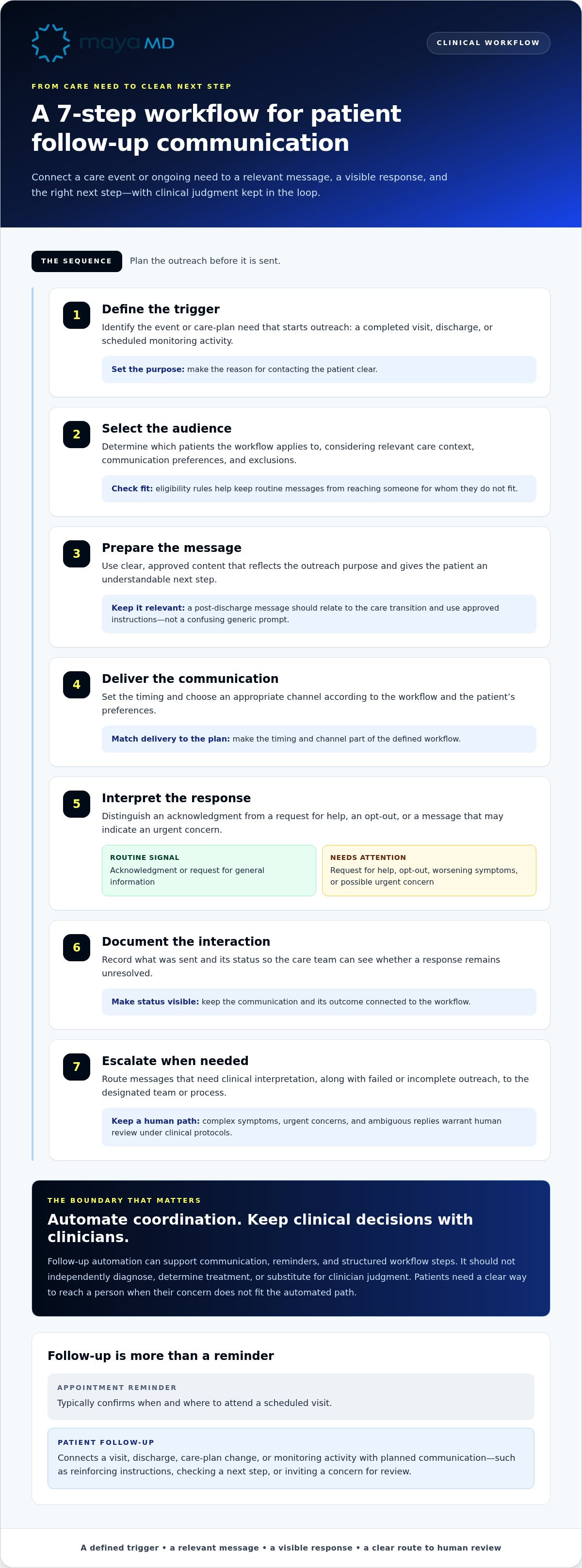
A reliable workflow connects a defined care need to an appropriate message and a clear next step. Automating patient follow-up communication therefore involves more than scheduling delivery. The process must account for who receives outreach, how replies are handled, and where the interaction is recorded. HealthIT.gov’s Health IT and Patient Engagement resource discusses how health IT can support patient engagement, a useful perspective when designing communication around care rather than message volume.
Define the trigger.
Identify the event or care-plan need that starts outreach, such as a completed visit, discharge, or scheduled monitoring activity.
Select the audience.
Determine which patients the workflow applies to, taking relevant care context, communication preferences, and exclusions into account.
Prepare the message.
Use clear, approved content that reflects the purpose of the outreach and gives the patient an understandable next step.
Deliver the communication.
Set the timing and choose an appropriate channel according to the workflow and the patient’s preferences.
Interpret the response.
Distinguish an acknowledgment from a request for help, an opt-out, or a message that may indicate an urgent concern.
Document the interaction.
Record what was sent and its status so the care team can see whether a response remains unresolved.
Escalate when needed.
Route messages requiring clinical interpretation, along with failed or incomplete outreach, to the designated team or process.
Patient context should shape both message content and routing. For example, a post-discharge message should relate to the patient’s care transition and use approved instructions, rather than send a generic prompt that could be confusing or inappropriate. Communication preferences can guide delivery, while eligibility rules help prevent a routine message from going to someone for whom it does not fit. Keep each message focused, relevant, and within its intended purpose.
Build the workflow around a clinical trigger
For each trigger, specify its purpose, intended recipient, timing, approved message, and expected next step. A monitoring prompt, for instance, should relate to a planned activity, not go out simply because a patient is enrolled in ongoing care. Define what counts as completion and what happens if no response arrives. These decisions make the workflow consistent without treating every patient or care event as identical.
Route replies with appropriate human oversight
Before activation, assign responsibility for reviewing messages and define the route for concerns that need staff attention. Acknowledgments may close a routine step. Requests for help need an appropriate response, opt-outs should follow communication procedures, and potentially urgent or unclear replies need prompt human review under clinical protocols. Document unresolved messages and failed outreach so they return to the care team rather than disappearing from view.
Response handling is part of automation, not an optional add-on. Without a defined route for replies, a delivered message can still leave a patient’s need unaddressed. Teams shaping these pathways can explore how a Clinical AI Agent connects patient communication with structured clinical workflows, or discuss a workflow suited to their care model.
How to compare patient follow-up automation approaches
The right approach depends on what the communication needs to accomplish. A reminder system may suit predictable administrative outreach, while follow-up involving patient responses, care context, or clinical review calls for more coordinated capabilities. To compare options for automating patient follow-up communication, assess not only how a message is sent, but also how it fits into care workflows and what happens afterward.
| Capability | Reminder tools | Messaging tools | Clinically oriented AI workflows |
|---|---|---|---|
| Clinical context | Usually focused on appointment details or other routine prompts. | May support tailored messages, depending on setup and available context. | Can connect communication to structured care workflows and defined patient needs. |
| Channel flexibility | Typically supports a limited set of reminder channels. | May offer multiple channels and two-way exchanges. | Depends on the workflow and platform configuration. |
| Response handling | May capture a confirmation or basic reply. | Can support replies, but staff may need to interpret and route them. | Can organize responses within a clinical workflow; human review remains important. |
| Escalation | Often limited to predefined administrative actions. | May rely on staff processes to route messages needing attention. | Should support defined pathways for review and escalation. |
| Documentation | May record delivery or confirmation status. | Can retain message history, depending on system capabilities. | Should make outreach and follow-up status visible within the relevant workflow. |
| Measurement | Can track delivery or attendance-related activity. | May measure engagement and response patterns. | Can help teams evaluate workflow completion and unresolved follow-up. |
Use the comparison as a starting point, not a universal scorecard. Consider how each option fits existing processes, who owns message review, and whether relevant information can reach the systems staff use. Avoid assuming that more automation is always better. A straightforward reminder may be enough for a routine administrative task, while a care transition may require response tracking and a clear route back to the team.
What capabilities matter for safe, useful follow-up?
Evaluate message relevance, response routing, human review, and documentation as separate capabilities. A personalized message is not enough if replies are difficult to review or unresolved outreach is invisible. Assess privacy safeguards and access controls against your organization’s governance requirements as well. For chronic-care programs, remote patient monitoring workflows can connect ongoing patient data with planned engagement, while clinical interpretation remains with the care team.
Match automation depth to the use case
Choose the simplest approach that reliably supports the intended task. Basic reminders may suit predictable administrative communication. Post-discharge or chronic-care follow-up may need coordination across messages, patient responses, and staff review. Assess a Clinical AI Agent by how it connects communication with structured care workflows, not by assuming it makes autonomous clinical decisions.
How to implement automated follow-up without losing patient trust
Trust depends on more than a courteous message. Patients need to understand why they received it, what action is expected, and whether a reply will be reviewed. A careful rollout also helps staff manage their workload by making ownership and escalation visible before outreach begins. Treat implementation as workflow design, not simply a decision to switch on automated messages.
Use a phased approach:
Choose one use case.
Start with a defined, repeatable need, such as a specific post-visit or post-discharge touchpoint.
Map the process.
Document who qualifies, what the message should accomplish, how replies are handled, and what happens if outreach fails.
Validate the content.
Have appropriate clinical and operational owners review message accuracy, clarity, and the next step offered to patients.
Pilot the workflow.
Begin with a bounded group or process so the team can observe how communication works in practice.
Refine before expanding.
Use patient responses and staff feedback to adjust message language, routing, and procedures.
Make ownership explicit. Assign responsibility for clinical content, operational monitoring, response review, and escalation. These roles may belong to different people, but unresolved messages need a clear destination. Agree on how staff will recognize an opt-out, an unexpected reply, or a report requiring clinical attention, and how those interactions will be recorded.
Design messages around patient understanding
Use plain language, identify the care context, and state the next action clearly. For example, distinguish a request to complete a planned follow-up step from an invitation to report a concern. Tell patients whether they can reply and how replies are handled. Choose timing and channel according to organizational policy and patient communication preferences, rather than assuming one format suits everyone.
Pilot, monitor, and refine the process
Before launch, establish baseline operational measures relevant to the workflow. During the pilot, review delivery, response, completion, and escalation patterns, as well as failed outreach and staff workload. These measures can help teams identify process issues, but they do not, on their own, prove improved clinical outcomes. Use opt-out patterns, unexpected replies, and team feedback to revise templates, routing rules, and procedures before expanding.
Connect follow-up to transitions of care
Discharge follow-up needs clear ownership because patients are moving between care settings and need an understandable next step. Make clear which team reviews responses and how an unresolved concern reaches that team. For a closer look at patient education in this context, explore hospital discharge education through conversational agents and this hospital-to-home transition overview.
A governed rollout makes automation a dependable extension of the care process, with clear limits and accountable human review. Discuss patient follow-up workflows with MayaMD to explore how connected communication can support care transitions and ongoing engagement.
How MayaMD supports connected patient follow-up workflows
Follow-up communication is most useful when it connects with the care process around it. MayaMD provides a cloud-based, HIPAA-compliant clinical AI platform that supports patient engagement, chronic care, remote patient monitoring, and post-discharge communication. Its Clinical AI Agent connects communication with structured clinical workflows, helping organizations treat outreach as part of ongoing care rather than as a series of disconnected messages.
The platform combines deterministic logic with generative AI to support structured workflows. These capabilities do not replace clinicians or independently make clinical decisions. Care teams retain responsibility for clinical judgment, approved content, and review of patient needs. That distinction matters when automating patient follow-up communication: technology can support consistency and coordination, while clinical oversight keeps each workflow aligned with organizational practice.
Connect communication with ongoing chronic care
For patients managing chronic conditions, follow-up may involve recurring engagement alongside planned care activities. Remote Patient Monitoring (RPM) can bring ongoing patient data into the broader care process, while communication connects monitoring activities with the care team’s workflow. MayaMD provides remote patient monitoring workflows for this ongoing-care context.
Advanced Primary Care Management (APCM) and Principal Care Management (PCM) also depend on coordinated support over time. Patient engagement can help organize planned communication around continuing needs. Post-discharge communication addresses a different transition, supporting continuity as patients move from a hospital setting back to home. Across these contexts, the appropriate message and response pathway depend on the care plan and the organization’s governance. The technology supports the workflow; the care team remains responsible for interpreting clinical information and deciding what action is appropriate.
Evaluate fit around the organization’s workflow
Start by identifying a follow-up process that creates friction for patients or staff. Be specific about its purpose: is the priority to coordinate post-discharge outreach, support chronic-care engagement, or connect monitoring activity with planned follow-up? A clearly defined use case makes it easier to assess whether a connected workflow fits the organization’s needs.
Evaluate the approach across four dimensions: workflow fit, including how outreach relates to existing care processes; governance, including clinical content ownership and human review; patient experience, including message clarity and appropriate response options; and operational measures, such as delivery, response, completion, and escalation tracking. These indicators can help teams assess how a process is functioning, but they should not be treated as proof of clinical outcomes. For veterinary practices exploring similar operational structures, Helpful.vet offers interactive workflow tools and clinic benchmarks to help teams assess daily performance.
A focused discussion can connect technology choices to your organization’s follow-up priorities. To explore how MayaMD supports workflows across chronic care, monitoring, or post-discharge communication, start a conversation with MayaMD.
Make the next follow-up workflow more connected
Start by identifying one communication gap that matters to your patients and care team, then define what a dependable process should look like. Consider where outreach begins, what a patient should understand, and how the team will know whether a response needs attention. This focused starting point gives your organization a practical way to evaluate automating patient follow-up communication without making technology the goal in itself.
MayaMD brings these priorities together in a cloud-based, HIPAA-compliant clinical AI platform. Deterministic logic combined with generative AI supports structured workflows across chronic care, remote patient monitoring, Advanced Primary Care Management, Principal Care Management, and post-discharge communication. The aim is coordinated support, with clinicians retaining responsibility for judgment and care decisions.
As your needs evolve, a connected platform can provide a foundation for aligning engagement across care settings while keeping governance and patient experience in view. The right workflow begins with your organization’s priorities. Discuss your patient follow-up workflows with MayaMD and explore a thoughtful next step for your team. Better continuity starts with a process designed around people.
Frequently Asked Questions
Can automated patient follow-up communication replace calls from clinical staff?
No. Automated outreach should not be treated as a universal substitute for calls from clinical staff. It may handle planned informational touchpoints, while conversations involving uncertainty, complex concerns, or clinical interpretation remain with the care team. A message confirming receipt of routine instructions, for example, differs from a call to discuss a new concern. Define the boundary for each workflow based on the patient population, organizational policies, and available clinical oversight.
Is automated patient communication HIPAA-compliant by default?
No. Using an automated tool does not make every communication or workflow compliant by default. Organizations should assess how patient information is handled, who can access it, how the system is configured, and whether operating practices align with their compliance program. MayaMD’s platform is HIPAA-compliant, but each organization remains responsible for its own policies and appropriate use of patient information. Review the complete workflow, not just the technology’s label.
What follow-up tasks can healthcare organizations automate?
Organizations can consider automating predictable communications tied to appointments, care transitions, monitoring activities, or planned follow-up. For example, a workflow might share an approved reminder about a scheduled care-plan step. The suitable scope depends on the message’s purpose and what happens after delivery. Keep communications that require interpretation, such as a patient describing a new or changing concern, within a defined process for human review.
How should an automated follow-up system handle patient replies?
It should route replies according to the action they require, rather than treating every response as a confirmation. A patient may acknowledge a message, ask for assistance, opt out, or describe a concern that needs review. Establish who monitors each category and how unresolved messages are tracked. Also tell patients whether replies are monitored and what channel to use for urgent assistance, so automation does not create misleading expectations.
How can a practice measure automated patient follow-up?
Choose measures that match the task, such as delivery success, response patterns, completion of a requested administrative step, or messages routed for review. Compare results with a baseline and consider staff observations alongside patient feedback. For instance, repeated questions may indicate that a message is unclear. Operational metrics can reveal workflow performance, but they do not establish that clinical outcomes improved without appropriate supporting evidence.
Does automated follow-up work for chronic care and post-discharge communication?
It can support planned communication in both settings when the workflow reflects the relevant care context. In chronic care, outreach may relate to ongoing engagement or monitoring. After discharge, messages may help patients understand the next step in their transition home. In either case, determine who reviews patient concerns and how they reach the care team. Automation supports continuity, but it does not replace clinical assessment.
How do we keep automated follow-up messages from feeling impersonal?
Make each message relevant to the patient’s care context and clear about why it was sent. A patient receiving a post-visit message should be able to distinguish it from routine appointment outreach and understand the requested action. Use communication preferences where appropriate, explain how replies are handled, and review recurring questions or opt-outs. These signals can help teams improve message clarity while maintaining privacy and consistent clinical governance.




See The MayaMD Difference
Fill the form below
Download Our Apps
MayaMD for patients and MayaPro for physicians - available on iOS and Android.
FOR PATIENTS
MayaMD App
AI-powered symptom assessment, triage, and secure access to your care team.

FOR PHYSICIANS
MayaPro App
MayaPro brings patient vitals, RPM/PCM care plans, and clinical decision support to your pocket.