
AI to Predict Patient Deterioration With Personalized Scores

A warning score is useful only when its signal is interpreted in context. The use of AI to predict patient deterioration can combine hospital observations with relevant health-record data to estimate changing risk and flag patterns that may merit clinical attention. The score supports, rather than replaces, assessment by the care team.
It’s reasonable to ask whether a model can distinguish a meaningful change from a patient’s usual pattern. The answer depends on the data used to train and validate it, its performance in the setting where it’s deployed, and whether the score accounts for patient characteristics.
This article explains how machine-learning models turn observations and records into warning scores, why validation matters, and how factors such as age and baseline physiology shape risk estimates. It also clarifies what a score can and cannot tell a care team, so you can assess how predictive tools might support earlier, more individualized attention.
Key Takeaways
• Understand how machine-learning models combine trends in hospital observations with health-record context to estimate deterioration risk.
• Learn why a model’s performance depends on more than a single accuracy measure, including the threshold used to trigger warnings.
• See how validation cohorts and care settings affect whether a warning score is relevant to the patients being assessed.
• Recognize how age-related differences and other patient variables can shape personalized risk estimates.
• Explore how connected AI patient engagement and post-discharge communication can support continuity of care beyond the hospital.
AI and machine learning for inpatient deterioration prediction
Hospitals can use AI to predict patient deterioration by analyzing observation patterns and estimating the likelihood of a defined event. Unlike a fixed score, a machine-learning algorithm can combine variables and identify relationships across patient records. Its output is a risk estimate, not a diagnosis. The care team must interpret that signal alongside the patient’s condition and the hospital’s escalation process.
Emergency department studies show why model performance needs careful interpretation. A systematic review included nine studies of machine-learning models predicting deterioration in emergency department patients. Across studies predicting in-hospital cardiac arrest after emergency admission, pooled AUC was 0.909, with a 95% confidence interval of 0.889-0.929. However, heterogeneity was high, at I² of 97.71%. The pooled result therefore summarizes varied studies, not one model’s expected performance in every care unit.
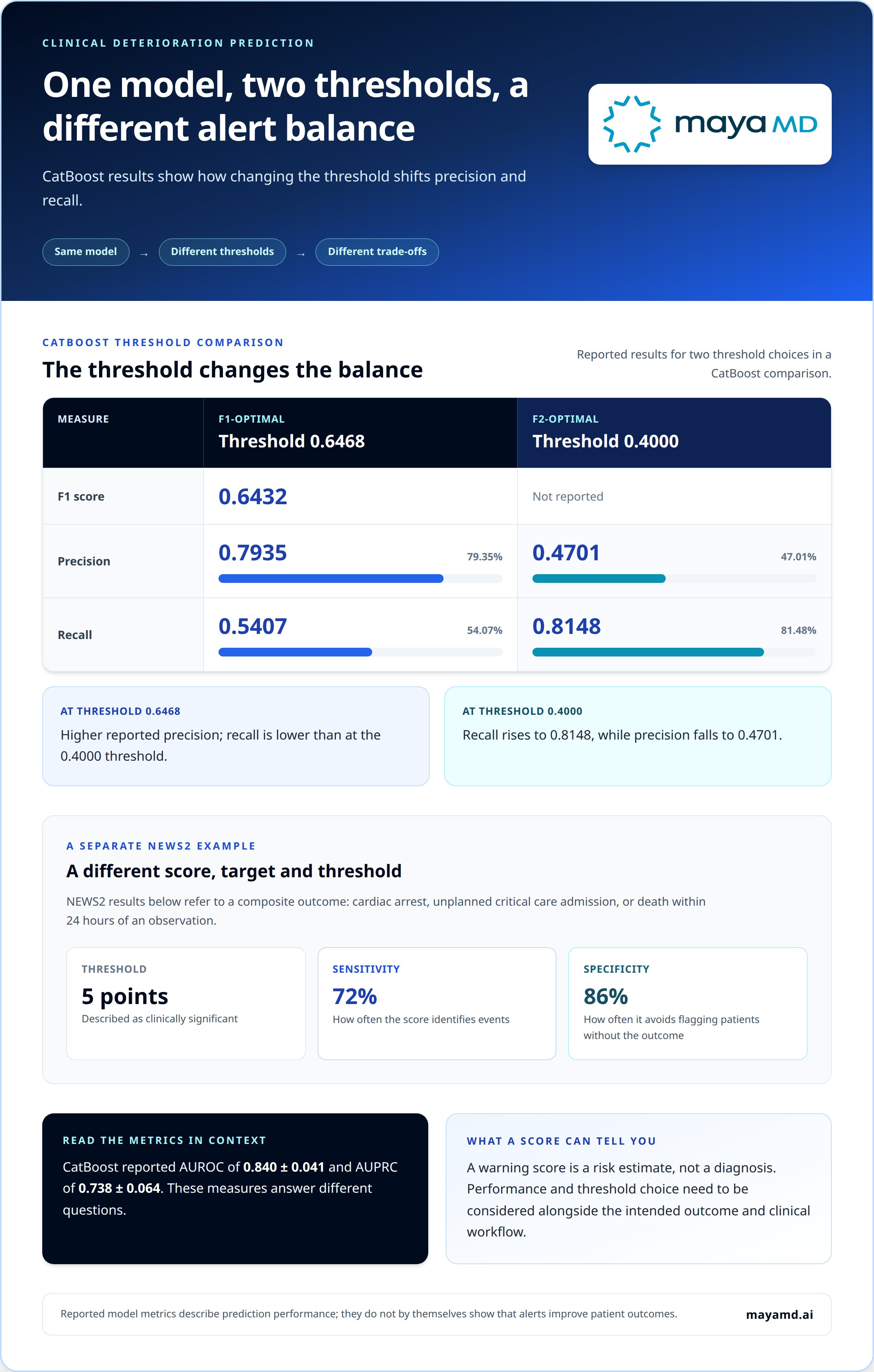
Individual comparisons also vary by model and outcome. In one study, NEWS2 had an AUC of 0.678 for predicting emergency department in-hospital cardiac arrest, while a random forest model reached 0.931 for that outcome. A separate CatBoost comparison reported AUROC of 0.840 ± 0.041 and AUPRC of 0.738 ± 0.064. These measures answer different questions: AUROC reflects ranking across thresholds, while precision-recall performance helps assess positive alerts when outcomes are less common.
Threshold selection changes how an algorithm behaves. At CatBoost’s F1-optimal threshold of 0.6468, its F1 score was 0.6432, with precision of 0.7935 and recall of 0.5407. At its F2-optimal threshold of 0.4000, recall rose to 0.8148, while precision was 0.4701. A hospital prioritizing missed-case reduction may prefer a different balance than one managing alert volume. Model comparison should therefore include threshold-specific results and the intended triage workflow.
For regulatory planning, hospitals assess privacy, security, clinical safety, intended use, and whether a software function falls under FDA oversight. HIPAA applicability depends on the organizations and data involved, while FDA status depends on the specific software and its intended use. No single rule or clearance claim applies to every prediction tool.
System costs vary with software scope, data integration, validation, workflow changes, and ongoing support. Hospitals weigh these factors when estimating implementation requirements, and pricing is determined after a quote request.
FDA clearance is product-specific, so a model described in a study does not prove that a commercial tool is cleared or available in the United States. When evaluating a system, check its exact product name, intended use, and regulatory status.
Prediction performance alone does not show that alerts improve patient outcomes. Reported AUC and threshold metrics describe model discrimination and classification, not the effect of deploying alerts on arrests, critical care admissions, or mortality. Outcome evaluation should examine how alerts affect recognition, escalation, and care delivery in the target setting.
Machine-learning prediction of clinical deterioration
A model can predict deterioration only after its target outcome is defined. Across reviewed studies, in-hospital cardiac arrest was the most common definition of clinical deterioration. Other targets include unplanned intensive care admission or death. These outcomes are not interchangeable: a model trained to identify cardiac arrest may not flag the same patients as one designed to predict broader clinical decline.
The target outcome determines the label used during training. For example, the model learns patterns preceding the selected event, not a universal concept of “getting worse.” When assessing an algorithm, identify its prediction target, time window, and included patients. Those choices determine what a warning means in the care unit.
Thresholds also affect the balance between missed events and additional alerts. NEWS2 uses a 5-point threshold described as clinically significant. At that threshold, it has 72% sensitivity and 86% specificity for the composite outcome of cardiac arrest, unplanned critical care admission, or death within 24 hours of an observation. Sensitivity describes how often the score identifies events; specificity describes how often it correctly avoids flagging patients without the outcome.
False alarms can prompt unnecessary reassessment, while missed deterioration can delay attention. Alerts that arrive too often or lack clear actions can cause alert fatigue, making staff less responsive. Bias may also arise when training data underrepresent patient groups or reflect uneven measurement and treatment patterns. Hospitals can compare alert rates and performance across relevant groups, then review how alerts affect clinical action.
Implementation is as much a workflow decision as a technical one. Akron Children’s uses unit-specific decision trees to guide escalation and communication. There, a declining deterioration index score over time triggers a warning and prompts a bedside care-team huddle. The example links a model signal to a defined response, rather than leaving staff to guess what should happen next.
Hospitals can evaluate a system in a practical sequence: define the deterioration outcome, assess performance in the intended patient population, map alerts to existing escalation pathways, and monitor the workflow after deployment. Check whether staff can identify the reason for a warning, who receives it, and what action follows. A test in one care unit may not establish performance in another, where patient mix and clinical processes can differ.
Evidence of predictive accuracy alone does not demonstrate improved outcomes. Evaluation should distinguish model performance from the effects of alert-driven care, including recognition, escalation, and patient outcomes. For teams translating prediction into an operational pathway, discuss clinical workflow requirements.
Physiological observations and electronic health records
Prediction quality depends on how patient data are represented over time. A preprocessed dataset contained 142 heart-rate time series, each eight hours long. A sequence preserves change and direction, unlike a single reading viewed alone. For example, an algorithm can evaluate whether measurements remain stable or shift across successive observations before estimating risk. This distinction makes the timing and consistency of recorded values relevant to interpretation.
Sampling detail matters. In one dataset, heart-rate data had one-minute granularity and an average missing rate of 20%. A model must distinguish an absent measurement from a normal value; otherwise, gaps can distort the pattern it evaluates. Preprocessing can align timestamps, identify missing intervals, and prepare consistent inputs. Those steps should preserve clinically meaningful changes rather than convert gaps into misleading normal readings.
Electronic health records add context to physiological observations. A heart-rate reading can be interpreted alongside information recorded in the patient’s chart, rather than treated as an isolated signal. The National Early Warning Score illustrates how a structured score can account for clinical context. It was updated as NEWS2 in 2017, including a dedicated section for patients with hypercapnic respiratory failure. That example shows why the meaning of a measurement can depend on the patient’s recorded condition.
Time alignment is essential when records come from different sources. A model needs to associate a measurement with the correct observation time and patient record. In a wearable-monitoring simulation, test time series were sent in sequential 30-minute segments. This tested how a system processed incoming data over time, instead of relying only on a complete record assembled afterward. For operational use, teams can evaluate whether incoming observations arrive in the expected sequence.
Missing-data tests also reveal how sensitive a model may be to incomplete observations. One study evaluated TARL at missing-data rates of 20%, 25%, and 30%. Its reported average earliness score was approximately 0.8 across those evaluated rates. Such stress tests help show whether a model can identify patterns when observations arrive unevenly. They also make data-quality assumptions visible during evaluation.
A practical data review can follow three steps: define which observation fields enter the model, align those fields with electronic-record timestamps, and evaluate performance when measurements are missing or delayed. Teams should also assess whether the records represent the intended care setting. These checks connect current data streams with model assumptions, helping clinicians interpret warnings in the context of the patient’s documented information.
Study settings and validation cohorts
A prediction model is only as informative as the population and setting used to evaluate it. A post-acute hospital study included 2,711 patients in its final cohort. That context differs from an intensive care dataset, where patient acuity, observation frequency, and deterioration patterns can vary. Results from one setting should therefore be interpreted against the patients and care processes represented in its cohort.
One study partitioned patient records into training and test sets using an 80%/20% split. Training data teach the algorithm to identify patterns; test data assess performance on records held aside during training. This separation helps evaluate whether the model applies learned patterns to new records from the same study population. It does not, by itself, show how well the model transfers to another hospital or care setting.
Validation across distinct cohorts helps assess that transfer. A dataset used to study intensive care prediction included 58 patients, 79 deterioration time series, and 63 recovery time series. These trajectories represent different clinical courses, so evaluation should distinguish whether a model recognizes deterioration, recovery, or both. The dataset’s size and composition also shape how broadly its results can be interpreted.
Cohort composition changes the meaning of a performance result. One study protocol defined its target population as adult inpatients older than 18 with routinely collected physiological observations. A model developed for that group should not automatically be assumed to perform similarly for pediatric patients or people in another care environment. Age, admission pathway, measurement practices, and outcome definitions affect which patterns the model can learn.
For a practical validation review, examine four elements:
Setting
Identify whether the cohort represents a general ward, post-acute hospital, emergency department, or intensive care unit.
Population
Compare the study’s eligibility criteria with the patients who will receive alerts.
Data separation
Confirm whether testing used records withheld from model training, as in the 80%/20% split.
Outcome
Check whether the measured event matches the intended clinical use, such as deterioration or recovery.
These distinctions help teams assess whether a result applies to their own patient population. A test result describes performance under the study’s specific conditions; it does not establish equivalent performance across every hospital, patient group, or workflow. Validation is most useful when the setting, cohort, and target outcome match the decisions clinicians need to make.
Additional patient variables for personalized warning scores
A personalized early warning score must account for how patient characteristics change the meaning of observations. Akron Children’s adapted a deterioration index originally designed for adults to reflect pediatric differences. Its adjustments included age-related heart rate, respiratory rate, blood pressure, and serum creatinine. These variables matter because observations should be interpreted in relation to a patient’s age and clinical profile, not as isolated values.
That adaptation illustrates a practical design principle: identify which patient variables can change the baseline or interpretation of a warning signal. For pediatric use, Akron Children’s accounted for four specified measures. A model designed for another population needs evaluation against that population’s characteristics and clinical setting. Personalization means fitting the score to relevant differences, not simply adding more inputs.
Model interpretation can also show how an algorithm responds to individual features. In a CatBoost partial-dependence analysis, predicted deterioration risk began rising at a pulse rate of approximately 80 beats per minute. The rise became steeper between 95 and 110 beats per minute. The same analysis showed a sharp respiratory-rate risk inflection between 20 and 25 breaths per minute.
Those patterns describe the model’s estimated relationship between a variable and predicted risk. They are not universal clinical cutoffs, nor do they establish that a change in one measure causes deterioration. A care team assessing an early warning score should consider the patient’s full presentation, measurement context, and trend. The CatBoost analysis also showed predicted risk decreasing as BMI rose from approximately 26 kg/m², another model-specific relationship rather than a standalone rule for an individual patient.
Before applying patient variables to scores, evaluation should ask:
Population fit
Does the score reflect age-related differences, as in Akron Children’s pediatric adaptation?
Input relevance
Are variables such as pulse, respiratory rate, blood pressure, and serum creatinine appropriate for the intended population?
Interpretation
Are partial-dependence patterns presented as model behavior, rather than universal thresholds?
Clinical use
Can staff interpret the score alongside the patient’s overall condition and observation history?
For teams developing personalized early warning workflows, these steps clarify which variables shape a score and how its output should be interpreted. Discuss patient-centered AI workflows that connect clinical context with digital care processes.
MayaMD
MayaMD helps healthcare organizations connect digital patient support with workflows surrounding inpatient treatment. Its Clinical AI Agent and AI patient engagement solutions support patient communication, while automated post-discharge communication helps maintain contact as patients transition home. These offerings complement deterioration-prediction work by supporting engagement and continuity, not by replacing a hospital’s validated warning model or clinical escalation process.
Consider MayaMD when your organization is assessing how AI-enabled communication can fit alongside existing care pathways. The appropriate approach depends on the patient experience and workflow you want to support. Contact MayaMD to discuss your needs.
Turn prediction into a practical care pathway
Using AI to predict patient deterioration is not an end in itself. The next step is to define how risk information fits into your organization’s clinical decisions, from who reviews a signal to how it connects with existing escalation and communication workflows. That alignment helps teams assess whether a predictive tool supports the care process they want to improve. Beyond diagnostic software, healthcare facilities exploring broader operational automation and support can look to gorobotics.co.uk for intelligent service robotics designed for clinical environments.
Start with a focused discussion of your priorities, patient populations, data environment, and operational constraints. These considerations help clarify where AI-enabled patient support fits and which questions need clinical, technical, and workflow review before implementation. MayaMD offers digital solutions for patient engagement and communication across care transitions, complementing an organization’s broader approach to connected care.
Discuss your AI priorities with MayaMD and identify a practical next step for your care pathways. Thoughtful planning can help your team move forward with clarity and keep patient needs at the center.
Frequently Asked Questions
What AI models are used to predict patient deterioration in hospitals?
Hospitals and researchers have evaluated models including CatBoost, random forest, LightGBM, and BERT for deterioration-related outcomes. These approaches learn patterns from patient data differently, so a model’s name alone does not establish its clinical suitability. When considering AI to predict patient deterioration, assess the target outcome, input data, validation population, and alert threshold, then determine whether the output can inform the intended clinical response.
How accurate are AI early warning systems compared with NEWS2 or MEWS?
There isn’t one accuracy figure that applies to every AI early warning system, NEWS2, or MEWS. Performance depends on the outcome being predicted, the patient population, and the threshold used to generate alerts. A useful comparison looks at the same outcome and cohort, then considers discrimination alongside sensitivity, specificity, and alert burden. A score that ranks risk well may still produce a different number of actionable alerts.
Which patient outcomes can deterioration prediction AI detect, such as sepsis, ICU transfer, or cardiac arrest?
Models can estimate specific outcomes, including cardiac arrest, intubation, in-hospital mortality, or unplanned critical care admission. Sepsis is a distinct target and should not be assumed just because a tool predicts general deterioration. For example, a model trained on cardiac-arrest labels estimates that outcome, not every possible cause of clinical decline. The intended endpoint determines what an alert means and how clinicians should interpret it.
What data do hospital AI deterioration prediction systems require?
Input requirements depend on the model. A system may use physiological observations such as heart rate, respiratory rate, or blood pressure, alongside relevant electronic health-record context. Some models evaluate sequences over time; others use structured snapshots. Before implementation, teams can map each required field to its clinical source, timestamp, and expected update pattern. This helps identify whether the data available in the workflow can support the model’s intended use.
How are AI early warning systems integrated into EHR workflows and clinical response teams?
Integration connects the model’s inputs and risk output to the workflow where clinicians review patient information. The hospital defines who receives alerts, where they appear, and which response pathway applies. For example, a unit may route a high-risk signal through its established escalation process instead of creating a separate, unowned queue. The team should also decide how to document reviews and handle unavailable or delayed data.
What clinical evidence shows that AI deterioration alerts improve patient outcomes?
The article reports no evidence that AI alerts improve patient outcomes. Predictive performance measures do not establish effects on arrests, critical care admissions, or mortality. Evaluation should examine how alerts affect recognition, escalation, and care delivery.




See The MayaMD Difference
Fill the form below
Download Our Apps
MayaMD for patients and MayaPro for physicians - available on iOS and Android.
FOR PATIENTS
MayaMD App
AI-powered symptom assessment, triage, and secure access to your care team.


FOR PHYSICIANS
MayaPro App
MayaPro brings patient vitals, RPM/PCM care plans, and clinical decision support to your pocket.