
AI for Post-Discharge Patient Follow-Up in Hospitals

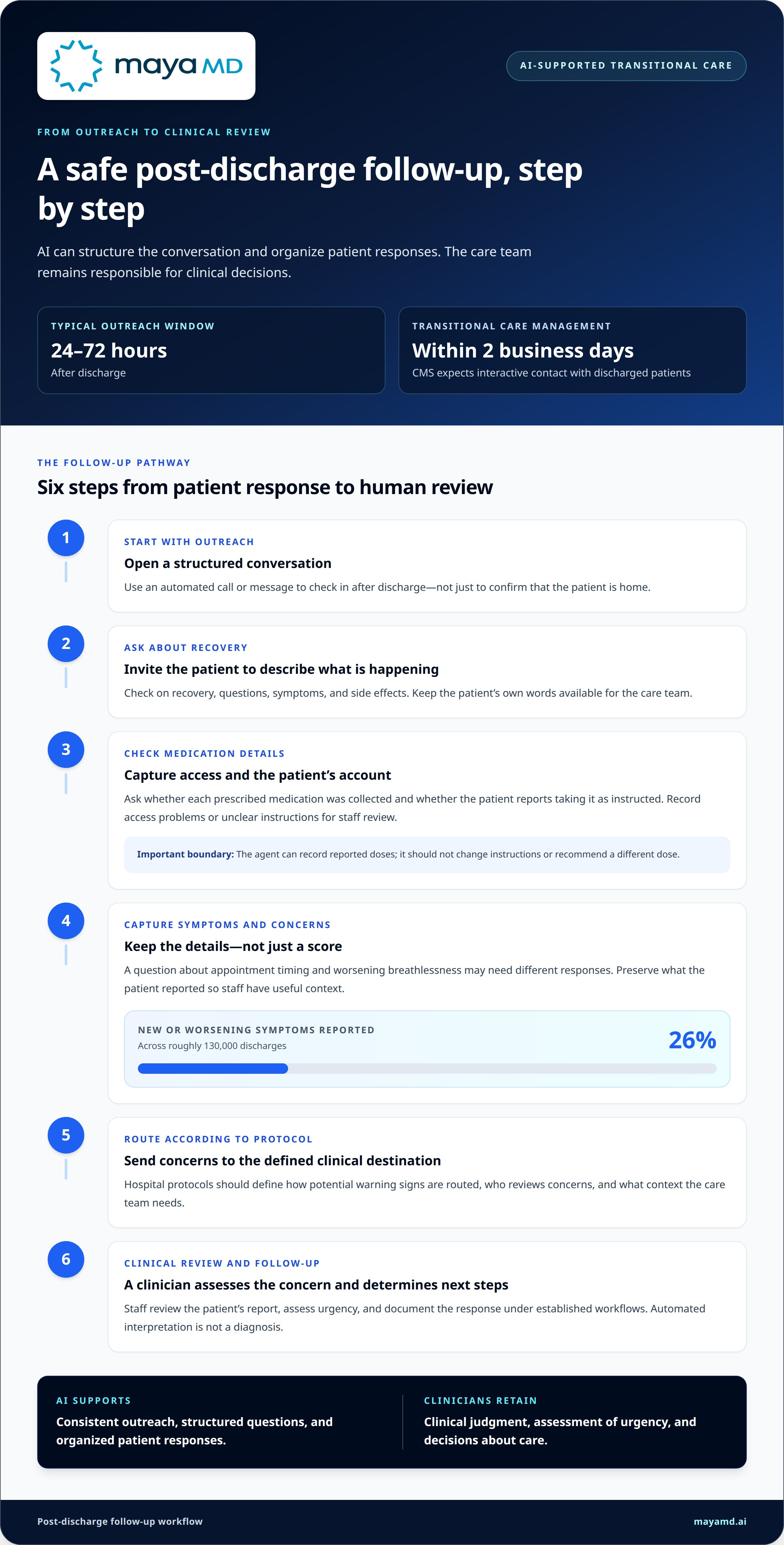
The first post-discharge call needs to do more than confirm that a patient is home. AI for post-discharge patient follow-up can support outreach within the typical 24 to 72 hours after discharge, asking about recovery, medication access, symptoms, and side effects while keeping clinicians central to decisions about care.
Hospitals know timely follow-up matters, but consistently reaching patients and identifying responses that need attention can be difficult at scale. AI patient-engagement tools can turn discharge information into clear, personalized follow-up conversations, helping patients understand next steps and keeping care teams connected between visits.
This article explains how AI agents support follow-up calls, medication and side-effect monitoring, and continuity of care after discharge. It also examines how escalation should work, why clinical judgment remains essential, and what hospitals should consider when evaluating an automated follow-up solution.
Key Takeaways
• AI voice agents can structure post-discharge conversations and surface urgent concerns for clinical staff, while clinicians retain responsibility for care decisions.
• Medication and side-effect check-ins can help care teams identify patient concerns that may need follow-up.
• Automated calls and messages can support consistent outreach after discharge and help organize patient responses for review.
• For transitional care management, the Centers for Medicare & Medicaid Services expects interactive contact with discharged patients within 2 business days.
• MayaMD’s automated post-discharge communication solutions support hospitals seeking to strengthen patient engagement and continuity of care.
Does an AI agent make clinical decisions?
AI can help patients understand discharge instructions and share concerns, but it does not replace clinical judgment. Hospitals should define how reported concerns reach care teams and who reviews them.
Escalation to Clinical Staff
Escalation begins with a defined response pathway. The agent gathers the patient’s words, identifies a potential warning sign, and routes the concern according to the hospital’s clinical protocols. For example, worsening breathlessness after discharge may require a different response from a question about appointment timing. Clear routing helps clinical staff distinguish urgent reports from routine follow-up needs.
Clinicians should define who reviews patient concerns, what context they need, and how the team records its response. A useful handoff preserves the patient’s reported words and relevant discharge information. This gives staff a practical starting point without presenting an automated interpretation as a diagnosis.
When a patient reports a concerning symptom, clinicians should review the details, assess urgency, and determine the next step under established workflows. AI can support communication by making patient responses available for review. It should not decide that someone is safe to wait or direct treatment without clinical oversight.
Comparing AI and Nurse-Led Calls
AI-supported follow-up and nurse-led care have complementary roles. Automated communication can deliver discharge instructions and invite patients to share questions, while nurses and case managers continue to interpret context and provide clinical follow-up. Automation can make outreach more consistent, but clinical responsibility stays with the care team.
Consider a patient who is unsure how to describe a concern. A plain-language follow-up conversation can help the patient explain what is unclear and make that response available to the care team. Staff can then ask further questions and decide whether assessment is needed. Helping surface a concern is not the same as evaluating its clinical significance.
Hospitals assessing AI for post-discharge patient follow-up should examine the handoff between automated conversations and human review. The process should make the original patient response available, identify the destination for escalation, and support documentation of follow-up. These workflow details help teams judge whether the system complements nurse-led care or creates extra review steps.
Clinician trust depends on clear responsibilities, relevant context, and appropriate limits on automation. Hospitals can walk through a sample discharge scenario, from sending instructions to reviewing a patient’s question and documenting the response. If the process helps patients understand next steps while keeping staff responsible for clinical decisions, AI is supporting care. It should never substitute for clinical assessment.
Medication adherence and side-effect monitoring
After discharge, medication questions often involve access, instructions, and unexpected symptoms. A structured follow-up workflow can capture these details and route concerns to the appropriate care team.
Adherence and Side-Effect Tracking
A follow-up conversation can ask whether the patient collected each prescribed medication and understands the discharge instructions. If a prescription wasn’t available, that access problem can be recorded for staff review. The agent can also ask what doses the patient reports taking, without changing instructions or advising a different dose.
Side-effect questions add important context. Across roughly 130,000 discharges, new or worsening symptoms were reported in 26% of patients. A patient reporting nausea after starting a medication, for example, can have that response documented and routed for clinical review.
Symptom and Medication Checks
Discussing medication questions alongside a patient’s other concerns gives the care team useful context. A patient who is unsure about an instruction may need clarification, while someone reporting a new symptom may need clinical review. Preserve what the patient said rather than reducing the conversation to a single adherence score.
Useful prompts follow the discharge plan and capture the patient’s own account. The system can record whether medication was collected, whether the patient reports taking it as instructed, and whether a new concern has appeared. If an answer raises concern, the established escalation process should direct it to clinical staff. An automated interaction should not diagnose a side effect or recommend stopping treatment.
Medication questions can reflect practical difficulties at home, confusion about instructions, or an unexpected symptom. Each concern may need a different response: staff can clarify an instruction, while a possible adverse effect may need clinical assessment. Capturing the patient’s specific question helps the team respond appropriately.
Patients may also have questions about prescribed medical equipment or how to follow related instructions. A follow-up conversation can capture what the patient reports and share it with staff. The system should not attempt a repair or substitute its own instructions for the care team’s guidance.
For chronic-care transitions, remote patient monitoring for chronic care management can complement communication by connecting ongoing monitoring with patient engagement. Hospitals planning medication and symptom check-ins can discuss post-discharge monitoring workflows suited to their care-team processes.
Post-Discharge Follow-Up Calls: How AI Voice Agents Automate Patient Outreach?
AI voice agents can automate structured calls and messages while recording patient responses for care-team review. Follow-up calls typically take place within 24 to 72 hours after discharge, when patients may need help understanding next steps at home.
Platform costs depend on the case and are provided after a quote request. The scope of outreach, call and message workflows, and integration requirements can shape the work involved.
A hospital follow-up workflow begins with the discharge information and outreach plan. The team defines which patients receive calls, what each conversation should cover, and how responses move to staff. A call might ask whether a patient understands the next appointment, has obtained prescribed medication, or needs help with a discharge instruction. These prompts make automated outreach purposeful rather than a generic check-in.
During an AI voice call, the agent guides the patient through a structured conversation and records the answers. If a patient says an appointment is missing, for example, the response can be routed for review under the hospital’s workflow. The agent can also capture that the patient has no questions, keeping the interaction available for continuity rather than relying on an undocumented call attempt.
A secure web link lets patients access their personalized conversation on a phone or computer, without downloading an app. The conversation should match the patient’s needs and explain how to get help with questions. When a patient reports a concern that needs clinical attention, the care team remains responsible for follow-up.
Repeated check-ins add context over time. A multi-call workflow can maintain conversation context across the 30-day post-discharge period, allowing later outreach to build on earlier responses. For instance, an agent can record that a patient previously reported difficulty following instructions, then revisit whether that issue remains unresolved. Staff can review the record and determine whether further action is appropriate.
Follow-up should also account for patients who do not engage with the conversation or leave a question unanswered. The workflow can record the outcome and help the care team identify where additional outreach is needed, rather than treating every contact as a completed check-in. Clear records help staff distinguish a completed conversation from a need that remains open.
Before implementation, hospitals can map the sequence from discharge list to completed call, recorded response, and staff action. Defining that pathway helps align agents with existing responsibilities and prevents automated outreach from becoming a separate, disconnected record. Hospitals planning these workflows can discuss automated outreach requirements with the care-team process in view.
Readmission prevention and continuity of care
Reducing readmissions depends in part on clear discharge communication and patients understanding what to do next. AI can help deliver personalized instructions and maintain communication after discharge, while the care team remains responsible for reviewing concerns and directing care.
For transitional care management, the Centers for Medicare & Medicaid Services expects an interactive contact with discharged patients within 2 business days. This makes the initial contact window a practical workflow consideration. The conversation can identify unresolved needs, such as a patient unsure about a follow-up appointment or unable to describe the next step in their care plan.
Appointment capture turns that conversation into a trackable transition task. A follow-up process can record whether an appointment is scheduled, whether the patient knows its timing, and whether a reported obstacle needs staff attention. For example, if a patient says they haven’t received appointment details, the care team can review that response and determine the appropriate action. Recording the outcome helps distinguish a confirmed appointment from an unresolved scheduling issue.
An admission, discharge, and transfer event, often called an ADT event, can serve as a trigger for creating a post-discharge care plan. The event identifies a transition that needs follow-up. A workflow can then associate the patient with relevant outreach and tasks, such as contact, appointment tracking, or review of a reported concern. The plan should reflect the information available to the hospital and the established responsibilities of its care team.
A clear follow-up process distinguishes between information delivered and questions that still need attention. Sending instructions alone does not show that a patient understands them. The workflow should help staff identify unanswered questions, concerns shared by the patient, and any follow-up that remains outstanding.
Continuity also requires attention beyond the first conversation. The first 30 days after discharge are a period when small problems can develop into readmissions. A care plan can keep follow-up tasks visible through that period, while staff review symptoms, appointment status, and barriers reported by patients. In 2018, the 30-day readmission rate for U.S. hospital discharges was 14%. That figure underscores why transitions need coordinated follow-through, not only an initial outreach attempt.
Hospitals can assess a transition workflow by tracing one discharge from the ADT event through contact, appointment capture, task assignment, and closure. Each step should have a defined owner and a visible status, so unresolved needs reach the right team. This connected approach to hospital-to-home transitions helps teams organize follow-up around the patient’s next care needs.
Clinician trust and clinical judgment
Clinicians need to understand how an AI follow-up system supports, rather than replaces, their judgment. Successful implementation depends on workflow integration and staff trust in that supporting role. A practical starting point is mapping how one patient response moves from conversation to review, then to a documented care-team decision.
Define responsibilities before introducing automated patient communication into hospital workflows. Specify who reviews questions that need follow-up and where the team records its response. Clear ownership helps prevent a patient concern from being overlooked. The process should connect each concern to an established care-team role.
Clinicians need access to the patient’s actual question and relevant discharge context, not just a label. If a patient says an instruction is unclear, the care team can see what needs clarification and respond accordingly. Preserving the patient’s words helps staff make an independent assessment.
Before deployment, teams can test the workflow with representative scenarios. Include a routine question, an ambiguous answer, and a response that should reach clinical staff. Trace each scenario through the connected process: what the system captures, where it routes the information, and what the clinician sees. This exercise can expose confusing handoffs before they affect daily use.
Feedback from clinicians should shape refinements to prompts and routing rules. If staff repeatedly find a particular alert lacks context, the team can examine which question or handoff needs improvement. Changes should follow an agreed review process, so updates remain consistent with clinical workflows. This makes integration an ongoing operational responsibility, not simply a technical connection completed at launch.
Staff should understand the limits of automated communication. A patient’s question can prompt review, but it does not establish a diagnosis or determine treatment. Teams can practice responding to a patient who needs clarification, using the original discharge information and established clinical processes to guide the next step.
Hospitals can monitor whether the workflow functions as intended by reviewing sample interactions and unresolved handoffs. Teams can examine whether alerts reach the assigned role, whether staff can understand the patient’s response, and whether the next action is recorded. These operational checks assess system fit without treating automation as a measure of clinical quality or patient outcome. Beyond internal reviews, healthcare organizations must also align new service delivery pathways with formal governance standards; for providers in England, CQC Consultancy supports healthcare services in meeting Care Quality Commission compliance and registration requirements.
To align AI follow-up with clinician workflows, discuss your integration and clinical review needs.
MayaMD
MayaMD helps hospitals communicate with patients after discharge through AI patient engagement. The care team sends a discharge summary by secure email; Maya creates a personalized, plain-language conversation that patients open through a secure web link. Teach-back helps confirm understanding, and patient questions can remain connected to the care team. Hospitals evaluating AI for post-discharge patient follow-up can consider this approach to support clearer instructions and continuity of care, with nurses and case managers retaining their existing roles.
To discuss how MayaMD can support your post-discharge follow-up workflow, contact MayaMD.
Build a Follow-Up Model That Fits Your Hospital
The next step is to define how patient communication should fit your hospital’s discharge workflow. Consider what information patients need, how they can ask questions, and how care teams will follow up. MayaMD’s discharge solution starts with a discharge summary sent by secure email and creates a personalized conversation patients can access through a secure web link.
MayaMD offers MayaRED discharge for patient communication after discharge, ASC and outpatient instructions, and remote care solutions that support ongoing care at home. For hospitals, MayaRED discharge turns existing discharge information into a personalized, plain-language conversation, with teach-back to confirm understanding.
Discuss your hospital’s patient follow-up needs with MayaMD and identify a useful next step for your care model. A deliberate, clinician-centered approach can help your team move forward with clarity.
Frequently Asked Questions
What Should a Post-Discharge Follow-Up Call Cover?
A useful follow-up conversation helps patients understand what to do next and gives them a chance to ask questions. Alongside discharge instructions, clarify whether follow-up details are understandable and whether anything is making the plan difficult to follow. For example, a patient may know an appointment is needed but be unsure about the details. Sharing that specific question helps staff respond.
Who decides when a patient needs a clinician?
The hospital’s clinical team sets the escalation criteria and decides how staff respond to flagged concerns. An AI system can identify an answer that matches the hospital’s configured warning signs, but it shouldn’t independently diagnose or determine treatment. For example, the workflow can route a patient’s reported symptom and relevant conversation context to the responsible team. A clinician then evaluates the report and decides the appropriate next step.
What is AI-powered post-discharge patient follow-up?
AI-powered post-discharge patient follow-up uses automated conversations to maintain communication after a hospital stay. An agent can ask structured questions, capture patient responses, and direct information into a review process. This differs from a one-way reminder because the patient can provide answers or raise concerns. The system supports outreach and organization; care teams remain responsible for clinical assessment, advice, and decisions about individual patients.
How should hospitals choose an AI tool or provider to automate post-discharge calls, texts, and symptom monitoring?
Hospitals should assess how a tool handles patient responses, urgent concerns, accessibility, privacy, and staff review. Consider whether the system can preserve the patient’s own account and route issues through existing workflows. MayaMD’s patient engagement uses a secure web link patients can open on a phone or computer. Its workflow starts with a discharge summary sent by secure email, without requiring EHR integration to begin.
How do providers implement AI patient follow-up after discharge for hospitals?
Implementation starts by defining which patients need follow-up, what information to share, and how staff will respond to questions. With MayaMD, the care team sends discharge instructions through secure email, and Maya generates a personalized conversation for the patient to open through a secure web link. Teach-back helps confirm understanding. Nurses and case managers retain their existing roles, including reviewing concerns and providing clinical follow-up.
What evidence shows AI follow-up reduces readmissions or improves outcomes?
Evidence should be interpreted according to its design and setting. MayaMD reports preliminary data from Spring Valley Hospital showing 43% lower 30-day readmissions among heart-failure patients versus matched controls. Separately, a 2021 JAMA Network Open meta-analysis of 60 randomized controlled trials found better discharge communication associated with a relative risk of 0.69 for readmissions. These findings concern discharge communication and should not be treated as a guarantee for every program.
What HIPAA and FDA rules apply to AI patient follow-up in the United States?
Hospitals should assess HIPAA privacy and security requirements for patient information and whether an AI tool’s intended functions raise FDA medical-device considerations. These questions concern distinct issues: protecting health information and evaluating the software’s clinical function. MayaMD describes its platform as HIPAA-compliant, but that does not establish FDA approval or clearance. For digital health developers and healthcare technology teams navigating these frameworks, advisory firms like APS Compliance Consultants Inc. offer guidance on FDA validation and regulatory compliance. Hospitals should base their review on the specific system, its use, and applicable requirements.
What privacy, safety, and bias risks come with AI post-discharge follow-up?
Risks include exposure of sensitive information, missed or misunderstood symptoms, and unequal performance across patients with different communication needs. A patient may describe a concern in unfamiliar terms or have difficulty using a digital channel. Hospitals can address these risks through controlled access, clear escalation pathways, staff review, and monitoring for patterns in incomplete or misinterpreted interactions. Human oversight remains essential for safety-critical decisions.




See The MayaMD Difference
Fill the form below
Download Our Apps
MayaMD for patients and MayaPro for physicians - available on iOS and Android.
FOR PATIENTS
MayaMD App
AI-powered symptom assessment, triage, and secure access to your care team.

FOR PHYSICIANS
MayaPro App
MayaPro brings patient vitals, RPM/PCM care plans, and clinical decision support to your pocket.