
AI for Identifying At-Risk Patients Sooner: Key Signals

The challenge isn’t simply detecting risk; it’s helping care teams recognize which patients may need attention first. AI for identifying at-risk patients sooner can surface patterns linked to sepsis, heart failure, kidney deterioration, cancer progression, and future hospital encounters, giving clinicians another signal to consider alongside their own assessment.
Earlier alerts can support timely prioritization, but they are useful only when they fit a clear clinical workflow. Teams need to understand which signals a model evaluates, how its risk output should guide follow-up, and whether they have capacity to respond to the patients it identifies.
This article explains how AI can detect changing risk patterns, which signals may matter across different conditions, and how prediction can support patient prioritization. It also looks at the human oversight and follow-up planning needed to connect an AI-generated alert with appropriate care.
Key Takeaways
• Risk models can help identify patients who may need support before an acute hospital encounter, but a risk score is a prioritization signal, not a diagnosis.
• Sepsis alerts are most useful when they bring changing clinical signals to a care team that can assess and respond to them.
• AI-generated flags can help organize follow-up, but workflow capacity and clear clinical ownership matter as much as detection.
• Signals from imaging, tests, and patient data may support earlier follow-up for heart failure, kidney deterioration, and cancer progression.
• Assess performance through measures such as risk calibration, detection of meaningful deterioration, and whether alerts lead to appropriate action.
AI-based prediction of future acute hospital encounters
AI for identifying at-risk patients sooner can help care teams prioritize patients who may need follow-up before an acute hospital encounter. Its value depends on defining the outcome, prediction window, and clinical response to the resulting risk signal.
Predicting Acute Encounters from Clinical Records
Predictive AI analyzes patterns across integrated clinical records to estimate a patient’s likelihood of a future acute hospital encounter. Depending on the model, records can include diagnoses, prior utilization, test results, and care history. AI for identifying at-risk patients sooner can help surface risk patterns across these records, rather than relying only on a recent visit or isolated data point.
The UCLA Population Risk Model defined at-risk patients as those with a predicted risk greater than 35% of an acute hospital encounter within the next 12 months. That threshold illustrates how a model can turn a broad aim, anticipating future hospital use, into a defined population for care prioritization. It is a model-specific criterion, not a universal cutoff.
How much do AI patient risk prediction platforms cost? There is no single standard price. Costs depend on factors such as the platform’s scope, data integration requirements, and intended clinical workflows.
Which hospitals and health systems use AI to identify at-risk patients? UCLA Health studied risk prediction among adults receiving primary care at 48 clinics. RWJBarnabas Health also implemented an AI-enabled early warning system across 11 hospitals.
Evaluating Prediction Accuracy and Performance
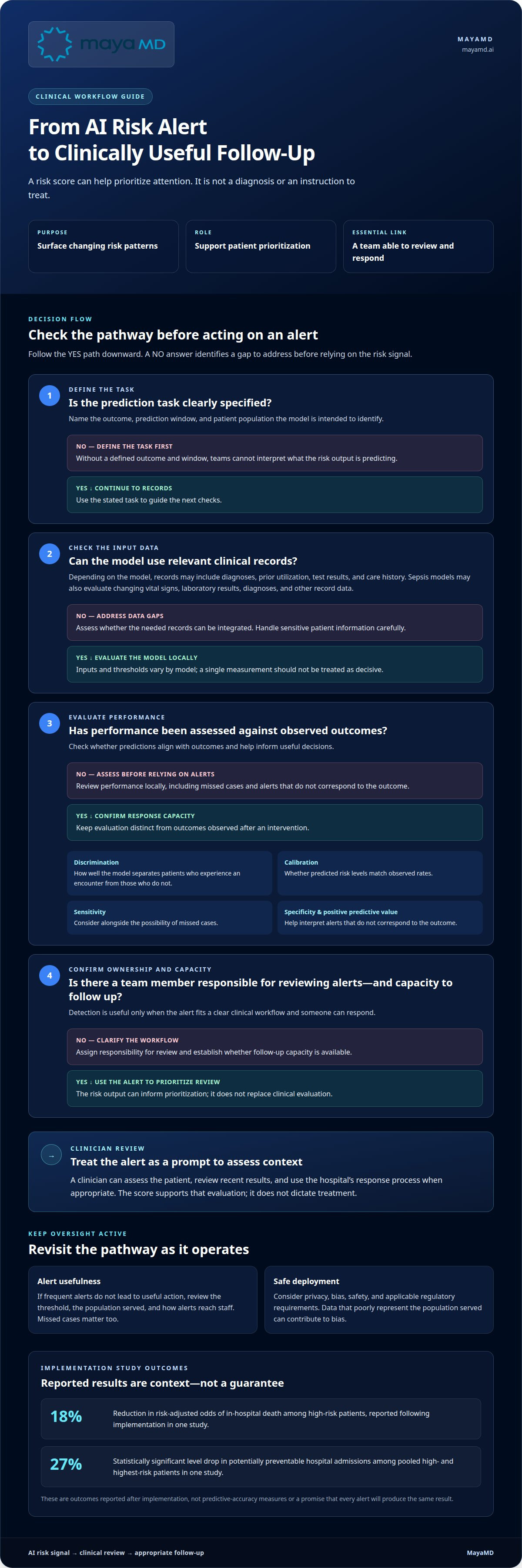
Performance evaluation measures whether predictions align with observed outcomes and support useful decisions. Discrimination shows how well a model separates patients who experience an encounter from those who do not; calibration assesses whether predicted risk levels match observed rates. Teams can also examine sensitivity, specificity, and positive predictive value to understand missed cases and alerts that do not correspond to the outcome.
UCLA Health’s primary analysis included 3,007 unique high- and highest-risk patients. Hospital admissions among the rising-risk subgroup decreased by 30%, with a statistically significant level drop; across all admissions, the study observed a nonsignificant 19% level reduction. These are study outcomes, not measures of predictive accuracy. Evaluation should distinguish model performance from changes following an intervention.
Implementing Risk Prediction in Healthcare
Implementation connects a defined prediction task to clinical records, review processes, and follow-up capacity. A health system first specifies the outcome and patient population, then checks whether relevant records can be integrated. Next, it evaluates the model locally, assigns responsibility for reviewing alerts, and tracks whether flagged patients receive appropriate follow-up. These steps help put predictions into practice.
UCLA Health assigned clinic groups to one of four intervention rollout waves. This phased approach offers a practical example of introducing risk-based workflows across a health system while assessing how they operate.
Privacy, bias, safety, and regulatory concerns shape deployment. Integrated records require careful handling because they bring together sensitive patient information. Bias can arise when data poorly represent the population served, while false alerts or missed deterioration can affect care decisions. Clear clinical oversight, ongoing performance review, and assessment of applicable regulatory requirements should accompany deployment.
AI-assisted sepsis risk stratification
Sepsis risk models analyze clinical signals to help identify patients who may need prompt assessment. Their role is to support, not replace, clinical evaluation: a score can prioritize attention, while clinicians assess the patient and decide what action is appropriate.
A model may combine changing vital signs, laboratory results, diagnoses, and other data in clinical records. Rather than treating one measurement as decisive, it can identify a pattern that raises concern, such as worsening observations alongside results suggesting infection. Inputs and thresholds vary by model, so care teams need to understand what an alert represents and how it fits their workflow.
Evidence from implementation studies shows why outcomes require careful interpretation. Following implementation, one study reported an 18% reduction in the risk-adjusted odds of in-hospital death among high-risk patients. Among pooled high- and highest-risk patients, the intervention was associated with a statistically significant 27% level drop in potentially preventable hospital admissions. These findings describe outcomes after implementation, not a guarantee that every alert will lead to the same result.
For a clinician, an alert is a prompt to assess context, not an instruction to treat. A patient with concerning changes may need bedside evaluation, review of recent results, or escalation through the hospital’s response process. If a model produces frequent alerts that do not lead to useful action, teams can review its threshold, the population it serves, and how alerts reach staff. Missed cases matter too: a model that rarely alerts may fail to surface deterioration in time for review.
A 2025 review on AI-driven early sepsis detection and tailored therapies appeared in Critical Care, volume 29, issue 1, article 366. Its focus reflects two connected questions: whether a system can identify risk early enough to inform assessment, and whether the information can support decisions suited to the patient. Local evaluation should therefore examine both alert performance and the clinical response that follows.
No single FDA rule applies to every AI risk tool; applicable oversight depends on its intended use, functionality, and claims. Health systems also need to assess privacy, security, and safety obligations for the data and workflow involved, without assuming one classification or safeguard covers every deployment.
For teams shaping sepsis alerts into a patient triage workflow, discuss clinical AI use cases as a way to consider how risk signals can connect with assessment and follow-up.
That need for careful local evaluation is especially relevant in the Asia-Pacific region, where sepsis mortality rates can reach 35%. Between 120 and 1,600 people per 100,000 are affected by sepsis in the Asia-Pacific region. Among patients hospitalized in the Asia-Pacific region, 15 per 1,000 develop sepsis as a complication of receiving healthcare.
These figures underscore why teams should consider which populations and care settings are represented when assessing a risk tool. Local review can show whether alerts support timely clinical assessment and whether the response process is workable. Risk estimates should remain prompts for professional judgment, with attention to the patient’s condition and the context of the alert.
Clinical workforce support and patient prioritization
AI can help organize clinical attention by ranking patients according to predicted need. Its operational value depends on what happens after a flag: staff must be able to review the signal, assess the patient, and arrange suitable follow-up. Stanford Health Care advises evaluating the full care workflow and downstream capacity before deploying a tool that identifies patients for follow-up.
Alerts should direct attention, not create another queue that nobody can manage. A model might flag a patient whose clinical data suggest deterioration, but a clinician still needs to interpret the alert and decide what action is appropriate. For example, a patient losing fluids may need a clinician to assess the change and administer fluids. The system’s role is to surface the signal, not deliver the intervention.
Implementation findings show how AI can affect response patterns. At RWJBarnabas Health, rapid response team activations among high-risk patients increased from 25.3 percent to 37.5 percent of hospital stays following implementation. That change indicates more activations, not by itself whether each activation was necessary or improved an outcome. Teams need to interpret alert volume alongside clinical appropriateness and the resources required to respond.
Follow-up capacity is part of prioritization. Stanford Health Care’s senior vice president and chief information and digital officer cautioned against introducing AI screening without enough downstream appointments for identified patients. A system that detects an imaging concern, for instance, can create demand for additional tests and consultations. Planning must account for appointment access and wait processes, so an alert leads to a realistic next step rather than an unserved referral.
AI can also support retrospective case finding. At Jefferson Health in Philadelphia, neurorestoration staff used AI to review MRIs from the past year for potential neurological conditions and flag patients for follow-up. Unlike real-time monitoring, this approach helps staff locate people who may benefit from later review, while clinicians determine the appropriate care pathway.
Human oversight needs a defined operational design. Penn Medicine’s chief health information officer said relying on people to monitor algorithms is not sustainable, citing limits on vigilance and healthcare staffing. The World Health Organization predicts a global shortage of 11 million healthcare workers by 2030, reinforcing the importance of assigning clear alert ownership rather than expecting continuous manual surveillance.
Route
Assign each alert type to a clinical role or response team.
Prioritize
Define how urgency and available appointment capacity shape follow-up order.
Review
Track alert volume, response patterns, and whether flagged patients receive appropriate next steps.
Early warning for heart failure, kidney deterioration, and cancer progression
AI can combine clinical data over time to flag changes that may warrant follow-up. For heart failure, kidney deterioration, or cancer progression, its practical value depends on connecting a signal to an appropriate clinical assessment.
Early Alerts for Disease Progression
AI-based early warning uses patterns in patient data to identify possible disease progression before a care team would otherwise review it. For heart failure, kidney deterioration, and cancer, this can direct attention to changes that may call for testing or follow-up. The signal supports prioritization; it does not establish a diagnosis or replace clinical interpretation.
For example, AI tools that identify risk in CT scans or EKGs can prompt follow-up testing, such as an ultrasound or echocardiogram. That next step requires planning: teams need to account for appointment availability and wait processes so a flagged finding can lead to timely assessment.
Different conditions call for different follow-up pathways. A heart-related signal from an EKG may lead to an echocardiogram, while a kidney-risk alert may prompt a review of relevant clinical records and testing. For cancer progression, a change in imaging or other available data may signal a need for clinician review. The model’s output should make clear what concern it flags and what information supports the signal.
Comparing AI with Traditional Warning Scores
Traditional early warning scores typically apply defined rules to current observations, while AI models can analyze patterns across multiple data points. This distinction matters because a score based on one assessment may not reflect a trend visible across a patient’s record. The usefulness of either approach, however, depends on the signal, its clinical context, and the response workflow.
For instance, a traditional score may highlight concerning observations during a hospital assessment. An AI tool may also identify a developing pattern in CT scans or EKGs, prompting further testing. Neither approach makes the clinical decision. Teams need to understand how the tool generates a flag, what it can miss, and how clinicians incorporate it into patient assessment.
Clinical Outcomes from Risk Prediction
Clinical outcomes reported after AI implementation include changes in mortality, hospital admissions, and escalation of care. Among high-risk patients in one study, deaths fell from 23.1 percent to 18.6 percent after implementation of an AI-enabled early warning system. This observed change describes that study’s results, not a guaranteed outcome across hospitals or patient groups.
Interpret outcomes in light of the model’s purpose and the actions it triggers. A tool intended to identify deterioration should be evaluated using relevant measures, such as whether flagged patients receive assessment and whether care teams can arrange indicated testing. For a CT or EKG finding, follow-up access matters: a signal cannot prompt useful clinical review if the next appointment or test is inaccessible.
AI risk prediction can complement established warning scores by surfacing patterns across data and directing attention to possible next steps. Hospitals should assess performance in their own workflows, including whether alerts lead to appropriate follow-up and how outcomes change after implementation.
AI Accuracy and Performance for At-Risk Patients
There is no single accuracy figure that applies to every clinical AI model. Performance depends on the target outcome, patient population, prediction window, and threshold for triggering review. For example, a model predicting hospital encounters should be evaluated against that outcome and timeframe, not a broader claim of clinical accuracy.
Start with the decision the model is meant to support. A tool used to prioritize follow-up should be assessed on whether it identifies patients who later experience the defined outcome and how many alerts require review. High overall accuracy can conceal missed high-risk patients when the outcome is uncommon. The useful question is whether the model’s errors and alert volume fit the intended clinical workflow.
Several measures clarify different performance dimensions:
Sensitivity
Among patients who experience the outcome, how many did the model flag?
Specificity
Among those who do not experience it, how many did the model correctly leave unflagged?
Positive predictive value
Among flagged patients, how many experience the defined outcome?
Calibration
Do predicted risk levels align with observed outcome rates?
Discrimination
Can the model rank patients with outcomes above those without them?
These measures can point in different directions. Lowering an alert threshold may capture more patients who later deteriorate, while also sending more alerts for clinical review. A hospital should examine sensitivity alongside positive predictive value and the team’s capacity to assess flagged cases. An alert that arrives without enough time or context for action may have limited practical value, even if the model ranks risk effectively.
Validation should reflect the setting where the model will be used. A health system can compare predictions with subsequent outcomes in a separate patient group, then assess performance prospectively within its workflow. Review should include relevant patient subgroups, since uneven performance can affect who receives attention. Results from another institution or population may not translate directly to local care.
Performance also needs monitoring after deployment. Changes in documentation, patient mix, clinical practice, or data availability can alter model inputs and the meaning of its output. Teams can track calibration, missed cases, alert volume, and downstream actions, then investigate material changes. A defined review process helps distinguish a genuine shift in risk from a change in how information enters the record.
For an assessment of how clinical AI could support patient prioritization, discuss your clinical AI use case.
MayaMD
MayaMD can support care teams working to connect patient communication with ongoing care workflows. Its Clinical AI Agent, AI patient engagement solutions, and automated post-discharge communication solutions can help address needs such as patient engagement and continuity after a hospital stay. These offerings are relevant when teams are considering how to maintain communication and follow-up alongside risk prioritization.
AI-generated signals still require clinical assessment and an appropriate care pathway. To discuss how MayaMD’s solutions may fit your patient engagement and follow-up needs, contact MayaMD.
Make the Next Step Clinically Meaningful
A well-governed approach to AI for identifying at-risk patients sooner begins with a practical decision: which patient needs attention, and what can the care team do next? The strongest approach connects prediction to clear clinical ownership, workable follow-up, and ongoing review of how alerts affect care. This helps teams move from model evaluation toward an operational plan grounded in their priorities.
Start with the care process you want to strengthen. Define how a risk signal should reach the appropriate team, how staff will assess it, and how follow-up will fit existing capacity. Keep the patient experience central: technology should help care teams respond with greater coordination, not create another disconnected step.
MayaMD can discuss how its healthcare AI solutions may align with your patient care and engagement goals. Contact MayaMD to discuss AI, and take a considered next step toward more connected care.
Frequently Asked Questions
How does AI identify patients at risk of deterioration or readmission?
AI estimates risk by finding patterns in patient records associated with a defined outcome and prediction window. For deterioration, a model may evaluate changing observations and test results; for readmission, it can assess records related to prior care and hospital encounters. Teams should interpret the result in relation to the model’s intended outcome, using it to prioritize clinical review rather than treating a score as a diagnosis.
Which AI models and data sources are used for early patient risk prediction?
Early risk prediction can use statistical or machine-learning models, selected to suit the clinical outcome and available data. Sources may include electronic health records, encounter history, vital signs, laboratory results, and imaging such as CT scans or EKGs. A model’s inputs should match its purpose: for example, a tool assessing imaging-related risk needs relevant imaging data and a defined process for reviewing flagged findings.




See The MayaMD Difference
Fill the form below
Download Our Apps
MayaMD for patients and MayaPro for physicians - available on iOS and Android.
FOR PATIENTS
MayaMD App
AI-powered symptom assessment, triage, and secure access to your care team.


FOR PHYSICIANS
MayaPro App
MayaPro brings patient vitals, RPM/PCM care plans, and clinical decision support to your pocket.