
AI for Healthcare Without a Data Scientist: Practical Uses

A shortage of data scientists doesn't have to put healthcare AI on hold. AI for healthcare without a data scientist is practical when teams begin with focused applications, such as automating administrative tasks or supporting clinical planning, rather than building custom models from scratch.
For healthcare leaders already managing staffing constraints, adding a complex technical program can feel out of reach. The more workable approach is to identify a specific workflow problem, choose an appropriate AI capability, and plan for clinical oversight and integration from the start. AI can support a process, but it should fit the way care teams work.
This article explains where AI can reduce administrative workload, how it can inform clinical planning, and what readiness involves. It also outlines how healthcare organizations can evaluate use cases and guide implementation without relying on an in-house data scientist, while keeping patient needs, workflow fit, and responsible oversight central to the decision.
Key Takeaways
• Prioritize repetitive administrative workflows, such as scheduling, billing, and documentation, where automation can reduce manual work.
• Explore how AI can surface potential mental health concerns, support triage, and inform treatment planning while keeping clinical judgment central.
• Build implementation around a defined workflow need, appropriate oversight, and attention to bias in data and model outputs.
• Use readiness as a practical starting point: Cisco's survey found that 97% of health leaders considered AI essential to their organizations' future, while 14% said their organizations were equipped to deploy it effectively.
• Staffing shortages don't rule out adoption; a focused use case and suitable existing AI capabilities can help teams begin without building custom models in-house.
Administrative workload reduction
In the United States, the Health Insurance Portability and Accountability Act (HIPAA) requires organizations to protect patient information’s privacy and security. In 2015, the U.S. Office for Civil Rights issued rules and regulations protecting health information and requiring providers to follow privacy rules when using AI. The U.S. Food and Drug Administration published an AI/ML-based Software as a Medical Device Action Plan in January 2021.
Administrative automation is most useful when it targets a repeatable task with clear inputs and outputs. For example, an AI workflow can organize patient instructions or follow-up information so people can understand their next steps. Staff can then focus on questions and exceptions rather than repeating routine explanations.
Patient communication offers another defined use case. AI can turn existing care instructions into clear, personalized information and guide patients through it. The tool should support communication, not make consequential clinical decisions. Providers retain oversight, especially when a patient’s record or needs are unclear.
Documentation and discharge communication can also benefit from structured support. A tool can use existing discharge summaries or instructions to create a plain-language care conversation. The care team remains in place, reviewing and managing patient care while the tool helps explain next steps and confirm understanding.
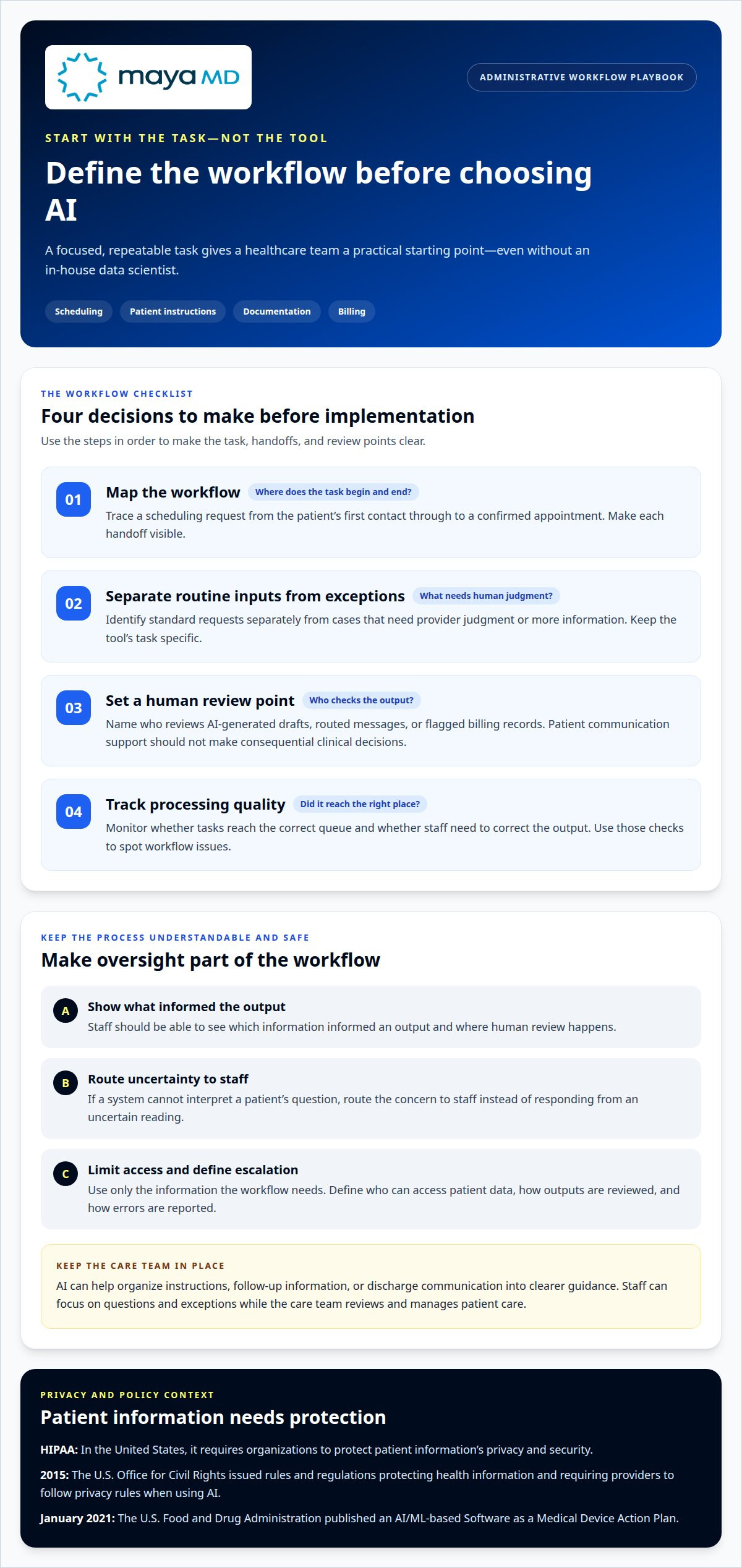
For organizations considering AI-supported communication, define the task before choosing a tool:
Map the workflow
Record how a scheduling request moves from patient contact to a confirmed appointment.
Identify routine inputs
Separate standard requests from cases requiring provider judgment or additional information.
Set a review point
Decide which person checks AI-generated drafts, routed messages, or flagged billing records.
Track processing quality
Monitor whether tasks reach the correct queue and whether staff must correct the output.
These steps make transparency operational. Staff should be able to see what information informed an output and where human review occurs. For instance, if a system cannot interpret a patient’s question, it should route the concern to staff rather than respond based on an uncertain reading.
Responsible implementation also means limiting information to what the workflow needs. Organizations should define who can access patient data, how outputs are reviewed, and how errors are reported. A clear escalation path helps providers address an inaccurate or concerning output before it affects a patient interaction.
Without an in-house data scientist, teams can begin with a focused communication workflow and their existing knowledge of care delivery. Operations staff can describe recurring delays, while clinicians identify decisions that must remain under their oversight. That collaboration gives an AI project a practical scope, clear review points, and a safer role in daily work, ensuring all records are stored and reviewed securely. The European Union classifies AI-enabled medical devices as high-risk AI systems. This classification highlights the importance of careful oversight when such systems are used, with clear human review of outputs and accountability for their use.
AI applications in diagnosis and treatment planning
AI can help clinicians organize signals from electronic health records and patient-reported information. For example, analysis may flag early signs associated with anxiety or depression. A flag is a prompt for clinical review, not a diagnosis. This distinction keeps the tool in a supporting role and helps providers interpret findings in context.
In a practical workflow, a system processes relevant records, identifies a pattern, and presents it for review. A clinician can then consider symptoms, history, and the patient’s account together. This can help teams notice information spread across records, especially when a patient reports changes between appointments. Clear presentation matters: clinicians need to understand which details informed a flag.
Treatment planning is another potential application. AI algorithms can predict how patients may respond to specific therapies, helping doctors tailor plans. A prediction can organize options for discussion, but it doesn’t replace clinical reasoning or the patient’s preferences. For example, a care team might use a predicted response alongside symptoms and prior treatment history when considering a plan.
Patient communication can also help direct concerns to an appropriate next step. A tool may organize a patient’s reported concerns and indicate when they need timely human attention. The workflow should make clear who reviews the information and how it reaches that person. Without a defined handoff, useful signals can remain disconnected from care.
Massachusetts General teams use AI-powered tools to improve diagnostic accuracy and develop personalized mental health care plans. This example illustrates how AI can support analysis and planning within clinical work. Its operational value depends on integration: outputs must reach the clinicians who can interpret them, at the point where they can inform care.
For teams assessing a use case, distinguish the task from the desired outcome:
Signal detection
Identify whether the tool flags patterns in records or patient-reported data.
Clinical interpretation
Define how providers review a flag alongside the full patient context.
Care coordination
Map how the result enters existing workflows and reaches the responsible team.
Outcome review
Assess whether the tool supports the intended decision without adding confusing steps.
These challenges are often workflow-driven, not model-driven. A technically capable system can still disrupt care if its alerts arrive in the wrong channel or lack useful context. Integration should therefore be evaluated against actual clinical tasks, such as reviewing a mental health concern or preparing a treatment discussion.
Transparency strengthens that evaluation. Clinicians need understandable reasons behind a flag or recommendation, while patients should know how their information supports care. Teams can begin with one bounded use case, such as organizing patient-reported concerns for review, and refine the process as they observe how it functions.
Organizations exploring AI-supported triage can discuss a clinical use case in the context of their existing care workflows.
AI implementation strategy for health care leaders
Healthcare leaders can begin implementation without building algorithms in-house. A defined workflow, appropriate safeguards, and clear human review give artificial intelligence a practical role in patient care.
HIPAA requires organizations to protect the privacy and security of patient information. Vendors handling protected health information may be asked to sign a business associate agreement (BAA), defining permitted data handling and safeguards; organizations should review those terms before sharing data.
Practical AI Adoption Without Data Scientists
No-code adoption means configuring an existing AI tool for a defined task rather than coding or managing a model. For a small practice, options include configurable assistants for patient messaging, documentation support, and triage workflows. These tools can support routine work while staff remain responsible for clinical decisions and exceptions.
Which tools integrate with common electronic health record systems? Integration varies by product and EHR, so leaders should identify the system and workflow the tool supports before implementation. A small practice can use AI without coding by selecting a task-specific service, defining staff review, and routing outputs through its existing process.
For implementation, map where information enters, who reviews an output, and how unresolved cases reach a clinician. For example, a patient communication workflow needs a clear handoff for concerns requiring clinical attention. This keeps the focus on the workflow, not on managing a model.
Costs for Small Practices
The cost of healthcare AI tools for small practices in the United States varies by tool and implementation scope; there is no single price that applies to every practice. Factors include the intended function, integration requirements, user access, support, and whether the service is priced by usage or subscription.
Leaders can assess value by comparing a tool’s cost with the staff time and workflow burden it is intended to address. A focused use case, such as improving discharge communication, makes that evaluation more concrete than adopting a broad system without a defined operational need.
Generative AI Risks and Limitations
Generative AI can produce inaccurate, incomplete, or misleading content, so clinicians should treat its output as a draft for review. It can also miss context in a patient’s history or produce different responses to similar prompts. Human review is essential before generated content informs clinical decisions.
What patient data can organizations safely enter into public AI tools? Use only information the organization has authorized for that tool and purpose; avoid identifiable patient details in public tools. De-identified or synthetic examples can support general tasks without exposing a patient’s record.
Before deployment, leaders should define permitted use, access, review, and escalation processes. Staff need a clear way to report errors, and providers need transparency about how an output was produced. These controls help organizations manage evolving tools while keeping clinical responsibility with qualified professionals.
Healthcare AI readiness
Readiness combines a clear use case, usable data, workflow fit, and accountable review. Cisco’s survey found that 97% of health leaders consider AI essential to their organizations’ future, while 14% said their organizations were equipped to deploy it effectively.
Preparing for AI Adoption
Healthcare AI readiness is an organization’s ability to adopt and oversee a tool within real clinical operations. It matters because successful adoption depends on more than software: staff, data, and workflows must support safe use.
For organizations pursuing AI for healthcare without a data scientist, a defined operational need can guide adoption. Start with one task, such as forecasting hospital admissions or organizing patient messages. Then identify who owns the process, which information the tool needs, and how its output reaches the responsible professional. Stanford Health Care uses predictive analytics to forecast patient admissions and plan staffing levels, illustrating how a clear objective can shape adoption.
Before implementation, map the existing process and its decision points. For example, a team improving discharge communication needs a clear route from the patient’s instructions to review and follow-up. Leaders can also identify data needs, workflow requirements, and staff responsibilities before introducing the tool. This makes readiness specific to the intended use, rather than treating AI as a single organization-wide project.
Evaluating Accuracy, Safety, and Bias
Evaluation means testing whether an AI tool produces useful, safe outputs for its intended users and setting. It matters because performance in one context may not reflect performance across different patients or workflows.
How can a healthcare provider evaluate accuracy, safety, and bias? Test the tool against representative cases, compare outputs with appropriate clinical review, and document errors and their consequences. Healthcare professionals can help reduce bias by overseeing data collection and promoting diverse training datasets.
For example, a team assessing a patient communication tool can review whether it consistently handles different types of questions appropriately. Include cases that reflect variation in language, concerns, and patient backgrounds. Track missed concerns, incorrect outputs, and content that requires correction. This gives clinicians specific evidence about where the tool supports care and where human review must intervene.
Safety review should also examine how an output enters patient care. A forecast that informs staffing has different consequences from an alert that influences an individual care decision. Leaders can assign reviewers, define escalation routes, and establish a process for reporting problems. These controls make oversight part of everyday practice, rather than a one-time approval.
Readiness changes as tools and workflows evolve. Review performance after implementation, collect feedback from professionals using the system, and revisit its intended role when the workflow changes. A hospital might reassess whether admission forecasts remain useful after staffing processes shift. This ongoing review helps leaders make adoption decisions based on observed performance and operational needs. For AI for healthcare without a data scientist, those reviews also help teams determine whether a focused tool remains appropriate as their needs evolve.
Shortages of data scientists and informaticists
When a health system lacks data scientists or informaticists, AI work can still advance by separating technical tasks from clinical and operational decisions. The key is to define who owns each task, from selecting an electronic health record workflow to reviewing its outputs.
A data scientist may develop or evaluate analytical models, while an informaticist connects clinical knowledge, information systems, and workflow design. Without either role available, leaders can start with a bounded use case that relies on an established tool rather than custom model development. For example, a care team might identify a recurring communication task that takes staff time.
Clinical professionals bring essential context to that process. They can explain which fields belong in a patient record, which results require review, and what makes an output useful during care. An operations lead can document current steps, while an IT lead assesses how information moves through the electronic health record. These defined contributions reduce dependence on one specialist.
Analytics still requires disciplined oversight. A team can use a practical review framework:
Define the task
Describe the workflow and the decision the tool will support.
Map information
Identify the record fields and data sources involved.
Assign responsibility
Name the person who reviews outputs and handles exceptions.
Track performance
Record errors, corrections, and workflow disruptions.
For example, a clinic evaluating an AI-generated care conversation can compare it with the source instructions and note omitted or inaccurate details. Clinicians judge whether it preserves relevant context; IT staff investigate whether information transferred correctly. This division helps the organization distinguish a workflow problem from a technical issue.
Leaders can also use established frameworks to structure evaluation. TRIPOD+AI, DECIDE-AI, and CONSORT-AI are international consensus-based reporting guidelines for reporting AI studies, depending on the study phase. These guidelines can help teams ask structured questions about evidence and evaluation, without requiring local staff to build an algorithm.
The practical takeaway is to secure access to the expertise each decision requires, rather than making every team member a technical specialist. A clinician can define acceptable clinical use, an operations lead can map the process, and IT can assess integration and data handling. For advanced analytics or custom development, specialist expertise remains important; a focused use of an existing tool is a more suitable starting point.
Discuss an AI workflow for your care team and identify where structured support could fit.
When specialist capacity is limited, organizations can make privacy review part of the same task ownership plan. In 2015, the U.S. Office for Civil Rights issued rules and regulations to protect individuals' health information and required healthcare providers to follow privacy rules when using AI. Teams should identify who checks that a proposed use handles health information appropriately and who can pause the work if concerns arise. This responsibility can be assigned alongside clinical review and technical assessment, rather than left implicit.
A small, clearly scoped project can also help leaders identify where outside expertise is needed, while keeping decisions about care and information handling with accountable staff. For leadership teams establishing structured oversight across complex technology initiatives, executive advisory resources from techaxisadvisors.com outline practical frameworks for AI governance and strategy alignment. Documenting questions, decisions, and unresolved risks makes it easier to seek targeted support without assuming every team member must become a data scientist or informaticist.
MayaMD: AI healthcare assistant
MayaMD provides AI patient engagement for transitions in care, helping teams communicate clear next steps without building custom models. The Clinical AI Agent supports patient engagement, while MayaRED discharge uses existing discharge summaries to create a personalized, plain-language care conversation with teach-back and follow-up support.
These capabilities suit organizations looking to strengthen discharge communication and continuity of care. They do not replace clinical judgment or the discharge team. Nurses and case managers continue their existing roles, with MayaMD supporting patient understanding and engagement between care settings.
To discuss how these tools could fit your organization’s workflows, contact MayaMD.
Make the Next Move Deliberate
For AI to become part of healthcare operations, the next decision is not simply which tool to adopt. It is which patient or staff experience the organization wants to improve, and how that improvement will be assessed over time. A focused objective gives clinical and operational teams a shared direction as capabilities and workflows evolve.
AI for healthcare without a data scientist can begin with solutions designed around defined care needs. MayaMD offers a Clinical AI Agent, AI patient engagement solutions, and automated post-discharge communication solutions. These capabilities can support communication and continuity while teams determine how AI should fit their care processes.
Choose a use case that aligns with an existing priority, then bring the relevant clinical and operational perspectives into the discussion. To explore how MayaMD can support discharge communication and patient engagement, contact the team at info@mayamd.ai.
Contact MayaMD about healthcare AI to discuss a potential fit for your organization.
Frequently Asked Questions
What steps should a medical practice follow to pilot and adopt AI without technical staff?
Choose one contained task, such as preparing plain-language follow-up instructions from an approved care plan. Define what a useful output must include and what errors would make it unsuitable. Assign a clinician to review each output during the pilot, and keep the existing process available if the tool is unavailable or produces incomplete content. Record corrections and staff feedback, then decide whether the workflow is ready to expand.




See The MayaMD Difference
Fill the form below
Download Our Apps
MayaMD for patients and MayaPro for physicians - available on iOS and Android.
FOR PATIENTS
MayaMD App
AI-powered symptom assessment, triage, and secure access to your care team.


FOR PHYSICIANS
MayaPro App
MayaPro brings patient vitals, RPM/PCM care plans, and clinical decision support to your pocket.