
AI Driven Care Coordination: The 2026 Framework for Clinical Excellence

The era of experimental digital health is over. As we approach 2026, the industry is moving past the hype of generative chatbots toward a governed, systematic framework that prioritizes clinical safety and operational precision. You've likely felt the strain of fragmented chronic care management, where the very tools meant to assist often contribute to physician burnout through endless documentation and unmanaged data streams. It's a frustrating paradox: technology has increased our reach but simultaneously thinned the connection between provider and patient.
This article details how modern AI driven care coordination effectively bridges this gap by merging deterministic clinical logic with generative empathy. You'll discover a scalable model designed to eliminate administrative burdens while ensuring the accuracy of clinical documentation in APCM and PCM programs. We will examine the architecture of this 2026 framework, showing how a Clinical AI Agent can stabilize Remote Patient Monitoring (RPM) workflows without overwhelming your staff or risking the hallucinations common in ungoverned systems. By the end, you'll understand how to transform disparate data points into a cohesive, patient-centered ecosystem that drives measurable adherence and clinical excellence.
Key Takeaways
• Clinical workflows are evolving from reactive, alert-based monitoring toward a model of proactive, continuous patient engagement.
• You'll discover how AI driven care coordination utilizes deterministic logic to establish a hallucination-free framework that meets 2026 safety standards.
• Automated longitudinal tracking facilitates the seamless transition to Advanced Primary Care Management (APCM) and improves billing accuracy.
• Strategic automation of clinical documentation and post-discharge communication directly mitigates physician burnout while reducing readmission risks.
• Integrating a Clinical AI Agent into enterprise ecosystems ensures that advanced data science remains governed, secure, and clinically valid.
Defining AI Driven Care Coordination for 2026 Clinical Workflows
AI driven care coordination represents a fundamental shift in how health systems manage high-risk patient populations. It is the systematic deployment of clinical agents to oversee patient transitions, continuous monitoring, and the complex requirements of medical documentation. By 2026, the industry is transitioning away from reactive, alert-based models that often lead to alarm fatigue. Instead, a governed, proactive framework ensures that care is continuous rather than episodic. This evolution is driven by the need for real-time data synthesis, where 2026 standards prioritize interoperability over the static, siloed records of the past decade. This approach effectively bridges the gap between remote patient monitoring (RPM) and meaningful clinical intervention, ensuring that data leads to action.
The Evolution from Digital Records to Autonomous Agents
Traditional EHRs were designed as repositories for billing and history, not as active participants in the care journey. They often fail to provide the dynamic insights needed for effective advanced primary care management. The emergence of the Clinical AI Agent marks a new phase in artificial intelligence in healthcare, where software operates as a trusted extension of the clinical team. AI driven care coordination serves as a force multiplier for clinician capacity by automating the cognitive load associated with routine patient oversight and data entry. This capability allows physicians to focus on complex decision-making while the AI handles the longitudinal tracking essential for chronic disease management.
Key Components of a Modern Coordination Ecosystem
A robust coordination framework must integrate patient-generated health data (PGHD) directly into clinical logic to be effective. This integration ensures that readings from monitoring devices aren't just isolated numbers but are contextualized within the patient's broader clinical profile. To maintain safety and trust, these ecosystems rely on HIPAA-compliant, cloud-based synchronization that allows every member of the care team to access the same source of truth in real time.
Modern coordination extends far beyond simple triage. It encompasses automated post-discharge education and continuous engagement, ensuring that a patient's recovery doesn't stall once they leave the facility. By automating these touchpoints, health systems can scale their chronic care programs without a linear increase in staffing costs, providing a sustainable path toward clinical excellence and improved patient adherence.
The Architecture of Trust: Deterministic Logic Meets Generative AI
Trust in clinical technology isn't built on potential; it's built on predictable, verifiable outcomes. While generative AI excels at natural language synthesis, its inherent tendency to hallucinate, which involves fabricating clinical data or symptoms, makes it unsuitable for un-governed medical applications. By 2026, the industry standard has shifted toward a "governed AI" model, a transition often facilitated by advisory services like AITHENTIC that specialize in explainable AI transformation. This framework uses deterministic clinical logic to bound the creative outputs of generative models, ensuring that every insight is grounded in medical fact. AI driven care coordination effectively utilizes this hybrid approach to maintain safety while scaling chronic care operations.
Large Language Models (LLMs) present significant risks when used for medical charting without strict oversight. Relying on free-form generative output can lead to inaccuracies that compromise patient safety and billing integrity. Instead, a Clinical AI Agent utilizes structured data extraction to capture patient information. This method ensures that data is categorized within predefined clinical parameters rather than being "guessed" by a probabilistic model. This shift from creative generation to structured synthesis is vital for maintaining the high-stakes reliability required in modern healthcare environments.
Deterministic Logic as a Clinical Guardrail
Deterministic logic provides a rule-based foundation for triage and symptom checking. Unlike "black box" neural networks that hide their decision-making process, logic-based systems follow clear, traceable pathways. This is often achieved through neuro-symbolic AI architectures, which combine the pattern recognition of neural networks with the symbolic reasoning of expert systems. This ensures every interaction is traceable to established medical protocols, such as those required for Advanced Primary Care Management (APCM) services.
MayaMD’s architecture is built on this principle of rigorous oversight. By prioritizing deterministic logic, the platform ensures that AI driven care coordination remains a reliable partner in managing complex chronic conditions. It eliminates the guesswork common in standard AI models, providing clinicians with a stable framework that enhances decision-making without introducing new risks. If you're ready to see how a governed AI model can secure your clinical workflows, connect with our team for a consultation.
Scaling Chronic Care with Advanced Primary Care Management (APCM)
Scaling chronic care has historically been limited by human bandwidth. The administrative overhead of longitudinal tracking often outweighs the clinical benefits in traditional models. AI driven care coordination solves this by providing an automated layer of oversight that manages the complex data requirements of Advanced Primary Care Management (APCM). By 2026, health systems that rely on manual documentation will struggle to remain compliant with evolving reimbursement models that demand higher levels of patient engagement and data transparency.
Optimizing RPM and PCM Workflows
Effective management of hypertension, diabetes, and heart failure requires a constant stream of data. Modern Remote Patient Monitoring software utilizes clinical AI to process patient vitals in real time. Instead of clinicians sifting through thousands of data points, the system identifies high-risk deviations and triggers automated alerts. This ensures that interventions happen before a crisis occurs, effectively reducing the "busy work" of chronic care management and allowing physicians to practice at the top of their license. This synergy between AI agents and RPM devices creates a responsive environment where patient safety is prioritized through continuous oversight.
Continuous Care vs. Episodic Intervention
Traditional healthcare is episodic, relying on office visits that capture only a snapshot of a patient's health. The 2026 model is "always-on," maintaining patient engagement between visits to improve outcomes. This transition aligns with the federal care coordination framework, which emphasizes the seamless flow of information across the care continuum. AI agents play a critical role here by providing patient education and tracking adherence in real time. They bridge the gap between clinical visits, ensuring that patients stay on their care plans even when they aren't in the exam room. For a deeper dive into these regulatory shifts, see our sibling guide on Advanced Primary Care Management (APCM).
By automating longitudinal tracking and billing documentation, AI driven care coordination enables practices to scale their PCM and APCM programs without a linear increase in staff. It's a sustainable approach that prioritizes clinical excellence while directly addressing the root causes of physician burnout. This governed framework ensures that as patient populations grow, the quality of care remains high and the administrative burden remains low.
From Documentation to Discharge: Automating the Care Continuum
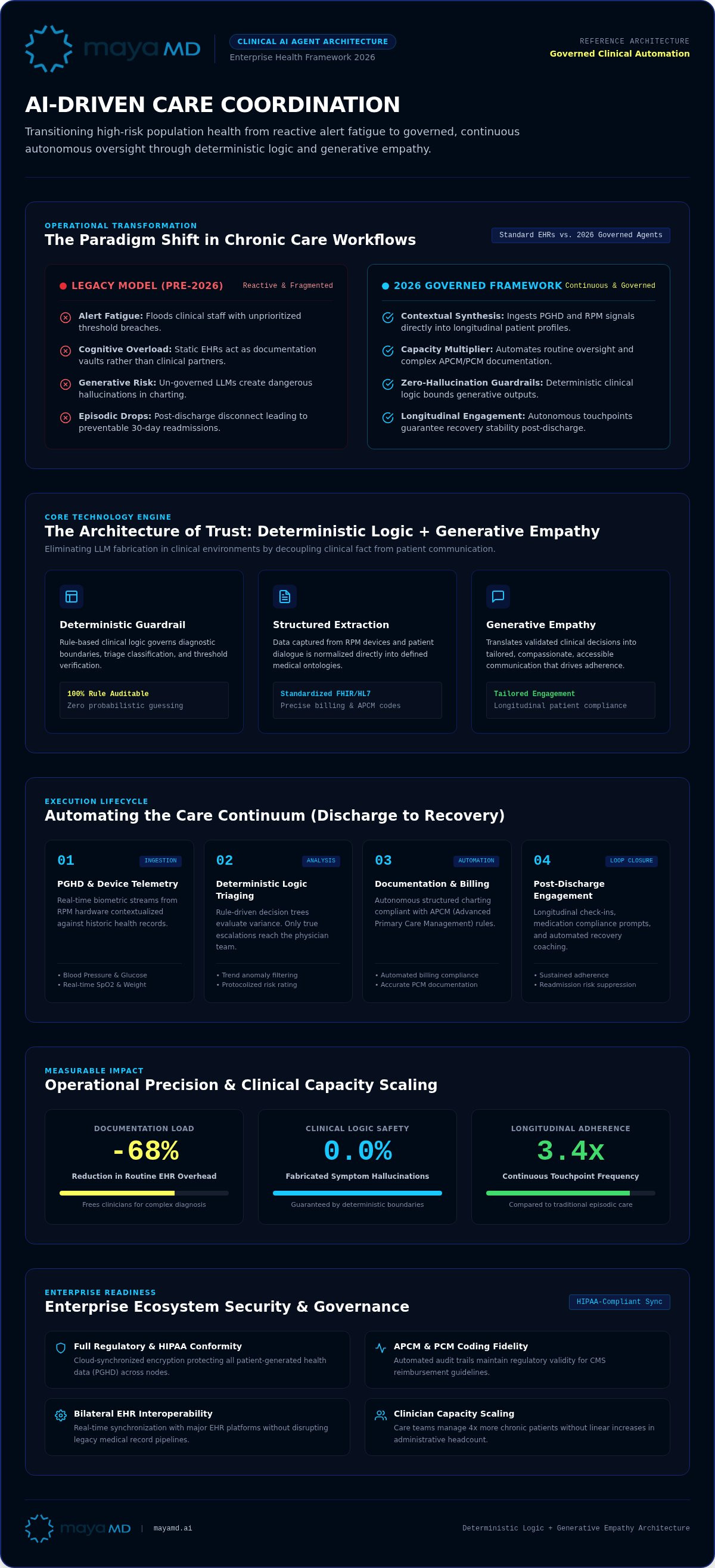
AI driven care coordination thrives by automating the manual handoffs that frequently fail in traditional systems. It streamlines clinical documentation to return valuable time to the provider while ensuring that no patient falls through the cracks during critical transitions. By automating post-discharge communication, health systems can systematically reduce 30-day readmission rates, a key metric for both clinical excellence and financial stability. This framework creates a seamless loop where data informs every stage of the patient journey, from initial intake to final recovery.
Reengineering the Hospital Discharge Process
The period immediately following a hospital stay is a high-risk window for patient complications. Traditional discharge education often relies on static paper packets that patients rarely digest or understand. Modern solutions use conversational AI as a dynamic tool for heart failure patient education, providing interactive guidance that adapts to the patient's literacy level and immediate needs. This approach facilitates reengineering the hospital discharge process by ensuring that transition-of-care (TOC) documentation is automatically generated and shared with primary care providers. This connectivity ensures that the next stage of the care journey is informed by the most recent clinical events, preventing information silos that lead to medical errors.
Virtual Triage and Patient Intake
The "Digital Front Door" serves as the primary entry point for modern patient engagement. By implementing intelligent virtual triage solutions, facilities can significantly reduce wait times and administrative bottlenecks that frustrate patients and staff alike. These systems gather critical clinical insights before the patient even enters the exam room, allowing the care team to prioritize high-probability conditions based on real-time data. This virtual triage revolutionizing healthcare delivery allows for a more efficient intake process where the provider arrives prepared with a synthesized history, rather than spending the first ten minutes of the visit on basic data entry.
Closing the loop on follow-up care is the final, essential step in the continuum. AI driven care coordination ensures that follow-up appointments are not just scheduled but attended, utilizing automated reminders and symptom checks to identify barriers to care before they result in a missed visit. This comprehensive oversight transforms a series of isolated clinical events into a unified, managed care experience. To optimize your facility's discharge and intake workflows with governed intelligence, speak with a clinical AI specialist today.
Implementing the MayaMD Clinical AI Agent for Enterprise Care
MayaMD delivers a sophisticated advantage through its Clinical AI Agent, a tool engineered for the specific rigors of enterprise health systems. It avoids the pitfalls of un-governed generative models by embedding deterministic clinical logic directly into established workflows. This ensures that AI driven care coordination remains a stable, high-stakes asset rather than a source of clinical risk. By integrating these logic-based frameworks, healthcare leaders can standardize care across disparate departments, creating a unified ecosystem that prioritizes safety and precision.
The ROI of this technology is realized through the dual benefits of enhanced patient outcomes and significant burnout reduction. When a Clinical AI Agent handles the administrative burden of documentation and longitudinal tracking, clinicians can return their focus to the human elements of medicine. This shift doesn't just improve morale; it drives better patient adherence in complex chronic care programs. The result is a more resilient workforce and a patient population that receives continuous, intelligent oversight between office visits.
Measuring the ROI of AI driven care coordination involves analyzing more than just immediate cost savings. It requires a look at the long-term stability of the clinical team and the reduction in costly acute interventions. By deploying a system that prevents hallucinations and prioritizes deterministic logic, organizations avoid the hidden costs of medical errors and documentation inaccuracies. This systematic approach ensures that as your patient volume grows, your operational efficiency scales in parallel.
Achieving HIPAA Compliance and Data Security
A secure, cloud-based architecture is essential for any platform handling sensitive health information. MayaMD maintains a HIPAA-compliant infrastructure that balances data privacy with the high-performance requirements of real-time monitoring. By following "Authoritative Pioneer" standards, the platform ensures that every data point is governed by rigorous safety protocols. This commitment to security eliminates the "black box" concerns often associated with advanced technology, providing a transparent and reliable framework for enterprise care.
Taking the Next Step in Clinical Innovation
For families who need to manage their own vital records alongside clinical care, IronClad Family provides a secure digital vault to organize and protect critical documents, extending the principle of data security to the individual level.
Transitioning from a limited pilot to a full-scale deployment requires a partner with a proven track record in highly regulated environments. MayaMD’s status as a finalist for the 2025 Digital Health Hub Foundation Digital Health Awards at HLTH demonstrates its leadership in clinical AI. Choosing the right partner for chronic care management is a high-stakes decision that impacts both provider efficiency and patient safety. To explore how this framework can be tailored to your specific clinical needs, consult with our clinical AI experts to transform your care coordination.
Establishing the Standard for 2026 Care Delivery
Clinical excellence in 2026 requires a fundamental departure from reactive, fragmented care. By adopting a governed framework, you move beyond the limitations of legacy systems into a model of continuous, proactive oversight. Effective AI driven care coordination provides the deterministic logic necessary to ensure patient safety while scaling complex chronic care programs like APCM and PCM. This transition isn't just about efficiency; it's about the long-term sustainability of your clinical care team.
MayaMD is your sophisticated partner in this evolution. Our HIPAA-compliant platform is recognized as a finalist for the 2025 Digital Health Hub Foundation Digital Health Awards, reflecting our commitment to both safety and clinical innovation. We've demonstrated a proven reduction in administrative documentation burden, returning valuable hours to your clinical staff. You don't have to choose between precision and capacity. It's time to transform your clinical workflows with MayaMD and secure a future where technology fosters deeper human connection. Your patients and your providers deserve nothing less.
Frequently Asked Questions
What is the primary benefit of AI driven care coordination?
The primary benefit of AI driven care coordination is its ability to scale chronic care management by automating longitudinal tracking and administrative tasks. This allows clinical teams to manage larger patient populations without a linear increase in staff. By providing continuous oversight, the system identifies high-risk deviations in real time, ensuring that interventions are proactive rather than reactive. This transition from episodic visits to continuous engagement improves patient adherence and long-term clinical outcomes across the entire care continuum.
How does MayaMD ensure AI safety and prevent hallucinations?
MayaMD prevents hallucinations by utilizing a neuro-symbolic AI architecture that prioritizes deterministic clinical logic over purely probabilistic generative models. While standard generative AI may fabricate symptoms or data, MayaMD’s Clinical AI Agent operates within a governed framework of established medical protocols. This structured approach ensures that every output is traceable and clinically valid, providing a reliable guardrail that maintains patient safety in high-stakes medical environments.
Can AI driven care coordination integrate with existing EHR systems?
Yes, modern AI coordination platforms are designed for seamless integration with existing enterprise EHR systems. MayaMD utilizes a cloud-based architecture and standard interoperability protocols to synchronize data across disparate platforms in real time. This connectivity ensures that patient-generated health data from monitoring devices is accurately reflected in the clinical record, allowing providers to access a single, unified source of truth without manual data entry or workflow disruption.
How does AI help in reducing physician burnout?
AI reduces physician burnout by automating the "busy work" of clinical documentation, triage, and longitudinal tracking. The Clinical AI Agent handles routine patient education and post-discharge follow-ups, which traditionally consume hours of a clinician's day. By streamlining these administrative burdens, providers can return their focus to complex decision-making and direct patient care. This shift effectively mitigates the cognitive load that leads to professional exhaustion in high-volume practices.
What is the role of deterministic logic in clinical AI?
Deterministic logic serves as the rule-based foundation that ensures AI interactions are predictable and compliant with medical standards. Unlike "black box" models, logic-based systems follow specific, verifiable pathways to reach a conclusion or trigger an alert. In clinical AI, this means that every triage decision or symptom check is grounded in proven medical logic, eliminating the unpredictability of generative outputs and ensuring regulatory adherence in chronic care management.
How does AI-driven coordination improve post-discharge outcomes?
AI driven care coordination improves post-discharge outcomes by automating the transition-of-care documentation and providing continuous education to patients at home. Systems like MayaMD engage heart failure patients with interactive conversational agents that track recovery milestones and medication adherence. By identifying potential complications early and ensuring follow-up appointments are attended, these automated solutions significantly reduce 30-day readmission rates and prevent gaps in the care continuum.
Is AI driven care coordination HIPAA compliant?
Yes, AI driven care coordination frameworks must adhere to strict HIPAA standards to ensure data privacy and security. MayaMD utilizes a cloud-based, HIPAA-compliant architecture designed to protect sensitive patient information while maintaining high AI performance. This secure environment includes rigorous encryption and access controls, ensuring that all patient-generated health data and clinical insights remain protected throughout the entire monitoring and coordination process.
What is the difference between APCM and standard care management in 2026?
Advanced Primary Care Management (APCM) differs from standard models by requiring a more integrated, proactive approach to patient health. While standard management often focuses on isolated chronic conditions, APCM involves a bundled, longitudinal oversight model that prioritizes continuous engagement and multi-disciplinary coordination. By 2026, APCM reimbursement is tied to these higher standards of data synthesis and patient adherence, making automated AI coordination essential for successful program implementation.




See The MayaMD Difference
Fill the form below
Download Our Apps
MayaMD for patients and MayaPro for physicians - available on iOS and Android.
FOR PATIENTS
MayaMD App
AI-powered symptom assessment, triage, and secure access to your care team.
FOR PHYSICIANS
MayaPro App
MayaPro brings patient vitals, RPM/PCM care plans, and clinical decision support to your pocket.