
AI Chronic Care Documentation: Support Continuous Care

AI documentation is most effective when it strengthens, rather than replaces, clinical review and keeps information useful across ongoing care. Streamlining chronic care documentation with AI can support timely note creation and organize patient information, while human oversight remains essential to clinical accuracy and continuity.
Technology can ease documentation demands, but speed alone is not enough when care depends on a clear, current record. The real value is helping clinicians find and carry forward relevant information without losing the context they need to make decisions.
This article explains how AI transcription and information organization work, what they can and can’t do for record accuracy, and how security and EHR integration affect implementation. It also explores the connection that matters most in chronic care: whether documentation helps care teams maintain a coherent view of a patient over time.
Key Takeaways
• Clinical notes help care teams share context and support patient care, so documentation quality matters as much as speed.
• AI transcription and record summaries can make relevant information easier to organize, while clinician review remains central to accuracy.
• Successful EHR integration depends on aligning the technology with existing workflows, clear implementation goals, and staff training.
• Security and oversight should be considered alongside documentation efficiency when evaluating AI for clinical use.
• In chronic care, the value of documentation is measured by how well it helps teams maintain a coherent view of patient needs over time.
How secure is AI medical documentation?
Clinical notes connect each patient encounter to the next decision. They help providers share symptoms, treatment changes, follow-up plans, and unresolved concerns across a care team. In chronic care, recording a medication adjustment without the reason can leave the next clinician with an incomplete picture. Notes also support legal and financial documentation, so accuracy and controlled access are operational priorities.
Security depends on how a system handles information throughout its lifecycle, from capture and review to storage and access. Before deployment, map which data the tool processes, who can view generated notes, and how long records are retained. For example, a workflow that captures a patient conversation should specify who reviews the draft and where the approved note is stored. These controls matter as much as the AI model itself.
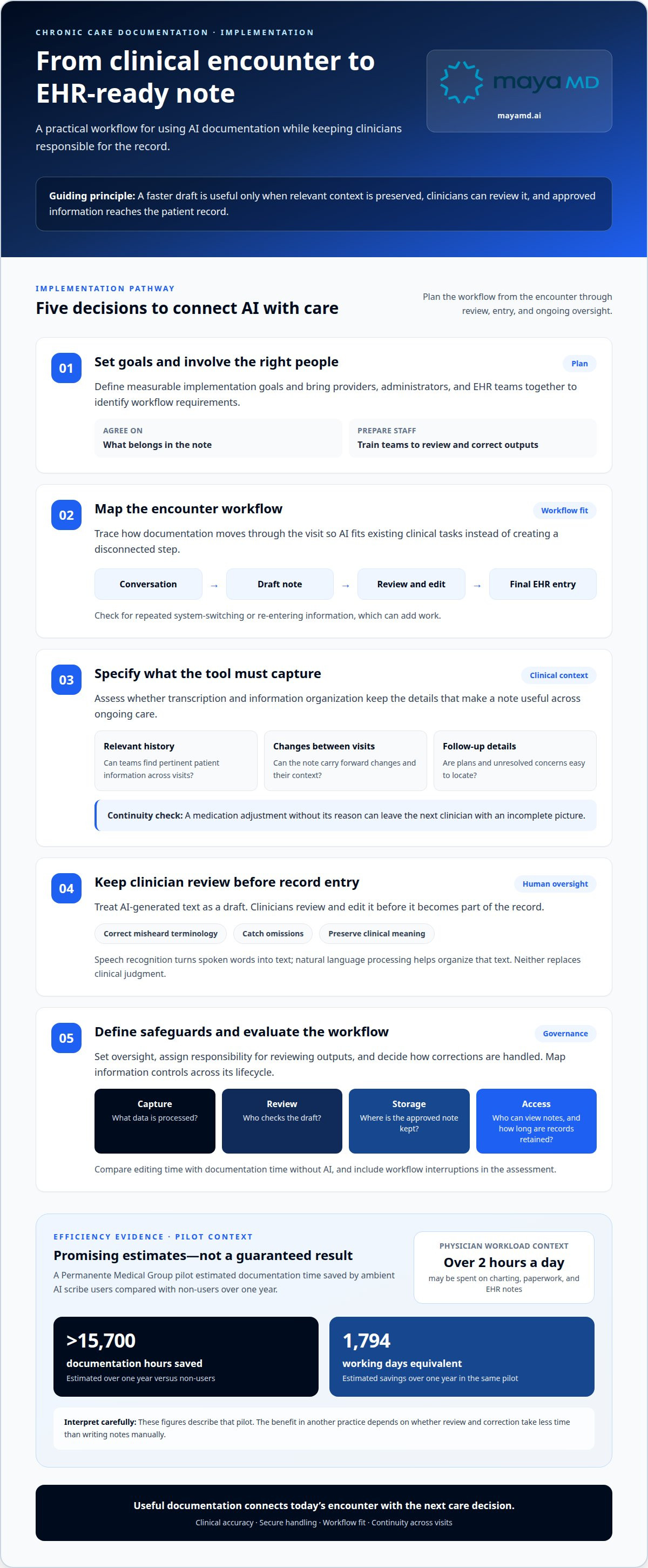
Ambient AI scribes use speech recognition and natural language processing to draft notes from clinical encounters. Clinicians review and edit each draft before it becomes part of the record. A simulated-patient-encounter study evaluated an AI scribe, while research published in Cureus reported that speech recognition and natural language processing can speed documentation and reduce provider workload. These capabilities support documentation, but they do not replace clinical judgment.
The results are promising but should be interpreted in context. A Permanente Medical Group pilot estimated that ambient AI scribe users saved more than 15,700 documentation hours compared with non-users over one year. The same pilot estimated savings equivalent to 1,794 working days over one year. Those figures describe that pilot, not a guaranteed result for every practice. Human review remains necessary to catch omissions, misheard terminology, or a generated statement that changes clinical meaning.
Administrative burden is another reason organizations assess AI. Charting, paperwork, and EHR notes can take physicians over two hours a day. Draft notes may reduce repetitive typing and help clinicians focus on patients during visits, but the benefit depends on whether review and correction take less time than writing notes manually. Compare editing time with documentation time without AI, and include workflow interruptions in the assessment.
How do AI scribe tools compare for chronic care workflows? Consider whether each tool supports longitudinal context, captures changes between visits, and fits the team’s review process. Even a polished visit note needs to preserve relevant history and follow-up details to support ongoing care.
What are the costs of AI medical documentation tools in the United States? Costs depend on workflow scope, EHR integration, and organizational use, so compare quotes against the same requirements. When streamlining chronic care documentation with AI, assess security controls, clinician oversight, and continuity needs alongside speed.
AI documentation implementation and EHR integration
AI documentation tools can combine speech recognition and natural language processing with an EHR workflow. Which tools support chronic care documentation and EHR integration? Look for tools that transcribe encounters, structure clinical information, and fit the organization’s review and record-entry processes.
Transcription Integration with EHRs
AI transcription integration converts spoken clinical content into text for review and entry into an electronic health record. That connection matters because a transcript is useful only when clinicians can incorporate its relevant details into the patient’s record. Automatic speech recognition processes spoken words, while natural language processing helps organize the text for clinical documentation.
For example, a team can define which encounter details belong in its note format, then assess whether generated text preserves them. Review the draft before it becomes part of the record. This distinction separates draft content from clinician-approved documentation and gives staff a clear opportunity to correct errors or omissions.
Workflow Integration
Workflow integration means fitting AI-supported documentation into the existing sequence of clinical tasks, rather than adding a disconnected step. Without careful integration, transcription can create extra work if providers must switch systems repeatedly or re-enter information. Map the encounter from conversation through review, editing, and final EHR entry.
Start implementation with measurable goals, relevant stakeholders, and staff training. A clinic, for example, might assess whether draft notes fit its existing format and how much editing clinicians need. Providers, administrators, and EHR teams can identify workflow requirements together. Training should clarify when staff review, correct, and use generated documentation.
Tools for Chronic Care Documentation
Tools for chronic care documentation include AI transcription and systems that extract, summarize, or structure information from clinical notes. They can help teams make patient history accessible across visits. Their practical value depends on what information they organize and how the output fits the clinical record and review process.
In chronic care, a team could assess whether a summary brings relevant history together with current encounter details. The aim is not simply a polished note, but a format that supports follow-up and coordination. Evaluate how the tool handles unstructured text, how clinicians correct its output, and how approved information enters the EHR.
Implementation also requires governance. Establish oversight for AI-supported documentation, assign responsibility for reviewing outputs, and define how corrections are handled. These decisions connect technical integration with clinical accountability. A pilot workflow can reveal friction in transcription, review, or record entry before broader use.
To plan a workflow around chronic care documentation and EHR integration, discuss your documentation workflow.
AI transcription and organisation of patient information
AI transcription uses automatic speech recognition and natural language processing to turn speech into clinical text. It can also summarize or restructure patient records, helping healthcare teams review key details without manually searching lengthy notes. For example, a chronic care summary can bring relevant history, examination findings, and diagnostic information together from unstructured documentation. Clinicians still need to compare the summary with the source record before using it in patient care.
Organization determines whether transcription becomes useful clinical documentation. AI can extract histories, physical examination results, and diagnostic findings, then arrange them into categories that support review. A provider could scan a structured summary for a change in symptoms, then return to the original note for context. AI-powered data input is described at 150 words per minute, but speed alone doesn’t establish whether information is complete, correctly attributed, or clinically meaningful.
Sharing patient data across healthcare systems requires attention to how information moves and who can use it. Identify which record elements need to be shared, such as medication history or a recent assessment, and how receiving teams will interpret them. Consistent terminology and clear source information help reduce confusion. For example, a summary should distinguish a patient-reported symptom from a clinician-observed finding.
Consider HIPAA-related data protection when evaluating transcription and record-summary tools. Map where speech, transcripts, and generated summaries are processed or stored, then define access and review controls at each step. Patient perspectives matter, too. Explain speech capture in plain language, clarify how the resulting documentation supports care, and give patients a chance to raise concerns during the encounter.
Ethical use also depends on preserving what patients mean. If someone describes dizziness after a medication change, a summary should retain both the symptom and its timing instead of reducing the account to a broad label. Providers can review uncertain phrases, correct context, and ensure the final record reflects the encounter. These checks help keep technology from obscuring an individual’s experience.
Assess patient satisfaction alongside documentation efficiency and clinical outcomes. A systematic review included eight studies of AI scribes; the cited study found no significant impact on patient satisfaction scores. This supports careful evaluation, rather than assuming every workflow feels the same to patients. Teams can gather feedback on whether clinicians remain attentive, conversations feel clear, and follow-up information is understood.
Accuracy and completeness of medical records
Accurate records help clinicians understand what changed, what was assessed, and what remains unresolved. In chronic care, missing symptom details or unclear medication history can weaken the context needed at a later visit.
Documentation Accuracy and Error Reduction
Documentation accuracy means that the record reflects the encounter clearly and completely, while error reduction focuses on finding omissions or inconsistencies before they affect care. AAPC describes clinical documentation improvement as reviewing records for completeness and accuracy. AI can help flag discrepancies or missing data during a visit, giving clinicians a prompt to review the source information.
For example, if a note includes a diagnosis but omits the related examination finding, a review prompt can draw attention to the gap. AI transcription tools can recognize complex medical terminology, which may reduce manual corrections. However, recognizing a term correctly does not mean the note captures its intended meaning. Clinicians should compare important details with the encounter and correct errors before finalizing the record.
A useful review distinguishes a missing fact from one that was never discussed. An empty field for a patient-reported symptom may need clarification, for instance, while an unmentioned symptom should not be inferred. Check whether the note preserves relevant history, examination results, diagnostic findings, and the clinician’s assessment. This makes completeness measurable without treating longer notes as automatically better records.
Balancing Documentation Efficiency and Accuracy
Documentation efficiency means reducing avoidable manual work while retaining the detail needed for clinical interpretation. Faster note creation has little value if providers then spend more time correcting errors. Compare both time saved and the quality of the completed record, including whether important findings remain clear after editing.
Assess generated notes using a consistent review framework: check terminology, confirm key facts, identify omissions, and correct statements that change clinical meaning. For example, compare the source encounter with the final note when a treatment change depends on symptom timing. This ties efficiency to accuracy instead of measuring speed alone.
Accurate, current records can support treatment, chronic-condition management, and coordination among providers. A quality review can assess whether another clinician can identify the patient’s relevant history, current findings, and documented plan. AI may help organize information, but the final record still requires clinical validation. This division of work can reduce documentation burden without confusing automated drafting with verified clinical judgment.
Teams can use recurring corrections to refine templates and review practices. If clinicians repeatedly correct medication names or restore omitted examination details, those patterns show where the workflow needs attention. Track these examples alongside note completion to assess whether AI improves documentation efficiency and record quality together.
Care continuity and documentation
Continuity depends on whether each care interaction leaves the next provider a usable account of the patient’s history, current status, and follow-up needs. In chronic care, a record that connects a symptom change with a treatment adjustment can help clinicians understand what happened between visits. Artificial intelligence can gather information from previous physician notes and update electronic records with medication and medical histories, helping teams carry context forward.
The challenge is not simply producing more notes. In the United States, 20.9% of physicians reported spending more than 8 hours on the EHR outside normal work hours. Manual clinical data input is described at 35 words per minute. A powered transcription workflow may reduce repetitive entry, but continuity depends on whether relevant information remains clear, current, and available to the next care team.
For example, a clinician reviewing a patient’s record before follow-up needs to distinguish a historical medication from a current one. AI can gather prior information, but the record still needs review so outdated details are not presented as current. Assess whether each update preserves its source and context, and whether the resulting note supports a clear next step rather than simply adding text.
According to the United States Bureau of Labor Statistics, clinical documentation specialists help maintain accurate patient records, support medical coding for billing, and securely store data for analysis. This work links documentation quality with care coordination and organizational processes. AI can analyze clinical documentation and suggest medical codes based on recorded diagnoses and procedures, while providers validate whether those suggestions match the documented encounter.
Identifying missing information can also support continuity. An AI scribe may flag discrepancies or absent details during a visit, giving clinicians a chance to clarify them before the next handoff. For instance, a note might mention a medication change without recording the related history. A prompt can highlight the gap; the clinician can confirm the details and update the record.
To assess whether AI significantly reduces administrative burden, track more than typing time. Compare the effort needed to review notes, correct errors, and find relevant history across follow-up encounters. If teams can find a patient’s current medication history and prior clinical decisions more easily, documentation is supporting continuity, not just speed. This is the central test for streamlining chronic care documentation with AI.
Explore how AI can support continuity across chronic care workflows.
MayaMD: Clinical AI Agent
MayaMD’s Clinical AI Agent supports healthcare teams seeking a more connected approach to chronic care. It complements documentation workflows by supporting patient engagement and communication beyond the clinical encounter, helping teams stay connected with patients as care continues.
For organizations focused on follow-up, MayaMD’s AI patient engagement and automated post-discharge communication solutions can support communication after a patient leaves a care setting. These services can connect ongoing patient interactions with a broader continuity-of-care approach alongside clinical documentation processes.
To discuss how these capabilities may fit your care model, contact MayaMD.
Make the Next Step a Deliberate One
A deliberate approach to streamlining chronic care documentation with AI starts with a question beyond automation: where does information lose its usefulness as care moves between people and settings? Use that question to identify a meaningful point in the patient journey, then define what a better handoff should make possible for the care team and the patient.
From there, establish an evaluation that reflects your care model. Consider which documentation tasks benefit from AI support, where clinical judgment must remain central, and how teams will learn from corrections and feedback. This gives the technology a clear role without making adoption the goal. The aim is a care process where useful information supports a connected patient experience.
When you’re ready to explore how AI could fit your organization’s priorities, start a conversation with MayaMD. A considered next step can help your team move toward documentation that serves care over time.
Frequently Asked Questions
How effective is the technology?
AI documentation can reduce repetitive work, but its effectiveness depends on how well it fits the encounter and review process. For a chronic care visit, assess whether the note captures changes since the previous appointment, relevant patient concerns, and agreed follow-up. Compare edited drafts with completed notes and track recurring corrections. This shows whether the tool supports the practice’s documentation goals instead of simply producing text quickly.
What happens if the AI makes a mistake in documentation?
A clinician should correct an AI-generated error before finalizing or relying on the note. If a draft assigns a symptom to the wrong point in a patient’s history, for example, compare it with the encounter and amend the record. Practices can log recurring errors, such as incorrect medication names, and use those patterns to improve prompts, templates, or review procedures.
Will AI documentation work with my specialty or practice size?
Fit depends on the language, documentation structure, and workflow your practice needs, not its size alone. A specialty team can test whether notes capture its typical terminology and visit details, while a smaller practice can assess whether review fits its workflow. Use representative encounters from the intended setting, then examine editing effort, missed context, and how clinicians complete documentation in the EHR.
Will AI replace the need for my judgment?
No. AI can generate or organize documentation, but clinical judgment is needed to interpret findings, decide what belongs in the record, and approve the final note. A transcript may capture a patient’s words without establishing their clinical significance. Providers determine how those words relate to the patient’s condition and care plan, then correct documentation that misstates that interpretation.
How can AI streamline documentation for chronic care management?
AI can help organize information across encounters so clinicians can review relevant changes without piecing together context from scattered notes. A team might use a structured summary to prepare for follow-up, then confirm key details against the record. Effective streamlining connects documentation to care, including the information that supports monitoring, coordination, and the next clinical decision.
What chronic care documentation tasks can AI automate?
AI can transcribe speech, draft clinical notes, extract details from unstructured records, and summarize patient histories. It may also flag missing or inconsistent information for review. For example, a generated summary could organize prior findings before a follow-up visit. These tasks support documentation, but they do not independently confirm accuracy or determine what care a patient needs.
How accurate are AI-generated clinical notes for chronic care?
Accuracy varies with audio quality, terminology, source information, and encounter complexity. A note may transcribe a medication name correctly yet omit why it changed. Review notes for clinical meaning, not just spelling: check timing, relevant history, findings, and the plan. Tracking corrections by type can help a practice identify where AI drafts need closer review or workflow adjustments.
What HIPAA and other U.S. rules apply to AI-generated clinical documentation?
HIPAA is a central consideration when protected health information enters an AI documentation workflow. Evaluate how information is captured, accessed, processed, retained, and shared, including which parties handle it and what safeguards apply at each step. An AI-generated format does not remove the need to protect patient data. Organizations should also account for applicable federal and state requirements when establishing privacy, security, and documentation procedures.




See The MayaMD Difference
Fill the form below
Download Our Apps
MayaMD for patients and MayaPro for physicians - available on iOS and Android.
FOR PATIENTS
MayaMD App
AI-powered symptom assessment, triage, and secure access to your care team.


FOR PHYSICIANS
MayaPro App
MayaPro brings patient vitals, RPM/PCM care plans, and clinical decision support to your pocket.