
ACO Care Management Solutions: Roles and Scope

Care management solutions for accountable care organizations bring clinical teams, patient engagement, and ongoing support together in a coordinated approach. They can help identify patients who need additional support, organize follow-up, and assist people managing chronic conditions. The right setup depends on patient needs, clinical workflows, and how responsibilities are assigned across the team.
That coordination takes more than assigning a care manager. Teams need clear roles, reliable communication, and processes that connect patient needs with appropriate clinical support. The practical challenge is making those elements work together without losing sight of each patient.
This article explains what care management includes in an ACO, how teams can be structured, and which roles contribute to delivering care. It also covers how digital tools can support patient engagement and continuity, helping ACO leaders assess where technology can complement their teams.
Key Takeaways
• Define care management scope around patient needs, clinical workflows, and the responsibilities assigned across the team.
• Assess platform capabilities by how well they support patient engagement, care coordination, and continuity of care.
• Use risk stratification to help teams prioritize follow-up and align support with each patient’s needs.
• Compare software platforms by their fit with your organization’s workflows, rather than by feature lists alone.
• Understand which factors shape solution costs, and where automated post-discharge support may complement your care model.
Management definitions and scope
For an ACO, care management organizes people, workflows, and information around patients who need coordinated support. A clearly defined program establishes who takes action, what information guides decisions, and how teams follow patients over time.
Care Management Scope for ACOs
Care management solutions for accountable care organizations combine processes and tools to help teams identify patient needs, coordinate services, and maintain follow-up. Defining the scope helps clinical leaders distinguish direct patient support from administrative coordination and reporting. For example, an ACO can set out how a care manager responds when a patient needs follow-up after a discharge across care settings.
Management also means assigning responsibility. A defined program can specify who reviews patient information, who contacts patients, and how unresolved needs reach a clinician. ACOs exploring a structured approach can review advanced primary care management as one related care model.
Risk Stratification and Care Coordination
Risk stratification groups patients according to indicators of potential support needs, while care coordination connects that assessment to appropriate follow-up. A risk label is useful only when it prompts a clear action and identifies the team member responsible.
For example, a care team may prioritize outreach to a patient after a care transition, then document the response and next step. Tools can organize work queues and communicate updates, while clinical judgment guides decisions about individual care. The ACO defines how these tasks fit its workflows.
Data Integration and Interoperability
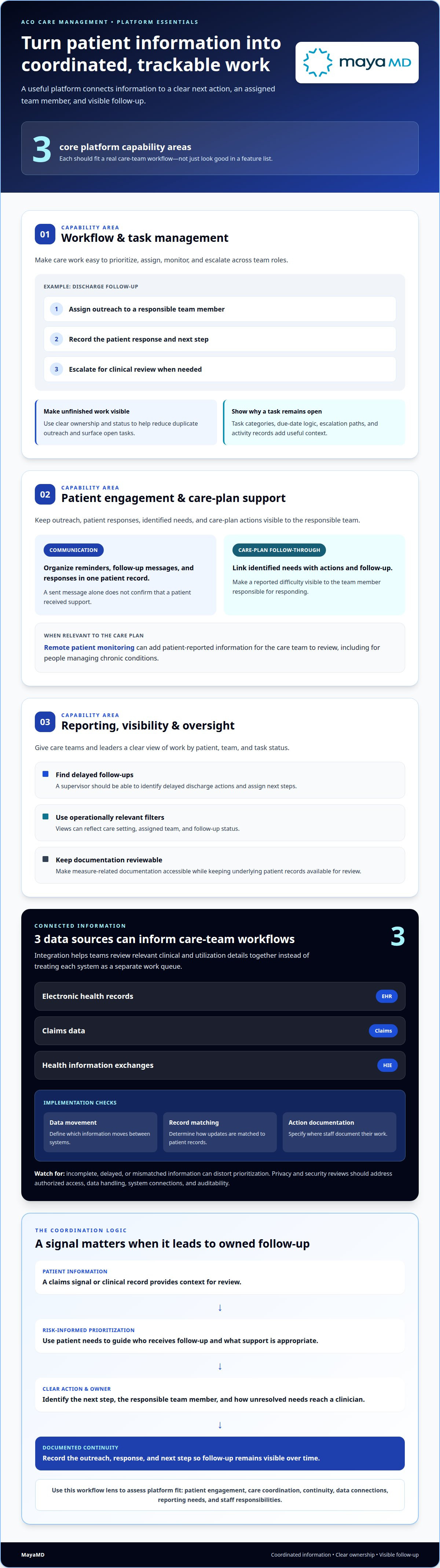
Integration brings information from electronic health records, claims data, and health information exchanges into care-team workflows. When these sources connect, staff can review relevant clinical and utilization details together instead of handling each system as a separate work queue.
During implementation, define which data move between systems, how updates are matched to patient records, and where staff document their actions. A claims signal might prompt a review, while an EHR record adds clinical context. Incomplete, delayed, or mismatched information can distort prioritization, so teams need to account for these interoperability risks.
Privacy and security reviews should cover authorized access, data handling, system connections, and auditability. ACOs should assess whether information sharing meets their applicable privacy obligations and agreements. These safeguards are important whenever EHR, claims, or exchange data move between platforms.
Care management tools can support CMS quality and reporting work by organizing relevant data, documenting outreach, and tracking follow-up. Because each CMS program sets its own measures and reporting rules, workflows should map to the applicable requirements rather than assume a universal checklist.
For Medicare Shared Savings Program ACOs, program rules shape reporting and care-management workflows. Align documentation and operational processes with the current requirements for the organization’s participation arrangement.
U.S. ACOs can choose among EHR-connected platforms, population-health tools, and specialized care-management software. Compare their fit with existing workflows, data connections, reporting needs, and staff responsibilities. A platform’s category alone does not establish whether it is suitable.
What features should an ACO care management platform include?
An ACO platform should turn patient information into coordinated, trackable work. Evaluate each feature against a real workflow, such as arranging follow-up after a hospital discharge or tracking an unresolved patient need. A polished dashboard is less useful if staff cannot identify the next action, its owner, and its status.
Workflow and task management
Work queues should help teams prioritize, assign, and monitor care tasks across roles. For example, a discharge follow-up can progress from initial outreach to a documented response and, when needed, clinical review. Clear ownership reduces duplicate outreach and makes unfinished tasks visible to supervisors.
Useful workflow controls include configurable task categories, due-date logic, escalation paths, and activity records. Care managers should be able to distinguish patients awaiting contact from those needing clinician input. It also helps when the platform records why a task remains open, rather than displaying only a status label.
Patient engagement and care-plan support
Communication features should help staff reach patients in ways that fit the care plan. A platform might organize reminders, follow-up messages, and responses in one patient record. For someone managing a chronic condition, remote patient monitoring can add relevant patient-reported information to the care team’s review.
Care-plan support should link identified needs with actions and follow-up. If a patient reports difficulty following a care plan, for example, the platform should make that response visible to the responsible team member. A clear record of outreach and responses helps staff maintain continuity without assuming that sending a message means the patient received support.
Reporting, visibility, and oversight
Operational views should let leaders assess work by patient, care team, and task status. A supervisor reviewing open discharge follow-ups needs to identify delayed actions and assign next steps. Reporting should make measure-related documentation accessible while keeping the underlying patient records available for review.
Look for filters that reflect actual program operations, such as care setting, assigned team, or follow-up status. Consistent definitions matter: if teams classify outreach attempts differently, their reports may not support meaningful comparisons. Role-based access and audit records also help organizations govern who can view or change sensitive information.
Usability and operational fit
Even a broad feature set can create friction when routine work requires staff to switch between disconnected screens. Test a common task, such as reviewing a patient record, documenting outreach, and assigning follow-up. The workflow should make the required information and next action clear to the staff member.
Implementation planning should account for staff roles, existing workflows, data connections, and training needs. A platform’s value depends on whether care managers and clinicians can use its features consistently in daily work. To discuss how these workflow needs relate to care-management operations, talk with the team.
ACO Solutions for Risk Stratification and Coordination
Risk stratification helps an accountable care organization direct attention to patients whose information indicates greater support needs. Care coordination turns those signals into assigned follow-up, shared plans, and communication across care settings.
From patient information to prioritized outreach
A care team can use clinical history, recent encounters, and patient-reported needs to identify people who may benefit from closer review. For example, a recent hospital discharge and an unresolved medication question can prompt timely outreach. These signals help prioritize work but do not replace clinical assessment.
Effective stratification makes the reason for a priority visible. Care managers should be able to see whether a patient was flagged because of a care transition, chronic condition, or reported barrier to follow-up. Clear criteria help teams explain decisions and focus reviews on relevant circumstances.
Risk categories also need a defined operational meaning. When a patient is marked for additional support, the system should connect that designation to a responsible role and an appropriate next action. Otherwise, a risk score may sit on a dashboard without changing the patient’s experience of care.
Turning priorities into coordinated action
Once a patient is prioritized, coordination connects the assessment to the people who can address the identified need. A care manager might arrange follow-up after discharge, while a clinician reviews a symptom concern. Recording the owner and outcome helps the ACO maintain continuity across interactions.
Shared care plans can make responsibilities visible to primary care teams, specialists, and care managers. A patient with a chronic condition, for instance, may need routine clinical follow-up and support understanding next steps. A coordinated workflow records each action, its status, and information that could shape the next interaction.
Communication matters when care crosses settings. An ACO workflow can specify who receives a transition update, who contacts the patient, and how concerns reach the appropriate clinical team. This structure helps prevent a handoff from becoming an unassigned message.
Reassessment and accountable workflows
Patient needs change, so teams should revisit priorities as new information arrives. A new encounter, a change in reported symptoms, or a completed follow-up task may change the appropriate next step. Reassessment keeps care plans grounded in current circumstances instead of treating an earlier classification as permanent.
Operational reviews can reveal where coordination breaks down. A supervisor might examine patients awaiting outreach, unresolved requests, or tasks returned for clinical review. These examples help teams distinguish effective prioritization from queues that lack clear ownership.
Useful ACO workflows link three elements: why a patient was prioritized, what action was assigned, and what result was documented. Keeping these connected helps care teams coordinate support consistently while retaining clinical judgment for individual decisions.
How do leading ACO care management software platforms compare?
ACO platforms differ in their primary roles: coordinating care, managing population health, extending an EHR, or supporting remote monitoring. Compare how each model fits your organization’s workflows, data environment, and patient needs. A feature list alone cannot show whether staff can turn an identified need into coordinated action.
Platform models and their strengths
An EHR-centered platform places care-management tasks close to clinical documentation, which may suit an ACO whose teams work mainly in one EHR. Population-health platforms typically emphasize broader views across patient groups, helping staff organize outreach and review patients beyond an individual encounter.
Specialized care-management software focuses on tasks such as outreach, care plans, and follow-up tracking. Remote-monitoring platforms emphasize patient-generated information and ongoing review. These categories can overlap, so compare actual workflows rather than relying on a product label.
Workflow and data fit
Consider a patient discharged from a hospital who needs follow-up. One platform may start the task inside the EHR; another may use a care-management work queue to coordinate outreach across teams. Compare how each approach assigns an owner, records contact, and makes unresolved needs visible to the right staff.
Data connectivity also shapes the comparison. Examine how a platform uses EHR records, claims information, and exchange data in daily workflows. For example, determine whether staff can see the context behind a prompt without leaving the system or manually reconciling separate records.
Reporting, oversight, and patient engagement
Reporting capabilities vary in how they organize operational activity and quality-related documentation. Compare whether leaders can review open tasks, completed outreach, and care-plan progress by team or patient group. Useful reports connect totals to documented work, so supervisors can investigate delayed follow-up rather than simply see a count.
Patient-engagement features vary, too. One platform may organize messaging and responses, while another focuses on monitoring patient-reported information. For someone managing a chronic condition, assess how new information reaches the team and becomes an actionable item for review, rather than remaining isolated in a separate dashboard.
A practical comparison framework
Assess each platform using the same workflow. Trace a scenario such as identifying a patient for follow-up, assigning outreach, documenting the response, and escalating a concern. This exposes handoffs and duplicated steps more clearly than a demonstration of disconnected features.
Then compare implementation fit, role-based access, auditability, and the effort needed to maintain workflows. The right platform for an ACO is one that supports its operating model and connects data to accountable work. A specialized system may complement an EHR, while another organization may prioritize a more integrated environment.
How much do care management solutions for ACOs cost
There is no single price for every ACO care-management platform. Total cost depends on scope, deployment model, data connections, and support requirements. An organization seeking task tracking alone, for example, has different implementation needs from one integrating multiple data sources and patient-facing workflows.
What shapes the total cost?
Platform scope is a primary cost factor. ACOs should distinguish core care-management workflows from optional modules for analytics, patient engagement, or remote monitoring. Added capabilities can affect configuration, user access, and integration work, so the proposed scope should match actual program operations.
Data integration also affects the project. Connecting an existing EHR, claims information, and other systems can require technical planning and workflow testing. Exchanging information with several systems, for example, can involve a different implementation effort from operating within one established environment.
Deployment and configuration matter as well. A standard setup may require different work from one tailored to specific care-team roles, escalation paths, and reporting processes. The number and types of users, training needs, and support arrangements can also affect the overall commitment.
Consider implementation and ongoing operations
Software licensing is only part of the financial picture. When assessing total cost, account for implementation, integration, configuration, training, and ongoing maintenance. A lower initial license expense, for instance, may not reflect the staff time needed to establish workflows and connect data.
Internal resources are another consideration. Clinical leaders, IT teams, compliance staff, and care managers may all contribute time during deployment and operation. A project plan should identify these roles and tasks, such as testing an interface or reviewing a workflow before launch.
Operational fit can influence long-term value. Re-entering information or switching repeatedly between disconnected tools can add work for staff. ACOs can examine a representative workflow, such as assigning follow-up after a care transition, to understand the practical effort involved.
How to assess a proposal
Compare proposals using the same scope. Document required workflows, user groups, data connections, reporting needs, and included support. Separate one-time implementation work from recurring costs, and identify assumptions that could change the total, such as additional interfaces or configuration requests.
For a tailored solution, the price depends on the case and is given after a quote request. Scope, integrations, configuration, user needs, and support requirements are factors that shape the estimate. Request a quote for your ACO’s care-management needs.
The Global Waste Management Outlook updates data on global waste generation and the cost of waste and its management since 2018. Separately, Maryland nutrient management plans specify how much fertilizer, manure, or other nutrient sources may be applied to crops to achieve yields and prevent excess nutrients from affecting waterways.
MayaMD: automated post discharge solution
MayaMD offers an automated post discharge solution for ACOs seeking to support communication after patients leave the hospital. It can complement care-transition workflows by helping maintain patient engagement beyond discharge. For ongoing chronic care support, remote patient monitoring can help connect patient information with clinical follow-up. AI patient engagement solutions and a Clinical AI Agent can also support communication between patients and care teams. These tools fit organizations looking to strengthen continuity while keeping clinical teams central to care decisions. The right application depends on the ACO’s workflows and patient-support priorities. To discuss how MayaMD’s solutions may fit your care-management needs, contact MayaMD.
Build the next step around your care model
Effective care management aligns digital support with the work teams already perform and the needs patients bring to each interaction. When refining care management solutions for accountable care organizations, consider where technology can support communication while preserving clinical oversight. Start by identifying the workflow that needs support, defining how staff will use it, and determining how patient interactions connect with care-team follow-up.
MayaMD offers a Clinical AI Agent, AI patient engagement solutions, and automated post-discharge communication. These capabilities can support ACOs seeking to strengthen patient communication and continuity around care transitions. Their value depends on how they fit the organization’s operational priorities and clinical workflows.
Explore how these capabilities could support your care model. Contact MayaMD to discuss care management and consider a practical next step for your team.
Frequently Asked Questions
What care management solutions are available for accountable care organizations?
ACOs can use population health and care coordination platforms, remote patient monitoring, patient engagement tools, and automated post-discharge communication. These options address different needs: monitoring can support ongoing chronic-care workflows, while discharge communication helps patients understand instructions after leaving a care setting. MayaMD offers these digital capabilities alongside a Clinical AI Agent. An ACO can select a focused tool or combine solutions to support distinct patient groups and care transitions.
What Medicare Shared Savings Program rules affect ACO care management?
Medicare Shared Savings Program rules shape ACO reporting and care-management workflows. Align documentation and operational processes with the current requirements for the organization’s participation arrangement.




See The MayaMD Difference
Fill the form below
Download Our Apps
MayaMD for patients and MayaPro for physicians - available on iOS and Android.
FOR PATIENTS
MayaMD App
AI-powered symptom assessment, triage, and secure access to your care team.
FOR PHYSICIANS
MayaPro App
MayaPro brings patient vitals, RPM/PCM care plans, and clinical decision support to your pocket.