
Start a Chronic Care Management Program in Texas in 2026

What if the biggest risk in launching chronic care management isn’t missing a billing code, but creating a workflow your team can’t sustain? If you’re asking how to start a chronic care management program in Texas, look beyond reimbursement. Patient eligibility, consent, care-plan documentation, staff responsibilities, and recurring monthly work all need to fit together.
A well-designed program can help your practice stay connected with patients between visits, but only when responsibilities are clear and the process is manageable. Align Medicare requirements with your patient population and staffing capacity instead of adding disconnected administrative tasks.
This guide lays out a practical sequence for building a patient-centered Texas CCM program in 2026. You’ll learn how to identify eligible patients, establish consent and documentation processes, assign staff, structure monthly care-management workflows, and assess technology needs. It also covers compliance checkpoints to review as requirements change, plus ways patient-engagement, care-transition, and remote-monitoring tools can support continuity while clinicians retain care decisions. The goal is a repeatable, well-governed approach to coordinating care between encounters without losing sight of the patient experience.
Key Takeaways
• Learn how to start a chronic care management program in Texas by aligning patient eligibility, consent, care planning, and documentation with current requirements.
• Map enrollment, outreach, escalation, and recordkeeping into a repeatable workflow with clear staff responsibilities.
• Compare in-house, supported, and technology-enabled operating models based on oversight, patient access, documentation, and workload.
• Use a measured launch sequence to assess readiness, define scope, configure workflows, pilot the program, and evaluate performance.
• See how MayaMD’s hospital-to-home care-transition and remote-monitoring capabilities can support continuity while clinicians retain care decisions.
Why Start a Chronic Care Management Program in Texas?
Care for chronic conditions doesn’t stop when a patient leaves the exam room. Medication questions, symptom changes, and competing care instructions can arise between appointments, when the clinical team may have limited visibility into what the patient is experiencing. A structured chronic care management (CCM) program gives a practice a defined way to maintain contact and coordinate appropriate follow-up between in-person encounters.
For a Texas practice exploring how to start a chronic care management program in Texas, the first question isn’t which billing code to use. Ask whether patients would benefit from more consistent coordination and whether the practice can provide it reliably. Start with the clinical purpose, then address reimbursement and billing as separate operational considerations that must follow applicable requirements.
What chronic care management means for a Texas practice
Under Medicare, CCM generally refers to non-face-to-face care-management services for eligible patients with multiple chronic conditions. Eligibility includes having at least two chronic conditions expected to last at least 12 months, or until death, that place the patient at significant risk of death, acute exacerbation or decompensation, or functional decline. Confirm current CMS definitions and billing requirements before designing a program. For a foundational overview of Chronic Care Management, see the topic’s general description and components.
In practice, coordination may include communicating with patients between visits, following up on care needs, and helping connect the parts of a care plan. These activities support continuity; they don’t replace clinical judgment or an appointment when an in-person evaluation is needed. Medicare requirements are federal. Review Texas-specific professional and practice considerations against current authoritative state guidance rather than assuming they are identical to Medicare rules.
Which patients and practices may benefit from a structured program?
Patients managing multiple long-term conditions may have care instructions, medications, and follow-up needs that span several clinicians or settings. In many communities, care teams also collaborate with local providers where modern pharmacy management software for independent pharmacies helps streamline medication synchronization and tracking alongside primary care plans. A dependable point of contact can help the practice understand emerging needs and coordinate next steps between scheduled encounters. A program can make communication and responsibility more explicit, but it cannot guarantee better health outcomes.
Physician groups and health systems serving patients with chronic conditions may find a structured approach useful when routine follow-up is difficult to sustain through ad hoc calls or visit-based care alone. Fit depends on patient needs, staff capacity, and clear continuity goals. A practice focused on broader, ongoing primary care can also consider how CCM relates to its advanced primary care management approach, while keeping each program’s requirements and scope distinct.
Start with the care gap. If patients regularly need coordination between appointments, determine whether the practice can support consistent contact and document it appropriately. That patient-centered rationale provides a stronger foundation for program planning than billing potential alone.
Design a Texas CCM Workflow Around Consent, Care Plans, and Documentation
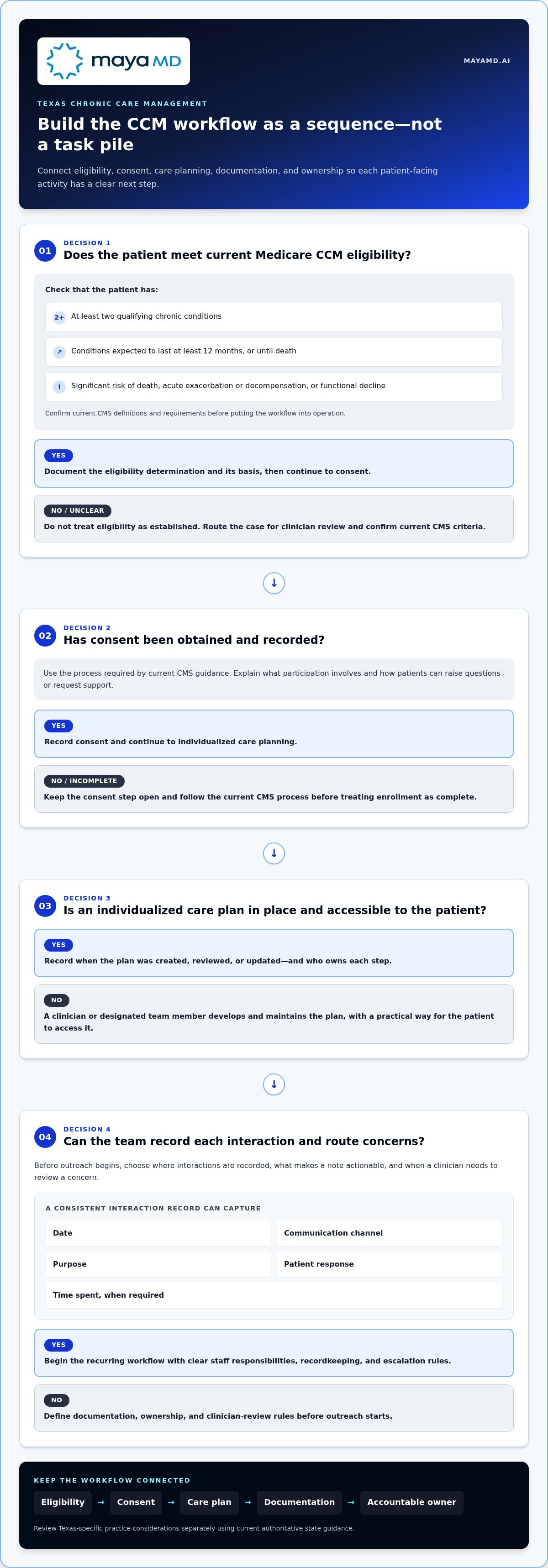
A reliable CCM process connects each patient-facing activity to a clear record and an accountable owner. Build the workflow as a sequence, not a collection of tasks spread across inboxes and staff members. That structure makes it easier to see whether enrollment is complete, who follows up, and when a clinician needs to review a concern.
Build an enrollment and care-planning process
Begin with a defined method for identifying potential participants, such as a clinician referral or a review of the practice’s patient panel. Staff can gather relevant condition information for clinician review, then document the eligibility determination and its basis. Under current Medicare CCM concepts, eligibility generally involves at least two qualifying chronic conditions expected to last at least 12 months, or until death, with significant risk of decline. Confirm current CMS eligibility, consent, care-plan, time, and billing rules before putting these steps into operation.
Once eligibility is established, obtain and record consent using the process required by current CMS guidance. Explain what participation involves and how patients can raise questions or request support. A clinician or designated team member can then develop and maintain an individualized care plan, with a practical way for the patient to access it. Record when the plan is created, reviewed, or updated, and assign responsibility for each step.
Review Texas practice considerations separately. Have the appropriate practice leaders assess professional responsibilities, communication processes, and other state-specific considerations using current authoritative guidance. Meeting federal Medicare requirements doesn’t automatically resolve every Texas practice question.
Set documentation, escalation, and oversight rules
Before outreach begins, decide where the team will record each interaction and what information makes a note actionable. A consistent record can capture the date, communication channel, purpose, patient response, time spent when required, next action, and responsible staff member. Make sure the care plan and relevant notes remain accessible to the care team, and define how corrections and follow-up will be documented.
Next, define escalation criteria with clinical leadership. For example, a patient reporting a new concern or difficulty following the care plan may need staff follow-up or clinician review, depending on the practice’s protocols. Specify who receives an escalation, how receipt is tracked, and how the final action is recorded. Automated tools may support communication and organize information, but they should not make clinical decisions independently or replace clinician oversight.
Enrollment owner
tracks eligibility review and consent status.
Care-management staff
conduct assigned outreach and document responses and follow-up.
Clinician
reviews clinical concerns and maintains appropriate oversight of the care plan.
Program lead
monitors workflow completion and identifies documentation gaps.
Keep adjacent models distinct as you design the process. Practices considering how CCM relates to broader Advanced Primary Care Management can compare their goals and requirements without treating the programs as interchangeable. If your workflow includes hospital-to-home communication, discuss how MayaMD can support care transitions and remote monitoring within its defined role.
Choose a Texas CCM Operating Model: In-House, Supported, or Technology-Enabled
Choose an operating model based on the work your practice needs to complete, not simply the tools it can acquire. In-house staffing offers direct integration with existing teams, while external operational support can add capacity for defined tasks. Technology-enabled workflows can help organize communication and information, but they don’t replace accountable staff, clinician oversight, or a complete CCM program.
Match staffing responsibilities to the care workflow
Separate administrative coordination and patient outreach from clinical assessment and decision-making. Name an owner for enrollment, routine follow-up, documentation quality, and escalation tracking. Clinicians should retain responsibility for decisions that require clinical judgment. Before assigning work across employees or external support, review current federal guidance and applicable Texas professional requirements. Don’t assume role boundaries from a workflow diagram alone.
Operating model | Potential advantages | Trade-offs to assess
In-house team | Familiarity with practice protocols and existing records can support continuity. | Competes for staff capacity; recurring outreach and documentation need protected ownership.
External operational support | May help with defined coordination or outreach tasks when internal capacity is limited. | Requires clear handoffs, documentation standards, escalation routes, and clinician oversight.
Technology-enabled workflow | Can organize communication, information, and follow-up steps across a team. | Tools don’t establish eligibility, ensure compliant billing, or make clinical decisions on their own.
These models can be combined. A practice might keep clinical review in-house, use operational support for specified coordination tasks, and use technology to make activity visible to the team. Assign an accountable person to every handoff, including who reviews an escalation and how its resolution is recorded.
Assess technology for continuity and patient engagement
Choose communication channels around patient preference and practical access. App-based communication may suit some patients, while voice or two-way text may work better for others. A consistent channel can make it easier for a patient to respond between visits, but the practice still needs a process for reviewing responses and routing concerns to the right person.
MayaMD supports care transitions from hospital discharge to home and remote monitoring through app, voice, and two-way text communication. Patients can reply through the app, by phone call, or by text, with replies captured in the same care plan. The clinician portal presents structured notes and escalations for clinician review. Clinicians retain all care decisions.
For workflows that incorporate connected readings, define how the clinical team reviews and acts on them. MayaMD’s connected devices transmit readings automatically, supporting visibility and follow-up within a remote-monitoring workflow. The practice still needs to decide who reviews the information and how concerns are escalated.
As you decide how to start a chronic care management program in Texas, test the model against real workflow scenarios: a patient who doesn’t respond, a new concern received by text, or a reading that needs review. For each case, confirm ownership, documentation, and escalation. This practical review reveals whether the model supports continuity or simply shifts administrative work elsewhere.
Launch a Texas CCM Program in Measured, Verifiable Steps
A staged launch lets a practice test its CCM design in daily operations before extending it across teams or patient populations. Treat the launch as a series of decisions with documented owners, evidence, and review points. Operational measures can show whether workflows are functioning, but they don’t guarantee reimbursement or clinical outcomes.
Assess readiness.
Review the patient population, existing follow-up processes, staffing capacity, and documentation systems. Estimate the work the team can reliably support, then identify where handoffs or records currently break down. Have compliance and clinical leaders identify which Medicare requirements need current CMS verification and which Texas-specific professional considerations need authoritative review.
Define the initial scope.
Select the conditions, patient group, and services the practice intends to include. Set boundaries for the program, including what staff can handle through routine coordination and what requires clinician review. Keep the scope manageable while making it meaningful enough to test the intended continuity goals.
Assign accountable roles.
Name owners for enrollment tracking, patient communication, documentation review, escalation routing, and clinician oversight. Clarify backup coverage and handoff expectations so tasks don’t remain in an unassigned inbox. Confirm role assignments against current federal guidance and applicable Texas professional rules.
Configure the workflow.
Map the patient journey from identification through follow-up. Set up documentation fields, outreach channels, escalation pathways, and a method for tracking completion. Before launch, walk through common scenarios with staff, such as a patient who can’t be reached or a response that needs clinical review.
Pilot and evaluate.
Begin with a manageable cohort. Set review dates in advance, then gather feedback from patients and staff to identify friction, access barriers, and unclear ownership. Adjust the workflow and record each change before expanding.
Measure operational performance, then validate
Establish a baseline before the pilot so the team can distinguish workflow changes from existing performance. Useful measures include the number of patients identified and enrolled, outreach completion, successful patient engagement, completed follow-up actions, and documentation completeness. Define each measure consistently. For example, specify what counts as a completed contact attempt and what information a note must include to pass review.
At planned checkpoints, audit a sample of records against current CMS requirements and internal protocols. Review consent and care-plan documentation, required time records where applicable, patient access to support, missed contacts, escalation handling, and unresolved workflow issues. Separate operational findings from billing conclusions. Validate coding and reimbursement processes against current CMS sources before billing.
Use the review to decide whether to maintain, revise, or expand the pilot. Document the issue, assigned owner, corrective action, and follow-up review date. Expand only when the team has evidence it can complete the workflow consistently, not on the assumption that a larger cohort will produce the same results.
If your launch plan includes hospital-to-home communication or remote monitoring, Book a 20-minute intro to discuss how MayaMD’s capabilities fit that part of the workflow.
Connect CCM to Hospital-to-Home Continuity with MayaMD
A CCM program can connect with care-transition work when a patient’s needs continue after hospital discharge. MayaMD supports patients from discharge through the critical months at home and provides remote-monitoring capabilities. Its role is to support this transition and ongoing monitoring, not to replace a practice’s full CCM program, billing processes, or clinician-led care decisions.
That distinction matters. A practice can define its CCM eligibility, care-plan, documentation, and billing workflows separately, then determine how post-discharge communication and monitoring fit into its continuity processes. For teams developing a hospital-to-home transition pathway, structured discharge-to-home communication can connect the transition experience with follow-up after a patient returns home.
Support patient engagement across communication channels
Patients differ in how they prefer to receive information and respond. MayaMD supports app, voice, and two-way text communication, so patients can engage through the channel that works for them. Patient replies and relevant follow-up can inform the team’s ongoing documentation and care coordination. Define how that information will be reviewed and incorporated into the practice’s care-plan processes.
For remote monitoring, MayaMD supports FDA-cleared cellular blood-pressure cuffs, scales, and pulse oximeters that transmit readings automatically. Define who reviews incoming information, how concerns are escalated, and how decisions are documented. The technology supports visibility and communication; clinicians determine the appropriate clinical response.
Protocol-driven Conversational AI uses a structured question flow, with AI doing the talking. Companion AI, through the Maya app, answers questions, sends reminders and education, and checks in day or night. Clinical staff support enrollment, outreach, follow-up calls, and EHR documentation, while the clinician portal presents escalations and structured notes for review. This keeps automation in a supporting role rather than positioning it as an independent clinical decision-maker.
Keep clinicians in control as the program develops
Clinician oversight is central. AI asks protocol-driven questions; clinicians make all care decisions. Clinical staff can support communication and escalation, while the portal helps present information for review. This division of responsibilities can connect patient engagement with accountable clinical follow-up, provided the practice defines clear ownership and operating protocols.
MayaMD has reached 300,000+ patients through partner practices. That experience provides context for practices considering how post-discharge engagement and remote monitoring may support continuity, without promising a clinical or financial outcome.
For implementation, the rollout option is: Start with one unit and go live in 4-6 weeks. A focused start gives the team a defined setting in which to align communication, monitoring, and escalation workflows before considering broader use.
To discuss how these care-transition and remote-monitoring capabilities could fit your program, Book a 20-minute intro. Phone: +1 (888) 629-2631. Email: info@mayamd.ai.
Make Your Next Step a Measured One
A sustainable program starts with a clear operational question: what would help your team stay connected with patients after they leave the hospital or complete an office visit? For practices considering how to start a chronic care management program in Texas, identify a manageable starting point, define what continuity should look like, and determine how follow-up will remain clinician-led.
MayaMD’s work at Spring Valley Hospital included 30%+ fewer 30-day heart-failure readmissions. That result is context, not a promise of what another program will achieve. Assess your own patient population, workflows, and measures of progress.
Use the next planning conversation to explore how hospital-to-home communication and remote monitoring could fit into your care model, while keeping clinical decisions and program requirements clearly governed. A focused discussion can help your team identify practical considerations before setting a pilot in motion.
Book a 20-minute intro to discuss a patient-centered next step. Your team can build a program deliberately, learn from implementation, and strengthen continuity over time. Phone: +1 (888) 629-2631. Email: info@mayamd.ai.
Frequently Asked Questions
Can a patient receive CCM and remote patient monitoring at the same time?
Yes, a patient may qualify for both, but receiving both services doesn’t mean they can always be billed together. CCM and remote patient monitoring are distinct services with potentially different eligibility, documentation, and billing rules. Before combining workflows, verify current CMS requirements for the specific patient, services furnished, and billing period. Coordinate records carefully so activities are documented appropriately and aren’t incorrectly counted across services.
How often should a CCM team contact each patient?
Contact frequency should reflect the patient’s documented care plan, individual needs, and applicable program requirements; there isn’t a universal cadence for every patient. For example, a change in a patient’s circumstances may call for a different follow-up plan than routine coordination. Record outreach attempts, responses, resulting actions, and clinician escalations consistently, then review the process against current CMS guidance.
Does a CCM program require a dedicated care manager?
A practice needs clear responsibility for CCM tasks, but that doesn’t necessarily mean hiring someone with the title “care manager.” Staffing structure depends on the practice, patient needs, and current requirements. For example, one person might coordinate scheduling and documentation while a clinician handles decisions requiring clinical judgment. Document task ownership and confirm personnel requirements against current CMS guidance and applicable Texas professional rules.
Can Texas practices deliver CCM outreach by phone or text?
Phone or text may fit some patients’ communication preferences, but no channel is automatically appropriate for every situation. Establish procedures for confirming identity, addressing consent where applicable, recording the interaction, and routing clinical concerns for review. For example, a message that raises a health concern should follow the practice’s escalation process rather than remain in a general inbox. Check current CMS requirements and organizational privacy policies before relying on a channel.
What should a practice do when a CCM patient is hospitalized?
Follow the practice’s transition workflow, coordinate relevant information with the patient and treating clinicians, and clarify who owns follow-up after discharge. Don’t assume CCM alone covers every discharge-related service. Where hospital-to-home communication and remote monitoring are part of the transition, MayaMD can support that defined pathway; clinicians retain all care decisions. Document handoffs and unresolved questions so the outpatient team can address them appropriately.
How can a small Texas practice start CCM without disrupting clinic operations?
For a small practice planning how to start a chronic care management program in Texas, begin by identifying patient needs and the staff capacity available for recurring work. Assign owners for coordination and documentation, then pilot a defined workflow before expanding. Track whether outreach is completed, records are usable, and escalations reach the right clinician. Review current CMS requirements and Texas-specific professional considerations before launch, without assuming reimbursement or outcomes.
What records should a practice retain for a CCM program review?
Organize records related to eligibility, consent where required, care planning, patient communications, services provided, and clinician follow-up. For example, a reviewer should be able to follow a documented concern from the patient’s message through the team’s response and any clinical review. This is not a complete legal checklist. Compare your recordkeeping process with current CMS guidance, payer requirements, and organizational policies, and address any gaps you identify.




See The MayaMD Difference
Fill the form below
Download Our Apps
MayaMD for patients and MayaPro for physicians - available on iOS and Android.
FOR PATIENTS
MayaMD App
AI-powered symptom assessment, triage, and secure access to your care team.
FOR PHYSICIANS
MayaPro App
MayaPro brings patient vitals, RPM/PCM care plans, and clinical decision support to your pocket.