
Remote Care for Rural Arizona: A Provider's Guide

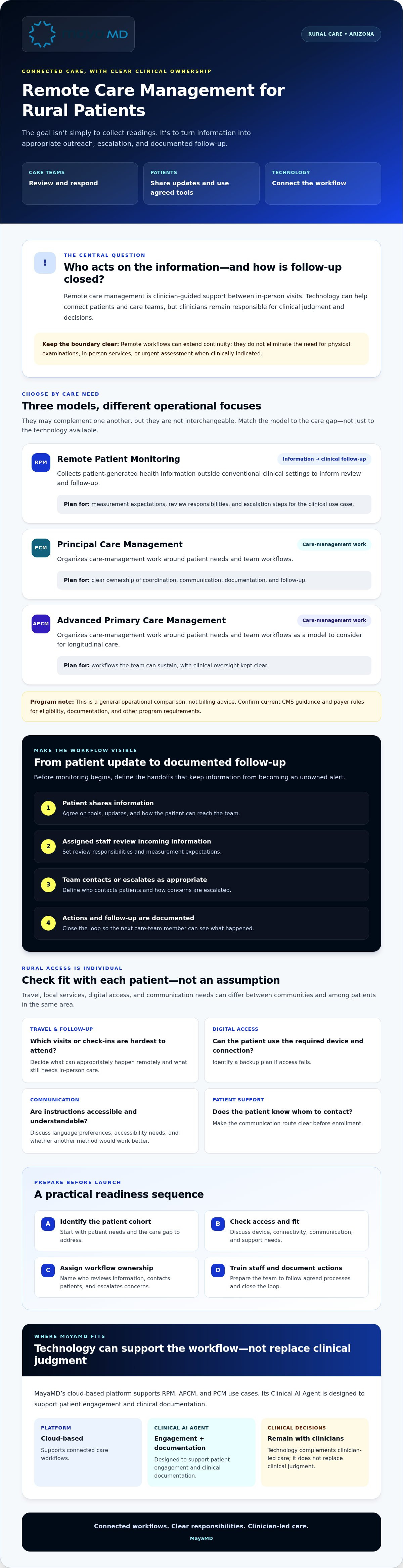
A remote care program can collect data and still leave patients unsupported. For organizations evaluating remote care management for rural patients, the key question isn’t simply which technology can monitor readings. It’s how care teams will turn information into appropriate outreach, escalation, and documented follow-up. Distance and differences in digital access make that distinction especially important.
Rural providers know that travel barriers can disrupt consistent follow-up. Choosing a remote care approach means matching patient needs and organizational capacity with workflows staff can sustain, while keeping clinical oversight clear. This guide compares remote monitoring, care management, and virtual engagement approaches, and explains how each can support continuity when responsibilities and processes are well defined.
It also covers practical considerations for enrollment, connectivity, monitoring, documentation, and escalation to help you assess a technology partner. MayaMD’s cloud-based platform supports RPM, APCM, and PCM use cases, with a Clinical AI Agent designed to support patient engagement and clinical documentation. These capabilities can complement clinician-led care, not replace clinical judgment. The goal is a connected workflow that helps teams stay informed and patients remain engaged, even when care takes place across long distances.
Key Takeaways
• Compare RPM, PCM, and APCM by the care need each is designed to support, then verify current program requirements before selecting a model.
• Assess remote care management for rural patients in Arizona against patient access, clinical oversight, documentation, and your team’s capacity to act on incoming information.
• Before introducing monitoring tools, define who reviews alerts, contacts patients, escalates concerns, and documents follow-up.
• Prepare for implementation by identifying the patient cohort, checking digital access, assigning workflow ownership, and training staff.
• Consider whether a cloud-based platform and AI-supported engagement and documentation can connect care workflows while keeping clinical decisions with clinicians.
Why remote care management matters for rural patients in Arizona
For rural patients, care can’t always depend on another trip to a clinic. Remote care management is technology-enabled, clinician-guided support between in-person visits. It can combine planned communication, coordination, and, when appropriate, monitoring to inform follow-up. Unlike a standalone video visit, it is an ongoing care process. Technology helps connect patients and care teams, while clinicians remain responsible for clinical judgment and decisions.
That distinction matters in Arizona, where a patient’s distance from a provider, access to local services, and ability to travel can vary by community. Remote workflows can help teams maintain contact between visits, but they don’t eliminate the need for physical examinations, in-person services, or urgent assessment when clinically indicated. The model should extend continuity, not suggest that every need can be managed remotely.
What does remote care management include?
A program may include scheduled outreach, care coordination, and review of patient-reported information or measurements. Remote patient monitoring (RPM) is one component: it uses technology to collect health information outside conventional clinical settings. A video appointment, by contrast, is an encounter at a particular time and may not include ongoing monitoring or follow-up. Patients provide updates and use agreed tools; care teams interpret the information, contact patients, document actions, and escalate concerns according to established protocols.
Technology can support communication and organize information, but it doesn’t determine the right care plan on its own. Program design depends on patient needs and the organization’s capacity to assign outreach, review incoming information, and close the loop. Providers assessing longitudinal care workflows may also find it useful to review advanced primary care management as one model to consider.
Which rural Arizona access needs should providers assess?
Start with the individual, not an assumption about “rural” patients. Ask how travel affects follow-up and what local services are accessible. Needs may differ between communities and among patients in the same area. Before enrollment, discuss whether the patient has a suitable device, reliable connectivity, and confidence using the proposed tools. Also assess language preferences, accessibility needs, and whether another communication method would work better.
Travel and follow-up
Which visits or check-ins are hardest to attend, and what can appropriately happen remotely?
Digital access
Can the patient use the device and connection required for the workflow? What’s the backup if access fails?
Communication and support
Are instructions accessible and understandable, and does the patient know whom to contact?
These questions help providers identify where remote care management for rural patients in Arizona may support continuity and where in-person care remains necessary. Validate access conditions with patients and community partners instead of treating statewide circumstances as uniform.
How RPM, PCM, and APCM support rural care in Arizona
These models address different parts of ongoing care. Remote patient monitoring (RPM) gathers patient-generated health information for review and follow-up. Principal care management (PCM) and advanced primary care management (APCM) organize care-management work around patient needs and team workflows. They may complement one another, but they aren’t interchangeable. For remote care management for rural patients in Arizona, choose a model based on the care gap you need to address, not simply the technology available.
The comparison below describes each model’s general operational focus, not billing advice. Eligibility, documentation, and other program requirements can change. Confirm current CMS guidance and payer rules before designing or billing a program.
| Model | Primary focus | Workflow consideration |
|---|---|---|
| RPM | Collecting health information remotely to inform clinical follow-up. | Set measurement expectations, review responsibilities, and escalation steps for the clinical use case. |
| PCM | Coordinating management for a patient with a complex health condition. | Define how the care team coordinates condition-related needs and documents its work under current requirements. |
| APCM | Organizing ongoing, comprehensive primary-care management. | Build workflows around longitudinal primary care and verify applicable program requirements. |
When is remote patient monitoring a fit?
RPM may be appropriate when information gathered between visits can help clinicians assess a patient’s status and determine follow-up. The device, measurement schedule, and thresholds for outreach depend on the clinical use case and the program’s protocols. Monitoring alone isn’t care. Teams need to know who reviews information, what requires action, and how that action is recorded. See the remote patient monitoring service overview for platform context.
Arizona providers can also review the University of Arizona Telemedicine Program’s Telehealth Innovations in Rural Health for regional examples of telehealth initiatives. Local needs still vary, so program design should reflect the population and services each organization supports.
How do PCM and APCM differ from monitoring alone?
Monitoring produces information; care-management models structure how teams support patients over time. PCM focuses on management of complex conditions, while APCM provides a distinct framework for ongoing primary-care management. Neither label alone establishes that a patient or organization qualifies for a particular program or payment. Confirm current CMS definitions and documentation requirements before implementation. MayaMD’s Advanced Primary Care Management framework offers further context on APCM.
To assess how these approaches could fit your clinical workflows, you can contact MayaMD about connected care workflows.
How to compare remote care management options for Arizona providers
The right platform should fit the care model and the people expected to use it. For remote care management for rural patients in Arizona, evaluate how each option supports clinical oversight, patient access, documentation, and daily work, not just the features shown in a demonstration. A monitoring dashboard has limited value if staff can’t tell who owns a new alert or what action should follow.
What should a clinical and operational evaluation cover?
Map the workflow from incoming information to documented follow-up. Ask vendors to demonstrate how staff see a patient update, determine its priority, record an action, and route a concern for clinician review. Specify who owns each step and what happens when the assigned person is unavailable. Clear escalation ownership turns incoming information into a more coordinated remote workflow.
Clinical fit
Can the workflow support the conditions and care objectives your program serves?
Oversight
Which decisions remain with clinicians, and how are AI-supported interactions reviewed, governed, and escalated?
Documentation
What actions and communications can staff record, and how can the organization retrieve them for care continuity and program review?
Workflow integration
Ask what data exchange or EHR integrations are actually supported, how they work, and what staff must do manually. Don’t assume compatibility based on a general claim.
Request a walkthrough using realistic scenarios, such as a missed check-in, an out-of-range measurement, or a patient who reports a new concern. Look for an explicit path from notification to review, outreach, escalation, and documentation. Ask how the system handles incomplete or conflicting information, and what the vendor can substantiate about performance. Separate confirmed capabilities from claims about clinical outcomes, savings, or reimbursement, and independently verify evidence relevant to your organization.
How can providers assess patient access and usability?
Test the proposed workflow with the patients and settings you serve. Confirm the required devices, connectivity, and patient actions. Then ask how onboarding, language needs, accessibility, and ongoing technical assistance are addressed. A process that works for someone with a reliable connection and confidence using digital tools may not work for a patient without either.
Plan alternatives before launch. Depending on clinical needs and organizational capacity, these might include an appropriate phone-based check-in or an in-person follow-up. Ask vendors to show the patient experience, not just the staff interface, and clarify what support is included and what your team must provide. Careful evaluation helps providers select technology that complements clinician-led care instead of adding alerts and administrative tasks without clear ownership.
How to prepare a rural Arizona remote care program
A workable program starts with defined care needs and accountable workflows, not a technology purchase. For remote care management for rural patients in Arizona, preparation should bring clinical, operational, compliance, and technology stakeholders together to assess whether the proposed model is safe, accessible, and manageable for the organization.
Establish readiness before launch
Use this sequence to turn a care objective into an operational plan:
Define the patient cohort.
Identify the population, clinical needs, care objectives, and inclusion criteria. Document existing follow-up gaps the program is intended to address.
Assess patient access.
Confirm what devices and connectivity the workflow assumes. Ask how patients will participate, and define a non-digital alternative for those who can’t reliably use the proposed channel.
Map responsibilities.
Assign ownership for reviewing incoming information, contacting patients, documenting actions, and escalating clinical concerns. Confirm that team capacity matches the anticipated workflow.
Set clinical protocols.
Specify what prompts routine outreach, what requires clinician review, and how urgent concerns are handled. Make clear that technology supports the workflow but doesn’t replace clinical judgment.
Review documentation and compliance.
Determine what the team needs to record and where. Have compliance and operational stakeholders independently verify applicable program, regulatory, and reimbursement requirements before relying on them.
Train staff and test the process.
Walk through ordinary and exception scenarios, including missed updates, technical difficulties, and information requiring escalation. Ensure staff know their roles and how to use the selected tools.
Pilot, measure, and refine
Begin with a pilot scope your team can oversee. Before launch, agree on measures that reflect the program’s purpose, such as patient participation, staff workflow burden, completion of planned follow-up, and patterns in escalations. Decide how each measure will be reviewed. Set targets only after considering the population, baseline, and available capacity.
Review findings with clinical and operational stakeholders. For example, repeated missed updates may point to a connectivity barrier or an enrollment process that needs adjustment, while unclear alert ownership may reveal a workflow gap. Refine protocols and staff training under clinical oversight, then continue evaluating whether the process supports patient needs without creating unmanageable work. Verify regulatory and reimbursement claims independently rather than treating vendor materials as authoritative.
Once your readiness questions and review process are defined, you can Discuss your care-management requirements with MayaMD.
How MayaMD can support connected remote care management
After defining the care model and operational requirements, providers can assess whether a technology platform supports the workflows they intend to run. MayaMD provides a cloud-based, HIPAA-compliant clinical AI platform that supports RPM, APCM, and PCM use cases for chronic care. For organizations considering remote care management for rural patients in Arizona, these capabilities may help connect patient engagement and documentation workflows, subject to the provider’s clinical protocols and operational needs.
Where can a clinical AI platform fit in the care workflow?
MayaMD’s Clinical AI Agent combines deterministic logic with generative AI to support patient engagement and clinical documentation, including post-discharge communication. These capabilities are intended to support care teams, not independently diagnose patients or replace clinician oversight. For example, technology may assist with structured communication or documentation while clinicians retain responsibility for interpreting relevant information and deciding what care is appropriate. Review the Clinical AI Agent overview for product-specific detail.
In a connected workflow, monitoring and care management serve related but distinct roles. RPM can provide patient-generated information for clinical review, while PCM and APCM workflows address ongoing care-management needs. A platform’s value depends on how well its supported capabilities align with the organization’s established process for communication, review, documentation, and follow-up. Technology alone doesn’t define that process.
What should providers confirm before evaluating a platform?
Use a vendor discussion to test the proposed workflow, not just the feature list. Ask for clear explanations of security practices, technical requirements, AI governance, and the responsibilities that remain with your care team. Confirm what is supported today and what would require additional configuration or manual work.
Workflow fit
How are patient outreach and documentation supported, and can staff see what has occurred?
Clinical governance
How are AI-supported interactions governed, reviewed, and routed for clinician attention?
Technical capabilities
What connectivity, data exchange, or integration capabilities are verified for your environment?
Claims and requirements
Which clinical or financial claims have supporting evidence, and which program requirements must your organization verify independently?
Evaluate claims about outcomes, reimbursement, integrations, or Arizona-specific implementation coverage against your own requirements and verified evidence. A structured review helps distinguish confirmed capabilities from assumptions while keeping clinical accountability with the care team.
To discuss whether MayaMD’s capabilities fit your planned workflows, Discuss a remote care management approach.
Build a connected care model your team can sustain
Effective remote care management for rural patients in Arizona depends on more than collecting information at a distance. Choose between RPM, PCM, and APCM based on patient needs and verified program requirements, then define who reviews updates, follows up, documents actions, and escalates concerns. Assess digital access early and provide an alternative when remote tools aren’t suitable.
A platform can support these workflows, but it shouldn’t replace clinician judgment. MayaMD describes its platform as cloud-based and HIPAA-compliant, with support for RPM, APCM, and PCM use cases, patient engagement, clinical documentation, and post-discharge communication. Providers should confirm how these capabilities fit their clinical processes, technical environment, and governance requirements.
Ready to explore a connected approach? Discuss your remote care management needs with MayaMD. With clear workflows and thoughtful implementation, your team can build a model that supports continuity while keeping care patient-centered and clinically governed.
Frequently Asked Questions
What is remote care management for rural patients?
Remote care management is technology-enabled, clinician-guided support between in-person visits. It may combine planned patient outreach, care coordination, and monitoring when clinically appropriate. Unlike a one-time video appointment, it establishes an ongoing workflow for gathering information, reviewing needs, and arranging follow-up. Patients participate through agreed communication channels, while care teams retain responsibility for clinical decisions, documentation, and escalation.
Can remote care management work for patients with limited internet access?
It can, if the program accounts for access limitations rather than assuming every patient has reliable internet or a suitable device. Providers should assess connectivity, device availability, language, accessibility, and comfort with digital tools before enrollment. They should also establish a practical alternative, such as phone outreach or an in-person follow-up when appropriate. The best channel depends on patient needs and the clinical workflow.
How does remote patient monitoring differ from care management?
Remote patient monitoring collects health information from a patient outside a traditional clinical setting, often for care-team review. Care management is the broader process of coordinating support, outreach, and follow-up over time. Monitoring can inform care management, but data collection alone doesn’t ensure action. Teams need defined responsibility for reviewing information, contacting patients, documenting decisions, and escalating concerns according to clinical protocols.
Is remote care management a replacement for in-person care?
No. Remote care management can complement in-person care by helping teams maintain contact between visits, but it can’t meet every clinical need. Some assessments and services require an in-person encounter, and clinicians must use judgment to determine the appropriate setting. Providers should define when remote communication is suitable, when an in-person evaluation is needed, and how patients can access follow-up if their condition changes.
How do providers choose between RPM, PCM, and APCM?
Start with the patient’s care needs and the work your team needs to perform. RPM focuses on gathering patient-generated information for clinical review. PCM and APCM are distinct care-management models with different program definitions and workflows. Before selecting or billing under a model, verify current CMS and payer requirements, including relevant eligibility and documentation rules. Don’t assume that monitoring automatically establishes fit for a care-management program.
What should a rural provider look for in remote care software?
Evaluate clinical fit, patient accessibility, security, documentation, and workflow ownership. Ask who reviews incoming information, how outreach and escalation are handled, what staff must record, and what happens when connectivity fails. Confirm device and technical requirements, language and accessibility options, and available onboarding or support. Request evidence for vendor claims about integrations or outcomes, and verify that proposed workflows align with your organization’s policies.
Can AI manage rural patients without clinician oversight?
No. AI can support defined tasks such as patient engagement or clinical documentation, but it shouldn’t replace clinician judgment or independently manage patient care. Care teams remain responsible for reviewing relevant information, making clinical decisions, and acting on concerns. Ask vendors how AI-supported interactions are governed, what staff can review, and how issues are routed to clinicians. Clear oversight helps keep technology within its intended role.




See The MayaMD Difference
Fill the form below
Download Our Apps
MayaMD for patients and MayaPro for physicians - available on iOS and Android.
FOR PATIENTS
MayaMD App
AI-powered symptom assessment, triage, and secure access to your care team.
FOR PHYSICIANS
MayaPro App
MayaPro brings patient vitals, RPM/PCM care plans, and clinical decision support to your pocket.