
AI-Governed RPM Software for Clinical Workflows (2026)

The sheer volume of data is no longer the solution to patient care; it has become the primary barrier to clinical efficiency. You likely feel the weight of every unread alert and fragmented EHR entry, knowing that somewhere in that noise is a patient who needs your immediate attention. While traditional RPM software for improving clinical workflows promised visibility, it often delivered a secondary epidemic of physician burnout and administrative fatigue. We recognize that the burden of documentation shouldn't eclipse the practice of medicine. This article demonstrates how AI-governed orchestration transforms raw biometric streams into high-fidelity, actionable insights that integrate directly with your existing systems. You'll learn how deterministic logic and automated clinical documentation can eliminate the friction between remote devices and professional decision-making. We will examine the shift from simple data collection to a systematic framework that reduces hospital readmissions and restores the human connection in chronic care management through the lens of 2026 technological standards.
Key Takeaways
• Learn how to mitigate physician burnout by transitioning from passive data collection to AI-governed orchestration that filters clinical noise.
• Discover the critical role of neuro-symbolic AI and deterministic logic in ensuring clinical safety while eliminating generative AI hallucinations.
• Understand how specialized RPM software for improving clinical workflows transforms raw biometric streams into high-fidelity, actionable alerts within your EHR.
• Explore how a Clinical AI Agent automates documentation and triage to reduce the administrative burden of chronic care management.
• Identify the strategic advantages of integrating RPM, APCM, and PCM into a single, governed ecosystem to demonstrably reduce hospital readmissions.
Defining the 2026 Clinical Workflow Crisis in Chronic Care
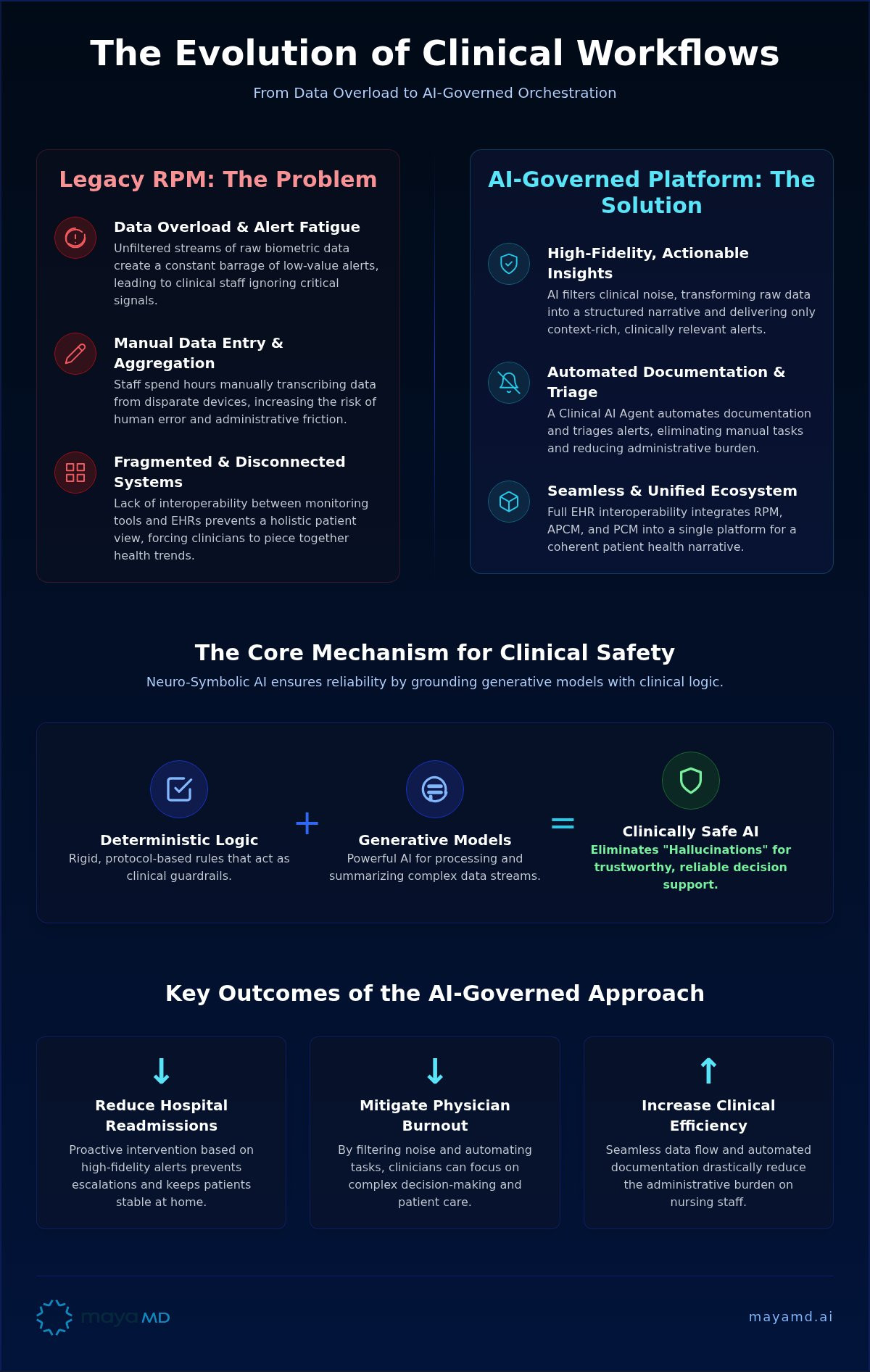
Chronic care management has transitioned from the era of paper charts to a digital environment defined by relentless data streams. This evolution was meant to provide clarity, but for many practitioners, it has resulted in a debilitating state of information overload. As we move through 2026, the challenge isn't the lack of data; it's the absence of governance over that data. Traditional models of Remote patient monitoring (RPM) often fail because they lack the intelligence to distinguish between a clinical emergency and a technical anomaly. This leads to alert fatigue, where clinicians are inundated with notifications that lack context or urgency. Administrative friction is the hidden cost of this inefficiency, consuming valuable hours that should be dedicated to complex patient management. AI-governed workflows represent the necessary shift from passive data collection to active clinical orchestration.
The Burden of Manual Remote Monitoring
Manual data entry remains a significant bottleneck in primary care. Staff often spend hours aggregating data from disparate patient devices, a process that slows clinical decision-making and increases the risk of error. In major metropolitan areas like Chicago, where staffing shortages are acute, the need for automated oversight is no longer a luxury. Modern RPM software for improving clinical workflows must do more than display numbers; it must synthesize them into a coherent health narrative. Fragmented data prevents a holistic view of the patient, forcing providers to spend time piecing together health trends from isolated data points rather than focusing on intervention. This manual labor doesn't just drain resources; it directly contributes to the burnout that characterizes the current primary care landscape.
Interoperability as a Workflow Foundation
True efficiency requires a foundation of seamless connectivity. Cloud-based, HIPAA-compliant platforms serve as the bridge between home-based monitoring devices and hospital EHR systems. This integration is essential for reducing the repetitive administrative tasks that currently plague nursing staff. When data flows securely and directly into the patient record, it eliminates the need for manual transcription and reduces the likelihood of documentation gaps. We see the resulting benefits in several key areas:
Elimination of duplicate data entry
across multiple software platforms.
Real-time synchronization
of patient vitals with the clinical record for immediate access.
Centralized oversight
that supports both Advanced Primary Care Management (APCM) and Principal Care Management (PCM).
By unifying these disparate records, organizations can ensure that high-fidelity data triggers the right action at the right time. This connectivity isn't just a technical feature; it's a strategic necessity for any practice looking to optimize its clinical output while maintaining a high standard of patient safety.
The Mechanism of AI-Governed Remote Patient Monitoring
Raw data is a liability without a governance layer. While legacy systems act as mere conduits for cellular monitoring devices, modern RPM software for improving clinical workflows functions as an intelligence layer that interprets biometric streams in real time. This shift is powered by neuro-symbolic AI, a sophisticated architecture that combines the reasoning capabilities of deterministic logic with the processing power of generative models. By applying this "governed" approach, the platform ensures that every alert is grounded in clinical reality. Advanced systems now personalize care with RPM and AI by filtering out environmental noise and highlighting only those trends that require professional intervention. This methodology transforms a chaotic influx of numbers into a structured, high-fidelity clinical narrative.
Deterministic Logic vs. Generative AI
Logic ensures safety. In a clinical setting, the unpredictability of standard generative AI is unacceptable because it risks "hallucinations" or deviations from medical protocols. MayaMD addresses this by utilizing deterministic logic as a primary framework. This logic serves as a rigid set of guardrails that generative AI cannot cross. The result is a system that follows established medical protocols without deviation, providing reliable decision support that clinicians can trust. When a patient's blood pressure exceeds a specific threshold, the system doesn't just "guess" a response; it executes a pre-defined, logic-based workflow that matches the severity of the event. This stability is essential for maintaining regulatory compliance and patient safety in high-stakes environments.
Automating Clinical Documentation with AI Agents
Documentation happens instantly. The Clinical AI Agent acts as a bridge between the patient's home environment and the provider's office, transforming interactions into structured clinical notes automatically. For physicians in Phoenix who often struggle with an "after-hours" documentation burden, this automation provides significant relief. The agent synthesizes real-time data for Principal Care Management (PCM) specialists, ensuring that complex biometric fluctuations are contextualized within the patient's specific history. To see these systems in action, healthcare leaders can explore the MayaMD clinical AI platform. By automating these repetitive tasks, the software allows providers to focus on higher-level clinical reasoning rather than clerical data entry. This capability-to-outcome shift is what defines the next generation of chronic care management, where the technology handles the administrative weight so the clinician can focus on the patient.
Comparing Legacy RPM vs. AI-Integrated Platforms
Distinguishing legacy systems from modern AI-governed platforms requires a fundamental shift in how we view the architecture of intervention. Legacy remote monitoring typically functions as a passive data conduit, where biometric information is collected in silos and pushed to clinicians without context. This model forces providers into a reactive posture, where they must manually sort through thousands of data points to identify a single clinical concern. By contrast, the adoption of RPM software for improving clinical workflows shifts the burden of initial analysis from the human to the machine. This transition is documented in recent literature concerning AI and remote patient monitoring in the US healthcare market, which highlights the move toward proactive, logic-based filtering. While legacy systems increase administrative weight, AI-governed platforms orchestrate data into streamlined clinical actions.
The impact on patient outcomes is measurable. Proactive intervention allows for the identification of health trends before they escalate into acute events. In a legacy environment, a rising blood pressure trend might go unnoticed until it triggers a high-priority alert. In an AI-integrated ecosystem, the system recognizes the trend early and triggers a logic-based documentation event or a patient engagement prompt. This allows clinicians to focus their limited time on high-risk patients who require immediate human judgment, rather than spending their shift managing technical noise.
Workflow Efficiency Metrics
Efficiency is defined by the reduction of friction. In manual systems, clinicians often spend significant time on each patient just to verify data validity. Automated triage changes this dynamic by processing biometric streams against established medical protocols instantly. This results in a substantial reduction in emergency department diversion rates, as patients are managed more effectively in the home setting. By automating the triage and documentation layers, organizations can quantify a decrease in physician burnout, as the "after-hours" clerical burden is replaced by real-time AI support. The outcome is a clinical team that operates at the top of their license rather than as data entry specialists.
Scalability in Chronic Care Management
Legacy systems struggle to scale because their management requirements grow linearly with the patient population. Managing a few hundred patients might be feasible with manual oversight, but managing thousands of complex chronic cases requires a different framework. Advanced RPM software for improving clinical workflows enables this scale by utilizing asynchronous management. Large health systems in cities like Indianapolis are increasingly moving toward these governed ecosystems to maintain continuity of care across vast networks. Because the AI handles the triage of stable patients, the clinical staff can manage a significantly larger patient panel without compromising the quality of care or patient safety.
Strategic Implementation: Reducing Administrative Burden
Successful implementation of an advanced digital ecosystem requires a methodical approach that prioritizes clinical safety and operational continuity. It's not enough to simply deploy new tools; organizations must re-engineer their processes to ensure that RPM software for improving clinical workflows actually delivers on its promise of efficiency. This strategic transition involves moving from manual oversight to a governed, AI-assisted framework. By following a structured roadmap, healthcare leaders can ensure that the technology serves the clinician rather than adding to their clerical workload. The goal is a seamless integration where data flows from the patient's home directly into a structured, actionable clinical record.
Step 1
Identify specific workflow bottlenecks, such as manual data entry or redundant alert triage, in your current chronic care model.
Step 2
Select an RPM platform that features native Clinical AI Agent capabilities to handle routine patient interactions.
Step 3
Integrate deterministic AI logic with existing EHR protocols to ensure that all automated actions follow established medical guidelines.
Step 4
Train clinical staff on AI-assisted documentation techniques to maximize the speed of record completion.
Step 5
Monitor clinical outcomes and optimize the underlying logic to meet evolving 2026 standards for chronic care.
Addressing Physician Burnout Directly
Burnout is often a byproduct of "cognitive load," the mental exhaustion caused by managing too many low-value tasks. AI-governed systems address this by handling 'Level 1' patient inquiries and routine data checks that don't require a physician's direct intervention. By establishing a clear capability-to-outcome roadmap, organizations can secure staff buy-in by demonstrating exactly how the software will reclaim their time. Clinics in Las Vegas have successfully utilized this approach to reduce administrative time, allowing providers to focus on complex patient cases. This shift ensures that the most highly trained members of the care team are not bogged down by repetitive documentation.
Compliance and Security in 2026
Maintaining a HIPAA-compliant cloud architecture is non-negotiable when managing remote patient data. As regulatory requirements evolve, the platform must ensure data integrity across all Principal Care Management (PCM) workflows. AI plays a critical role here by maintaining audit-ready clinical documentation that is both precise and transparent. This systematic framework ensures that every clinical action is logged and justified by the underlying data, reducing the risk of compliance gaps. To begin modernizing your practice with these governed solutions, you can request a consultation with MayaMD. This proactive approach to security and documentation provides the stability needed to scale chronic care programs across large, complex health systems while protecting both patient privacy and provider liability.
MayaMD: Orchestrating the Future of Clinical Workflows
MayaMD represents the next stage of clinical evolution, functioning as a single, governed ecosystem that unifies disparate care programs. While basic digital tools often create fragmented data silos, our platform provides a comprehensive framework that integrates RPM, APCM, and PCM into a cohesive clinical strategy. This orchestration is essential for organizations transitioning to value-based care, where continuous monitoring and data integrity are the primary drivers of reimbursement. By utilizing RPM software for improving clinical workflows, providers can move past reactive management and adopt a proactive stance that prioritizes long-term patient health. We provide the technical depth and clinical validity required to manage complex chronic populations with precision.
Local expertise is foundational to our approach. We understand the specific regulatory and operational challenges faced by providers in Houston, Phoenix, and Indianapolis, offering a sophisticated partnership that goes beyond simple software provision. Our platform is built on the cold, hard logic of advanced data science, yet it remains deeply empathetic to the patient experience. This balance ensures that technology fosters connection rather than creating a digital barrier. By providing high-fidelity patient data that triggers actionable alerts, we enable clinicians to deliver superior care while maintaining the operational stability of their practice.
Advanced Primary Care Management (APCM) Solutions
The 2026 healthcare landscape requires a more integrated approach to primary care. MayaMD supports the latest APCM frameworks by bridging the gap between specialty care documentation and primary care oversight. This connectivity ensures that every member of the care team has access to a unified health narrative, reducing the risk of conflicting treatments or documentation gaps. Our system is designed to handle the nuances of multi-condition management, providing the deterministic logic needed to navigate complex clinical pathways safely. To understand the full scope of these requirements, you can read our definitive guide to APCM. By aligning your workflow with these standards, you ensure both clinical excellence and financial sustainability.
Deploying the Clinical AI Agent
Activating AI-governed workflows in your practice involves a methodical transition to automated triage and documentation. MayaMD allows for the customization of deterministic logic to match the specific needs of your patient population, ensuring that the AI follows your established protocols without deviation. This capability-to-outcome structure allows you to automate routine inquiries, freeing your staff to focus on high-stakes clinical decision-making. You can explore the role of Clinical AI Agents to see how this technology functions as a reliable partner in modern care. This deployment doesn't just improve efficiency; it restores the professional gravity of the clinical environment by eliminating the administrative noise that has historically hindered patient-provider connection.
Modernizing Chronic Care Through Governed Orchestration
The path forward for chronic care management is defined by the transition from passive data collection to proactive, governed orchestration. By implementing RPM software for improving clinical workflows, healthcare organizations can finally address the root causes of administrative burnout and fragmented care. This shift is enabled by our neuro-symbolic AI architecture, which provides the clinical safety of deterministic logic alongside the efficiency of automated documentation. It's a systematic framework designed to restore the human connection in medicine while maintaining rigorous professional standards.
Our HIPAA-compliant cloud architecture ensures that specialized modules for APCM and PCM function in harmony, creating a stable environment for long-term patient support. You now have the tools to transform raw biometric streams into high-fidelity clinical actions that prioritize both provider well-being and patient outcomes. We invite you to see how this systematic approach can modernize your practice and restore your focus on patient care. Request a Demo of MayaMD’s AI-Governed RPM Platform to begin your journey toward a more efficient, evidence-based future. Your practice is ready for the next era of medicine.
Frequently Asked Questions
How does RPM software specifically improve clinical workflows?
Modern RPM software for improving clinical workflows automates the data collection process by converting raw biometric streams into actionable clinical insights. This eliminates the need for manual data transcription and reduces the time staff spend on routine monitoring. By streamlining the flow of information from the patient's home directly to the clinic, it allows the care team to focus on high-risk interventions rather than clerical oversight.
Can RPM software integrate with my existing EHR system in Chicago?
Yes, our platform utilizes a cloud-based, HIPAA-compliant architecture to ensure seamless interoperability with major EHR systems used by providers in Chicago. This connectivity allows patient vitals to synchronize directly with the clinical record in real time. It removes the friction of manual data transfer, ensuring that documentation remains accurate, centralized, and accessible across your entire care network.
What is the difference between standard RPM and AI-governed monitoring?
Standard RPM often functions as a passive conduit for data, while AI-governed monitoring acts as an active intelligence layer. AI-governed systems use deterministic logic to filter clinical noise and highlight only significant health trends. This prevents the alert fatigue common in legacy platforms, where clinicians are frequently overwhelmed by non-critical notifications that lack necessary clinical context or urgency.
Is AI-driven clinical documentation HIPAA-compliant?
The platform is engineered within a HIPAA-compliant framework that prioritizes data security and regulatory adherence. Every automated note generated by the Clinical AI Agent is encrypted and stored in a secure cloud environment. This systematic approach ensures that patient privacy is maintained while providing an audit-ready trail for all remote monitoring activities and clinical decisions.
How does RPM software help in reducing physician burnout in 2026?
Utilization of RPM software for improving clinical workflows reduces burnout by offloading repetitive administrative tasks to a Clinical AI Agent. In 2026, these systems handle routine documentation and initial patient triage, significantly lowering the cognitive load on providers. This allows physicians to reclaim hours spent on clerical work and focus on direct patient care and complex clinical reasoning.
What are the Medicare reimbursement requirements for RPM software in 2026?
For 2026, CMS requires at least 16 days of data transmission per month for CPT 99454 and a minimum of 20 minutes of clinical staff time for CPT 99457. The data must be collected via a medical device as defined by the FDA. Proper documentation of these interactions within the EHR is essential to ensure compliance and successful reimbursement for monitoring services.
Does MayaMD provide RPM solutions for specialists in Houston?
MayaMD offers specialized modules tailored for various clinical settings, including specialty practices in Houston. These solutions support Principal Care Management (PCM) for patients with single, complex chronic conditions. The platform's modular design ensures that specialists can monitor high-fidelity data specific to their field while maintaining a single, governed ecosystem for comprehensive patient management and engagement.
How does deterministic logic prevent AI hallucinations in healthcare?
Deterministic logic functions as a rigid set of clinical guardrails that prevent the AI from deviating from established medical protocols. Unlike standard generative models that might guess an answer, logic-based frameworks execute specific actions based on verified data inputs. This ensures clinical safety by providing predictable, evidence-based responses that are essential for reliable decision support in chronic care management.




See The MayaMD Difference
Fill the form below
Download Our Apps
MayaMD for patients and MayaPro for physicians - available on iOS and Android.
FOR PATIENTS
MayaMD App
AI-powered symptom assessment, triage, and secure access to your care team.
FOR PHYSICIANS
MayaPro App
MayaPro brings patient vitals, RPM/PCM care plans, and clinical decision support to your pocket.