
AI for Predictive Analytics in Healthcare: From Risk Signals to Better Care

What good is a prediction if it doesn’t change what happens next for a patient? AI for predictive analytics in healthcare can identify patterns that may signal rising risk, but a model’s output is only a starting point. Clinicians need to understand what the signal means, how reliable it is, and whether it fits the care decision and workflow.
It’s reasonable to question whether predictions are accurate, equitable, and actionable, especially when they’re difficult to interpret or disconnected from clinical systems. Predictive analytics is also different from generative AI: predictive models estimate the likelihood of future events, while generative AI produces content or responses. This article explains the predictive analytics lifecycle, common clinical use cases, and how to assess evidence, data governance, bias, and workflow fit before adoption. It also explores how connected patient engagement, monitoring, and follow-up can help care teams respond to needs over time, with AI supporting rather than replacing clinical judgment.
Key Takeaways
• AI for predictive analytics in healthcare estimates future risks from patterns in data; predictions indicate probabilities, not diagnoses or guaranteed outcomes.
• Follow the analytics lifecycle from defining a clinical question through data preparation, model development, validation, deployment, and ongoing monitoring.
• Interpret risk scores in context. Consider false positives, false negatives, calibration, and whether the model’s performance applies to the population being served.
• Before implementation, define the action each prediction should inform, who owns the response, and when escalation is appropriate.
• Connect insights to patient engagement, monitoring, and follow-up so care teams can support continuity while keeping clinical judgment central.
What Is AI for Predictive Analytics in Healthcare?
AI for predictive analytics in healthcare uses patient and population data with statistical or machine-learning methods to estimate future events. Depending on its intended use, a model might estimate a patient’s risk of clinical deterioration, an avoidable readmission, or a need for closer care-management follow-up. These are possible applications, not guaranteed results. Usefulness depends on the population, data quality, prediction timeframe, and what a care team can do with the signal.
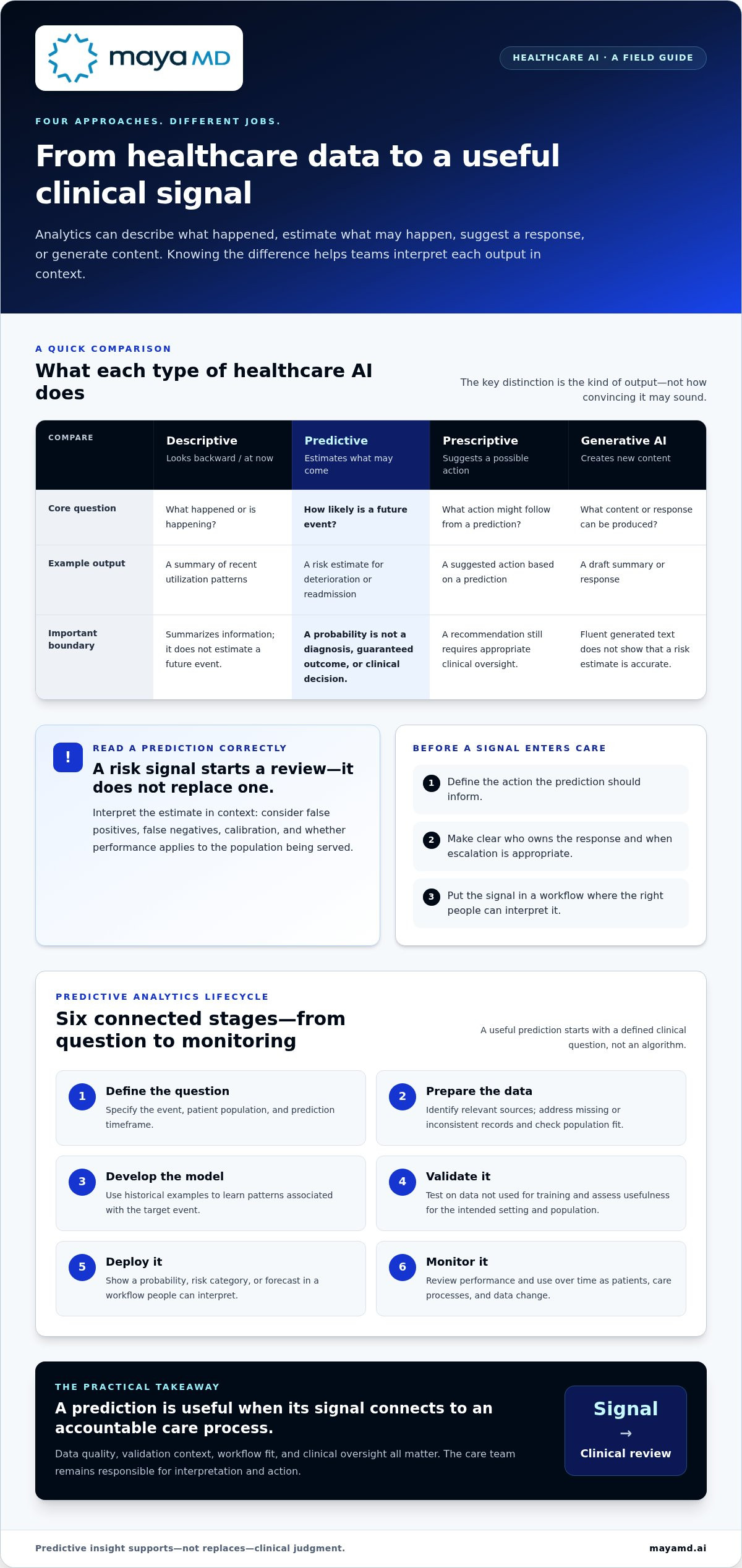
A predictive risk estimate describes the likelihood of an event; it is not a diagnosis, a guaranteed outcome, or a clinical decision. It may help a clinician identify where further review or outreach could be appropriate, but interpretation and action remain the care team’s responsibility.
How predictive analytics differs from other forms of healthcare AI
Descriptive analytics summarizes past or current information, such as recent utilization patterns. Predictive analytics estimates the probability of a future event. Prescriptive analytics goes further by suggesting an action based on a prediction, though a recommendation still requires appropriate clinical oversight. Generative AI produces new content, such as a draft summary or response. Fluent generated text does not, by itself, show that a risk estimate is accurate.
Predictive insights may appear in a Clinical Decision Support System, alongside information relevant to a care decision. The interface and workflow matter: a signal that arrives without context or a clear next step may be difficult to use safely.
Where healthcare teams may use predictive insights
Teams may use risk stratification to group patients for review, care coordination to focus attention on changing needs, or follow-up prioritization to identify who may benefit from timely outreach. For example, a model might flag a pattern associated with deterioration or readmission risk. That flag should prompt appropriate assessment, not replace it.
For a useful implementation, define the target population and the action the prediction is meant to inform. A model developed using one patient group or care setting may not perform the same way in another. Consider whether the data reflect the people being served, what decision the estimate supports, and who is responsible for responding. The value lies not in prediction alone, but in connecting an interpretable signal to a suitable, accountable care process.
How Healthcare Predictive Analytics Turns Data Into Risk Signals
A useful prediction starts with a defined clinical question, not an algorithm. The lifecycle for AI for predictive analytics in healthcare typically includes six connected stages:
Define the question.
Specify the event to estimate, the patient population, and the time period the prediction should cover.
Prepare the data.
Identify relevant sources, address missing or inconsistent records, and check whether the data reflect the intended population.
Develop the model.
Select an analytical approach and use historical examples to learn patterns associated with the target event.
Validate it.
Evaluate performance on data not used to train the model, including whether results are useful for the intended setting and population.
Deploy it.
Present outputs, such as a probability, risk category, or forecast, in a workflow where the right people can interpret them.
Monitor it.
Review performance and use over time. Changes in patients, care processes, or data can affect reliability.
Model performance depends on data quality and the context in which the model is validated. A strong result in one dataset doesn’t establish that a model will perform equally well in another clinical setting.
Which healthcare data can inform predictions?
Electronic health records may contribute structured information such as diagnoses, medications, encounters, and laboratory results. Claims can add a view of billed services and utilization, while remote patient monitoring may contribute observations between in-person encounters. Each source offers a different perspective. Its value depends on access, completeness, recency, and how consistently information is recorded.
Interoperability standards such as FHIR can support the exchange of health information between systems. They don’t, on their own, ensure that exchanged data are complete, comparable, or suitable for a particular model.
How models are validated and maintained
Training data are used to develop a model; separate evaluation data test how it performs on examples it hasn’t learned from. Calibration asks whether estimated probabilities align with observed rates. Sensitivity reflects how often the model identifies people who experience the target event, while specificity reflects how often it correctly identifies those who don’t. No single measure tells the whole story.
Validation should reflect the model’s intended population and clinical use. A University of Minnesota study discusses evaluating AI tools for accuracy and bias, illustrating why assessment should look beyond a headline performance score. Ongoing review also matters: patient populations, workflows, and data patterns can change.
For teams connecting patient engagement and monitoring with ongoing care workflows, explore a conversation with MayaMD.
What Predictive Analytics Can, and Cannot, Tell a Care Team
A risk score is a decision-support signal, not an autonomous clinical judgment. It can help a team decide where to look more closely, but it cannot establish what is happening with an individual patient or determine the right response on its own.
Every model can make errors. A false positive flags someone as being at elevated risk when the event doesn’t occur, which may prompt unnecessary review. A false negative misses someone who later experiences the event, leaving a possible need for attention unidentified. Calibration describes whether predicted probabilities correspond to observed event rates. For example, if a group receives similar risk estimates, calibration asks whether events occur at rates that align with those estimates.
Performance can also vary between populations or care settings. If a model’s development data underrepresent a group, its results may be less reliable for that group. In AI for predictive analytics in healthcare, a performance measure from one setting shouldn’t be treated as proof of equal performance elsewhere.
Why an accurate model may still be hard to use
A model can perform well in testing yet offer limited practical value if its output arrives too late, lacks relevant context, or isn’t connected to an appropriate action. Missing or delayed information, such as an outdated medication list or an unrecorded change in symptoms, can make an estimate less relevant to a patient’s current circumstances.
Workflow design matters. If a low threshold generates frequent alerts without clear escalation criteria, clinicians may face alert fatigue and struggle to distinguish urgent signals from routine ones. A prediction without an owner or next step can add work without improving care. Technical accuracy is only one consideration; teams also need to assess clinical utility, workflow fit, and whether the process benefits patients.
Governance, privacy, and clinical accountability
Responsible oversight defines who can access predictions, who reviews them, and how decisions and follow-up actions are documented. Access controls should align with staff roles, and ongoing performance review can help teams notice when reliability or usefulness changes. Clear accountability keeps the model in a supporting role and leaves clinical decisions with qualified care professionals.
HIPAA is a privacy and security framework for protected health information. It doesn’t, by itself, establish that a predictive model is clinically valid, unbiased, or suitable for a particular workflow. Those questions require separate evaluation. Pairing governance with a defined response pathway helps teams use risk signals carefully, protect sensitive information, and keep attention centered on the patient.
How to Evaluate and Implement Predictive Analytics in Healthcare
Consider a model only when its prediction has a defined purpose, a responsible owner, and a practical response. A staged evaluation helps healthcare teams assess not just technical performance, but whether a predictive tool can fit into care without adding avoidable burden.
Define the use case.
Specify the population, event being predicted, time horizon, and intended users. Keep the question focused, such as identifying which patients may need a review during a defined period.
Map the workflow.
Identify where the prediction appears, who reviews it, what action may follow, and which criteria require escalation. Each output needs a clear owner and next step.
Assess the data.
Review data sources, access, completeness, representativeness, and recency. Longitudinal information from remote patient monitoring may contribute observations between encounters, but its relevance depends on the use case and how the information is incorporated.
Validate the model.
Evaluate performance in the intended population and setting. Review more than one metric, and assess whether the output is understandable and appropriate for the decision it is meant to inform.
Pilot a bounded workflow.
Begin with a defined use case and involve clinicians and operational staff in reviewing how predictions affect real work.
Monitor and refine.
Set a recurring review process for model behavior, workflow effects, and changes in data or care practices. Define how concerns are escalated and who can recommend adjustments.
Questions to answer before a pilot
Before testing begins, document the prediction target, timeframe, intended users, data sources, and workflow touchpoints. Name the team accountable for acting on a result, and specify what happens when the signal is missing, unexpected, or urgent. Establish baseline measures before introducing the tool so changes can be compared with existing practice.
Choose measures across several domains: model performance, staff adoption, safety, operational workload, and patient experience. For example, track whether alerts are reviewed and lead to the intended follow-up, while also watching for unnecessary escalations or delays. Include integration, usability, transparency, privacy, and access controls in the evaluation rather than deferring them until after the pilot.
How to move from pilot to monitored workflow
Use pilot findings to decide whether the workflow is ready to continue, needs revision, or should stop. Keep clinical and operational teams involved after launch, with a documented process for reviewing concerns and performance changes. A Clinical AI Agent can support related patient engagement and documentation workflows; those capabilities are distinct from predictive modeling.
To explore how connected patient engagement and care workflows can support ongoing care, discuss your workflow with MayaMD.
Connecting Predictive Insights With Continuous, Patient-Centered Care
A risk estimate becomes useful only when it informs a defined care process. The signal must reach the right person, be considered alongside the patient’s circumstances, and connect to an appropriate next step. That keeps AI for predictive analytics in healthcare in its proper role: supporting care teams, not making decisions for them.
From a risk signal to a care-team response
Consider a prediction that suggests a patient may need closer follow-up. A team member can review the signal alongside current clinical information, decide whether outreach is appropriate, and communicate the next step to the patient. The process should make clear who reviews the signal, who documents the decision, and how follow-up is tracked.
Not every signal calls for the same response. A defined pathway helps teams distinguish routine review from situations that need escalation, while preserving room for clinical judgment and patient preferences. Communication matters too: patients should understand the purpose of outreach and how it relates to their care. Automation may support parts of an established workflow, but it can’t guarantee an intervention or replace a clinician’s assessment.
Where MayaMD fits in connected chronic care
Predictive analytics and ongoing-care support serve different functions. MayaMD’s Clinical AI Agent supports patient engagement and clinical documentation, while its chronic-care solutions support workflows for remote patient monitoring, Advanced Primary Care Management (APCM), and Principal Care Management (PCM). These capabilities can help teams maintain communication and continuity over time; they are not predictive models or risk-scoring tools.
Remote monitoring can provide observations between in-person encounters, while engagement and follow-up workflows help teams stay connected with patients as care continues. When evaluating these capabilities, consider how each fits the team’s existing care process and how information moves from monitoring to review and follow-up.
The central principle is straightforward: a prediction can inform attention, but accountable people and well-designed workflows turn that signal into a considered response. For chronic care, monitoring, communication, and follow-up are practical ways to maintain continuity between encounters.
If you’re exploring how patient engagement and follow-up can fit into connected care, start a conversation about connected care workflows. To discuss how MayaMD’s clinical AI and chronic-care solutions may support your care processes, contact MayaMD.
Turn Risk Signals Into More Connected Care
AI for predictive analytics in healthcare can help teams identify patterns that warrant attention, but a risk estimate is only a starting point. Its value depends on evidence that fits the intended population, a clear response pathway, and ongoing human oversight. Predictions should inform care, not replace clinical judgment.
Connected workflows help carry that attention forward. Patient engagement, monitoring, documentation, and follow-up can support continuity as care needs evolve. MayaMD’s cloud-based clinical AI platform is HIPAA-compliant, and its Clinical AI Agent combines deterministic logic with generative AI to support patient engagement and clinical documentation. MayaMD’s solutions also support remote patient monitoring, Advanced Primary Care Management, and Principal Care Management. These capabilities support ongoing care workflows, not predictive analytics or risk scoring.
Responsible adoption starts with a focused use case and grows through validation, thoughtful integration, and careful monitoring. When technology fits the clinical process, teams can direct more attention toward meaningful communication and coordinated support. Discuss connected, patient-centered care workflows with MayaMD to explore how workflow support can contribute to continuity of care.
Frequently Asked Questions
What is predictive analytics in healthcare?
Predictive analytics in healthcare uses historical and current health data with statistical or machine-learning methods to estimate future events or risks. A model might estimate the likelihood of deterioration or readmission for a defined population and time period. Its output is a probability or risk category, not a diagnosis. It doesn’t confirm that a patient has a condition or guarantee that the predicted event will occur.
How is AI used for predictive analytics in healthcare?
AI for predictive analytics in healthcare applies computational methods to data to estimate a defined future event or risk. A model is developed using training data, then evaluated on separate data to test its performance. Validation should reflect the intended population and care setting. Care teams interpret estimates alongside patient context, decide whether review or follow-up is appropriate, and monitor whether the output remains useful in practice.
What data is used in healthcare predictive analytics?
Healthcare predictive analytics may use electronic health record information such as diagnoses, medications, encounters, and laboratory results. Claims data can add information about billed services and utilization. Remote monitoring may contribute observations between in-person visits. No source is automatically useful for every model: relevance depends on the prediction target, population, and timeframe. Data access, completeness, recency, and representativeness also affect how well the information supports the intended analysis.
Can predictive analytics improve patient outcomes?
Predictive analytics may help care teams identify patterns that warrant review or prioritize follow-up, but a prediction alone doesn’t improve outcomes. Potential value depends on whether the model has been validated for the relevant population and whether its output leads to a suitable, timely action. Organizations should assess clinical and patient outcomes using evidence from the specific tool and setting. Without that evidence, improved outcomes shouldn’t be assumed.
Is predictive analytics in healthcare accurate?
Accuracy varies by model, population, care setting, and prediction target, so there’s no single answer for every use. Calibration helps show whether estimated probabilities align with observed event rates, while other measures assess different kinds of errors. Performance may differ across patient groups or change as data and workflows evolve. Review results in the intended context and monitor the model over time rather than relying on an initial evaluation alone.
What are the risks of predictive analytics in healthcare?
Risks include biased results when data poorly represent the population and unreliable estimates when information is incomplete or outdated. False alerts can create unnecessary work, while missed signals may leave some needs unidentified. Sensitive health information also requires appropriate privacy and security safeguards. Governance should define who can access outputs, who reviews them, and how actions are documented. Human oversight remains essential because predictions don’t replace clinical judgment.
How can healthcare organizations implement predictive analytics?
Start by defining the use case, target population, prediction timeframe, intended users, and action each output should inform. Assess whether available data are suitable, then validate performance in the intended context. Pilot the model in a bounded workflow with clear ownership, escalation criteria, and baseline measures. Evaluate usability, safety, and operational effects as well as technical performance. Continue monitoring after deployment, since changes in data or care processes can affect usefulness.
How does predictive analytics differ from generative AI in healthcare?
Predictive analytics estimates the likelihood of a future event, such as deterioration within a defined timeframe. Generative AI produces content, such as a draft note or response, based on its input and design. These approaches may serve different roles in healthcare workflows, and one may be used alongside the other. Fluent generated content doesn’t demonstrate predictive accuracy, while a risk estimate doesn’t itself provide a clinical decision or patient communication.




See The MayaMD Difference
Fill the form below
Download Our Apps
MayaMD for patients and MayaPro for physicians - available on iOS and Android.
FOR PATIENTS
MayaMD App
AI-powered symptom assessment, triage, and secure access to your care team.


FOR PHYSICIANS
MayaPro App
MayaPro brings patient vitals, RPM/PCM care plans, and clinical decision support to your pocket.