
AI for Care Team Efficiency: 2026 Healthcare Guide

What if the most effective use of AI in healthcare isn’t making decisions, but reducing the coordination work that keeps clinicians from patients? AI for care team efficiency can support repetitive communication, documentation, and follow-up when it fits the workflow and keeps clinical judgment in human hands.
Care teams know the cost of fragmented workflows. Important context can be difficult to carry from one interaction to the next, and new tools can add review work instead of removing it. The question isn’t simply whether AI can automate a task. It’s whether it can support continuity, patient engagement, and timely coordination without compromising clinical quality or trust.
This guide explains where AI can support care teams, how to assess workflow fit and governance, and what to measure during implementation. It also looks at how combining deterministic logic with generative AI can support repeatable work while leaving clinical decisions under professional oversight.
Key Takeaways
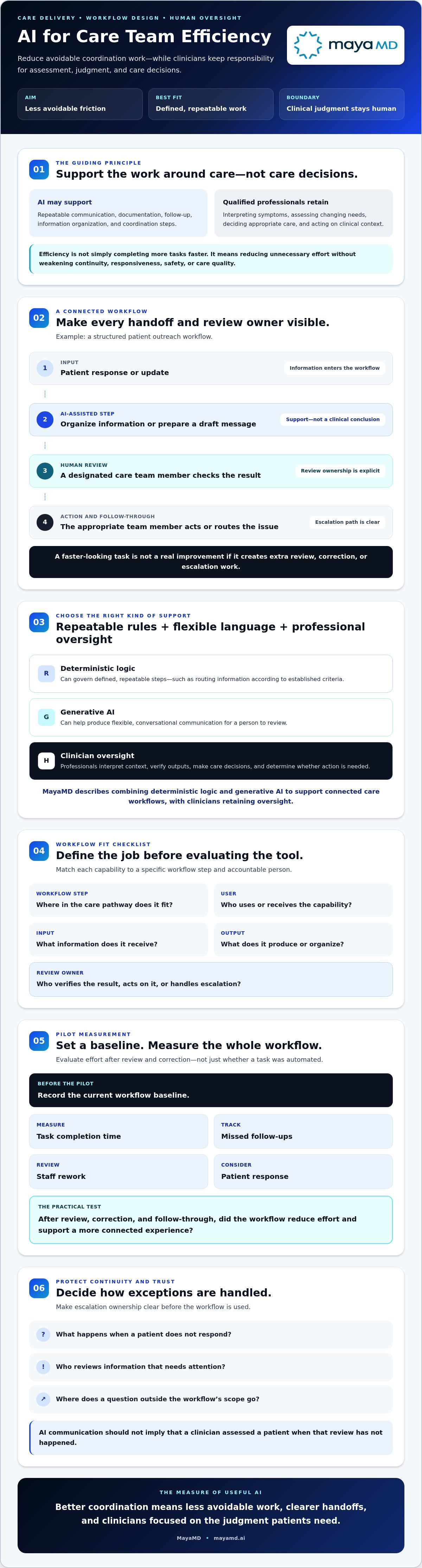
• Assess AI for care team efficiency by matching each capability to a specific workflow step, user, input, output, and review owner.
• Separate repeatable communication and coordination tasks from clinical decisions that require professional judgment.
• Set a baseline before a pilot. Consider task completion time, missed follow-ups, staff rework, and patient response.
• Evaluate whether AI reduces effort after review and correction, not just whether it automates a task.
• Explore how MayaMD combines deterministic logic and generative AI to support connected care workflows, with clinicians retaining oversight.
What AI for Care Team Efficiency Means in Clinical Practice
AI for care team efficiency is the governed use of artificial intelligence to reduce avoidable administrative and coordination work while clinicians retain responsibility for assessment, judgment, and care decisions. The goal isn’t to automate care itself. It’s to help teams handle repeatable workflow steps so they can direct more attention to patients and complex needs.
Healthcare AI spans applications such as documentation, communication, and clinical support. The Artificial intelligence in healthcare overview describes this broad range, but care teams need to assess each application in its own clinical context. A tool that drafts routine outreach serves a different purpose from one that informs clinical assessment. Neither should be assumed to make decisions independently.
Which care team activities create avoidable workload?
Work can accumulate across recurring communication, follow-up, documentation, and coordination. Staff may need to send reminders, record information from interactions, check whether a follow-up happened, or route a patient’s question to the right team member. AI may assist with some repeatable steps. Others depend on context and need human review.
Fragmented handoffs can make routine work harder. For a patient managing a chronic condition, relevant information or an expected follow-up may not be visible to the next person involved in care. That can interrupt continuity and lead to extra calls or chart review. AI may help organize information or support repeatable workflow steps, but interpreting symptoms, assessing changing needs, and deciding what care is appropriate require clinical expertise.
What efficiency should mean for patients and clinicians
Efficiency shouldn’t mean asking each staff member to complete more tasks in less time. It should mean reducing unnecessary friction without weakening the care experience. A workflow may look faster on paper yet create more review, correction, or escalation work in practice.
Evaluate the effect on both sides of the interaction. For clinicians and staff, consider whether a tool reduces avoidable administrative effort and supports clear handoffs. For patients, consider whether communication is timely, follow-up is easier to maintain, and care feels connected across interactions. Safety, responsiveness, and care quality matter alongside workload. If an AI-generated message is unclear or a task is routed incorrectly, the apparent time saving may not amount to meaningful efficiency.
A practical standard is to use AI for well-defined, repeatable work, with clear boundaries for review and escalation. Keep clinical judgment with qualified professionals, and assess whether the full workflow improves for both the team and the patient.
How Clinical AI Can Support Care Team Workflows
Clinical AI is most useful when it has a defined place in the care pathway. Before adopting a capability, identify the workflow step, who uses it, what information it receives, what it produces, and who reviews or acts on the result. For example, an outreach workflow could use a patient’s response as input, prepare a draft message as output, and assign review to a designated care team member. This makes responsibility visible instead of leaving it implicit.
Workflow automation can organize and support repeatable tasks, but it shouldn’t be mistaken for clinical decision-making. Deterministic logic can govern defined steps, such as routing information according to established criteria. Generative AI can help produce flexible, conversational communication for human review. Together, these approaches can support consistency without treating generated language as a clinical conclusion.
Patient engagement, monitoring, and follow-up
For chronic care, structured outreach can support communication between visits, such as asking a patient to share an update or helping a team track a planned follow-up. In remote patient monitoring, incoming information can be organized for team review according to defined workflow criteria. The care team remains responsible for interpreting the information and deciding whether action is needed. Learn more about remote patient monitoring for chronic care.
Make escalation ownership clear. Teams should decide what happens when a patient doesn’t respond, shares information that needs attention, or asks a question outside the workflow’s scope. AI can help structure communication, but it shouldn’t suggest that a clinician has assessed a patient when that review hasn’t happened.
Documentation, handoffs, and post-discharge continuity
Documentation support is one part of the workflow, not an end in itself. A draft or summary can make relevant information easier to review, while the responsible professional verifies its accuracy and determines what belongs in the record. A useful handoff lets the next person identify what happened, what remains outstanding, and who owns the next step.
After discharge, planned communication can help patients stay connected to their care team during the transition home. The workflow should specify the purpose of each message, how responses are handled, and when a staff member must review or follow up. MayaMD describes its Clinical AI Agent as supporting patient engagement, documentation, and continuity. Assess whether the specific workflows and configurations fit your organization’s needs. Policy discussions of the risks of artificial intelligence in healthcare also underscore why review processes and clear accountability matter.
To explore how these workflow requirements relate to your care setting, contact MayaMD.
Can AI Improve Care Team Efficiency Without Adding Risk?
It can, but automation alone doesn’t establish value. If staff spend more time reviewing, correcting, and escalating AI outputs than they save, the workflow may add burden. Evaluate the complete process, including exceptions and human review, rather than only the task the system performs.
For AI for care team efficiency to be responsible, its role must match the task’s risk. Preparing routine outreach for review may be appropriate assistance. Delegating diagnosis, treatment recommendations, or decisions about a patient’s care to a system without qualified professional oversight is different. Define these boundaries before a tool enters a live workflow.
Where human oversight should remain explicit
Assign a clear role to review outputs that could affect care, handle exceptions, and act on escalations. Define what triggers review, where concerns go, and how unresolved items are tracked. A patient-reported symptom or unusual response, for example, may need assessment by a qualified team member rather than a routine automated reply.
Communication support isn’t diagnosis. A system may help organize a patient’s message or prepare a response, but teams should make clear whether a clinician has reviewed it. Responsibility shouldn’t disappear between the tool and the staff member expected to act.
How to assess privacy, reliability, and workflow fit
Before implementation, ask how patient information is handled, which privacy and security controls apply, and whether compliance claims are current and documented. Confirm that the proposed use fits your organization’s requirements and that oversight responsibilities are clear.
Test reliability with representative workflows, including routine cases, incomplete information, and exceptions. Document review criteria so staff know what to verify, correct, or escalate. Give them a practical way to understand what the system produced and report problems. Outputs that can’t be monitored or corrected are difficult to govern.
A simple evaluation matrix can make trade-offs visible:
Task
Draft a routine patient follow-up message.
AI role
Prepare a draft from approved workflow information.
Human review
Confirm accuracy and suitability before sending.
Risk
The message may omit context or misstate information.
Success measure
Assess completion time alongside corrections, escalations, and patient response.
Use the same structure for each proposed task. If the review burden, error patterns, or escalation pathway isn’t acceptable, revise the workflow or don’t expand it. Evaluate efficiency and clinical quality together.
How to Evaluate and Implement AI for Care Team Efficiency
A disciplined implementation moves in stages: choose a bounded workflow, establish a baseline, run a monitored pilot, review the evidence, and then expand cautiously. This sequence helps leaders determine whether AI for care team efficiency improves the actual process, rather than automating one step while shifting work elsewhere.
Choose a measurable, bounded workflow first
Start with a repeatable task that has a clear owner, known inputs, and observable completion criteria. Before introducing AI, map the current steps, handoffs, exceptions, and sources of delay. Routine follow-up communication, for example, may be easier to assess than a broad goal such as “improve care coordination.”
Establish a baseline using measures that reflect staff and patient experience:
Task completion time
How long does the full workflow take, including review?
Missed follow-ups
How often are planned contacts or next steps left incomplete?
Staff rework
How much correction, duplicate entry, or manual routing is required?
Patient response
Are patients receiving and responding to communication as intended?
Safety and reliability
Are errors, exceptions, or escalations identified and handled appropriately?
Set success criteria before the pilot begins. A useful measure accounts for the full workflow, not just the time spent on the task AI supports. For context on how AI may fit into clinical processes, review this overview of the Clinical AI Agent.
Run a monitored pilot before scaling
Involve frontline clinicians and operations staff in workflow design. Their feedback can reveal practical issues, such as unclear ownership or steps that don’t match how work happens. Train users on the system’s role, review expectations, and escalation process. When appropriate, explain AI-supported interactions to patients in clear language that describes the role of human care team members.
During the pilot, track baseline measures alongside adoption, corrections, escalations, and unintended work. Assign owners to monitor outputs, review concerns, and coordinate governance review. Document how to report issues and how the workflow can be paused or revised if results fall short.
Expand only after governance owners have reviewed performance against the predefined criteria and confirmed that the workflow remains manageable for staff and patients. To discuss how an AI-supported workflow could fit your care setting, contact the MayaMD team.
How MayaMD Supports More Connected Care Team Workflows
Once an organization has defined its workflow, review responsibilities, and pilot measures, it can assess whether a platform fits those requirements. MayaMD describes its cloud-based clinical AI platform as HIPAA-compliant and built with deterministic logic alongside generative AI. As with any platform, assess privacy details, supported configurations, and the specific workflow before adoption. The platform is intended to support care workflows, not replace clinical judgment or provide staffing.
MayaMD’s Clinical AI Agent supports patient engagement, documentation, and continuity across chronic care programs, including remote patient monitoring (RPM), Advanced Primary Care Management (APCM), Principal Care Management (PCM), and post-discharge communication. The value depends on how each capability aligns with a specific task, who reviews the output, and how the team handles exceptions. That fit matters more than a broad promise of AI for care team efficiency.
Match MayaMD capabilities to care program needs
For teams supporting chronic care, patient engagement and ongoing monitoring can help organize communication between visits. Documentation and post-discharge communication can support continuity across care interactions. Assess these capabilities against the team’s defined workflow and oversight model. For more on the program context, see MayaMD’s Advanced Primary Care Management information. Confirm applicable workflows and configurations directly, and keep clinical assessment and decisions with qualified professionals.
A practical evaluation asks what information enters the workflow, what the AI produces, and which team member checks or acts on it. A communication support task, for example, may require a different review pathway from information gathered through a monitoring program. Mapping these roles helps leaders assess fit without assuming every step can or should be automated.
Plan a workflow conversation with MayaMD
Bring a current workflow map to an initial discussion, including the points where follow-up or handoffs become difficult and the measures you want to improve. Ask how oversight is assigned, what privacy and data-handling details apply, which configurations are supported, and how staff can review and correct outputs. This gives both sides a concrete basis for discussing governance and implementation needs.
The aim isn’t to automate every interaction. It’s to determine whether a defined capability can support a repeatable task while preserving clinician control and continuity for patients. A focused discussion can clarify where the platform may fit, what needs further review, and what should remain unchanged.
Discuss your workflow and implementation needs with MayaMD.
Make Your Next AI Step Measurable
AI for care team efficiency works best when it supports a clearly defined workflow, reduces avoidable coordination effort, and keeps clinicians responsible for clinical judgment. Start with a measurable task, establish a baseline, and pilot the change with clear review and escalation ownership before considering expansion.
Measure the whole workflow, not just the automated step. Task completion time matters, as do staff rework, missed follow-ups, patient response, and safety. If review demands outweigh the benefit, adjust the workflow.
MayaMD describes its platform as cloud-based and HIPAA-compliant, with an approach that combines deterministic logic and generative AI. Include privacy, supported configurations, and oversight in your evaluation. The goal is a thoughtful fit between technology, governance, and the needs of the care team.
Discuss your care team workflows with MayaMD to explore workflow fit, oversight, and implementation considerations. A measured approach can support more connected care while keeping people at the center.
Frequently Asked Questions
How can AI improve care team efficiency?
AI can support repeatable communication, documentation, follow-up, and information coordination. For example, a tool may help prepare routine patient outreach or organize information for staff review, reducing manual steps when it fits the workflow. Define who checks outputs and handles exceptions, then compare the full process with a baseline. If review and correction create more work than the tool removes, reconsider the workflow.
Which care team tasks can AI automate safely?
AI may assist with well-defined, repeatable operational tasks, such as drafting routine outreach, organizing information, or supporting documentation for staff review. Whether a task is suitable depends on its risks, inputs, and required oversight, not simply on whether it can be automated. Set clear boundaries, review criteria, and escalation paths. Assessing a patient’s condition and making diagnosis or treatment decisions require appropriate clinical expertise and shouldn’t be delegated as routine administrative automation.
Can AI reduce administrative work without replacing clinicians?
Yes. AI can support administrative and coordination steps while clinicians retain responsibility for professional judgment and care decisions. For instance, it may help prepare a message or organize documentation, while a designated team member verifies the content and determines the next step. Make this division of responsibility explicit. Measure whether total workload decreases, including review and correction, rather than assuming that automating one task reduces administrative effort overall.
How should healthcare organizations measure AI-driven efficiency?
Establish a baseline before a pilot, then assess the full workflow against it. Useful measures include task completion time, missed follow-ups, staff rework, patient response, and the frequency and handling of corrections or escalations. Pair efficiency measures with reliability, safety, and patient experience. Include time spent reviewing outputs so a faster automated step doesn’t conceal added work elsewhere. Set evaluation criteria in advance and use them to guide decisions about revising or expanding the workflow.
What risks should care teams consider before adopting clinical AI?
Consider inaccurate or incomplete outputs, privacy and data-handling practices, workflow disruption, unclear accountability, and the possibility that review or escalation work outweighs the benefit. Test the system with representative cases and define what staff must verify, correct, or route for clinical review. Ask vendors to clarify applicable privacy and security controls, supported configurations, and relevant compliance claims. Keep a process for reporting problems and reassessing the workflow as staff gain experience.
Can AI support remote patient monitoring and chronic care management?
Yes. AI-supported workflows can help organize patient engagement, monitoring information, documentation, and follow-up for chronic care programs. MayaMD describes solutions that support remote patient monitoring and chronic care management, including APCM and PCM. Route monitoring information for review according to the organization’s workflow, with clear responsibility for interpreting concerns and deciding what action is appropriate. AI can support continuity between interactions, but it doesn’t replace clinician assessment or care team oversight.
How does a clinical AI agent differ from general-purpose AI?
A clinical AI agent is intended to support defined healthcare workflows, while general-purpose AI is designed for a broader range of tasks. Organizations should examine the agent’s intended role, information inputs, outputs, review process, and escalation boundaries rather than relying on its label. MayaMD describes an approach that combines deterministic logic with generative AI to support patient engagement, documentation, and continuity. Clinicians remain responsible for clinical judgment and decisions.




See The MayaMD Difference
Fill the form below
Download Our Apps
MayaMD for patients and MayaPro for physicians - available on iOS and Android.
FOR PATIENTS
MayaMD App
AI-powered symptom assessment, triage, and secure access to your care team.


FOR PHYSICIANS
MayaPro App
MayaPro brings patient vitals, RPM/PCM care plans, and clinical decision support to your pocket.